Showing posts with label WW1 Non-Fiction. Show all posts

Sunday, 29 July 2018

Sunday WW1 Remembered


Over the last four years of adding WW1 information onto my blog I have found lots of books really interesting so I thought it was time to share them.


The Western Front
BBC Books
1999
I've had my copy since 1999.
The book that it was republished in 2008 with a new cover.


7739291
BBC Books
2008


From the book:

For most British people, the First World War was the Western Front, the trench line stretching from the Swiss Frontier to the North Sea. It was there that the majority of nearly nine million British and Dominion soldiers who enlisted during the war served, and where most of the 947,000 who were killed met their deaths.

This detailed but accessible account covers everything from how the front was created and the experiences of the British Army in France, to the battle of Verdun and the last hundred days of the war. Holmes' concise and heartfelt narrative is illustrated with photographs, diagrams, maps and quotations that bring this inhuman four years of history to life.

In one of the best single-volume histories of the First World War available, Holmes skillfully clarifies the complexities of the Western Front, and highlights the political, military and human dilemmas of this, the most bitter and bloody of conflicts.

My thoughts:

The battles and events that shaped the war on the Western Front is complex and bloody. Many lives were lost on the battlefields of northern France and dreams of a better future disappeared amidst the  carnage and guns which echoed relentlessly, maiming, butchering and killing young men in the thousands.

The Western Front reminds us of their sacrifice.


~****~

Sunday, 8 July 2018

Sunday WW1 Remembered..


Over the last four years of adding WW1 information onto my blog I have found lots of books really interesting so I thought it was time to share them.

Michael Joseph 1988
Penguin 1991


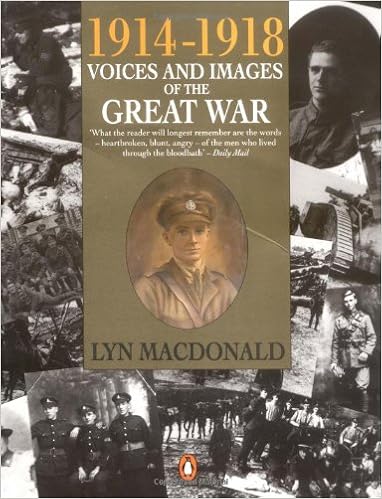
Lyn MacDonald writes with authority on the events of WW1 and this book in one that I use when I want to check up on facts or to look for inspiration for a blog post. It's a very readable account of what happened during 1914-1918 and what I find most useful is the poignant mix of the serious and the ordinary, which all add up to a fascinating account of the lives of those soldiers who fought, and died, on the Western Front.

It contains lots of illustrations, poignant photographs and letters, amateur poetry from 'ordinary' soldiers and the events they describe in letters home are both enlightening and desperately sad. There's even information in a letter which was been sent to The Times newspaper, in 1914, accusing them of reporting false news..so we know that phrase isn't new then !

Of the many books in my WW1 bibliography, 1914-1918 : Voices and Images of the Great war is one of my particular favourites especially as it gives a voice to those ordinary soldiers who found themselves, often unwillingly, living out their, sometimes very short, lives in extraordinary and difficult circumstances.

First written 30 years ago, the book is perhaps a little harder to come by now, however, it's well worth a read if you spot it in a library or second hand book store.


~****~

Sunday, 1 July 2018

Sunday WW1 Remembered...


Over the last four years of adding WW1 information onto my blog I have found lots of books really interesting so I thought it was time to share them.

Some like this one have been featured before, but it's always worth a reminder.


Where Poppies Blow

John Lewis -Stempel


29905681
W&N
2016


WHERE POPPIES BLOW is the story of the British soldiers of the Great War and their relationship with the animals and plants around them. This relationship was of profound importance, because it goes a long way to explaining why they fought, and how they found the will to go on. And in that relationship is found some of the highest, noblest aspirations of humanity in times of war.


My thoughts...

It's not all about blood and bullets and this glorious book looks at the continuance and constancy of allowing, in the midst of carnage, the therapeutic benefits of nature. And, of how, even in the midst of horror, the birds still sang, the blossom bloomed as beautiful as ever, and the tiny creatures of nature still went about their daily business.

The joy of nature brought comfort and in some cases, healing, when I am sure it seemed like the entire world had been plunged into chaos. The author very cleverly divides the content of the book into manageable chapters, each with a  foot firmly placed in what was happening in the war, whilst at the same time allowing a glimpse into a very different world.

The book begins as it should, with a beautiful poem, August, 1914 by John Masefield, who juxtaposes the beauty of the English countryside against what was happening just a few hundred miles away in the trenches of the Western Front. And just as poetry can evoke such strong emotions, so can this recounted story of a group of soldiers, from the Royal Warwickshire, who tenderly buried a dead pigeon they found in a communication trench, or the deep and abiding comradeship between an officer and his horse, or of how medics treated both wounded soldiers and animals, even to making artificial wooden legs for dogs who were thus injured in battle.

One of my favourite chapters, entitled The Bloom of Life explains how soldiers cultivated small trench gardens and regularly sent home for seeds and how grassy mounds would be transformed with nasturtiums, daffodils and hyacinths, and how billets would bloom with tiger lilies, auriculas and roses. And of course, who can forget the image of the poppy fields of Flanders.


~****~

Sunday, 24 June 2018

Sunday WW1 Remembered..


Over the last four years of adding WW1 information onto my blog I have found lots of books really interesting so I thought it was time to share them.

Some, like this one have been featured before, but its always worth a reminder.


22292393
AA Publishing
August 2014

My thanks to the publishers for my copy of this book

In Men of Letters, the author has with considerable skill, given the men of the Post Office Rifles their own very special voice and in a series of personal stories, poignant letters and diary entries, their life at the front becomes a heart rending chronicle of war. Their social observations forcibly remind us of just what life was like at the front, the interminable boredom of long periods of time closeted in the murk and mud of the French countryside, balanced against the shock of the sniper’s bullet and the agonising terror of waiting for the call to go over the top. It is especially heart breaking to realise that over 1500 of them didn’t make it to the end of the war.

In this evocative retelling of the history of the men of the Post Office Rifles, I was forcibly reminded of just how the Great War impacted on the lives of men and women, and of how the ordinary man in the street rose to the challenge of the call to arms. With over 10,000 registered letters per month reaching the Western front, I had never visualised the effort that it took to get the morale boosting mail packets to the men, and yet, whilst the Post Office rifles were made of up from the ranks of postal workers, they were very much part of the fighting force and acted honourably and with great courage under enemy bombardment.

The book is easy to read and well divided into understandable chapters, which cover the involvement of the Post Office Rifles,from the Battle of Festubert during the spring offensive in May 1915, through to their involvement in the Battle of Passchendaele in 1917. The sensitive use of personal documentation highlights the very human face of war and as names begin to crop up in the narrative, I found that I formed an emotional attachment to many of them, and seeing their photographs and reading their memories emphasised to me in a very poignant way, that these are real stories and not just dusty records from the annals of history.

We owe a huge debt of gratitude to, not just the men of the Post Office Rifles, but also to the many thousands of young men and women, who gave their lives unquestionably and who with pride and patriotism served their country in a war they really didn’t fully understand.


~****~

Sunday, 8 April 2018

Sunday WW1 Remembered...


Whenever I visit the Imperial War Museum North I take time to visit the shop, carefully browsing the shelves for books and memorabilia that highlight WW1. On my most recent visit I came across this quirky little book which is packed full of interesting snippets about the war.

World War One

A Very Peculiar History

by

Jim Pipe

11391670
Book House
2017
192 pages

I've enjoyed flipping through this book, discovering little bits and pieces about the war that I didn't already know. I especially enjoyed reading a section towards the end of the book which mentions famous ex-soldiers, and considers what the twentieth century would have been like if these men hadn't survived their experience of WW1:

Humphrey Bogart 
Bela Lugosi 
Walt Disney 
George Braque
Henry Moore 
Ernest Hemingway 
F Scott Fitzgerald 
A A Milne 
C S Lewis 
J R R Tolkien 
Walter Gropius 
Winston Churchill 
Charles De Gaulle 
Harry S Trueman 
Benito Mussolini
Adolf Hitler

and Angelo Roncalli, later Pope John XXIII


~****~

Sunday, 18 March 2018

Sunday WW1 Remembered...


Ordinary Lives of the First World War


29501076
Imperial War Museum
2016
“The war had begun and my heart beat then as it had never beaten before.”—Rosie Neal on the outbreak of war, 1914


In Their Own Words: Untold Stories if the First World War brings together for the first time, the personal accounts of 11 people who lived through the conflict, in a compelling and poignant collection from IWM's unparalleled Documents Archives.

In Their Own Words is a unique collection of stories and more, all of which look at the war from a different perspective.

My thoughts about it...

The eleven stories contained within the collection are a fascinating and poignant look at the effect of the First World War on the lives on ordinary people.

From Rosie's story at the outbreak of war in 1914, through to the reminiscences of Arthur on Armistice, 1914, the collection focuses on the personal accounts of those who were caught up in the evnts that happened between 1914-1918 and includes:

Gallipoli , 1915
The Battle of Loos, 1915
Prisoner of War, 1915-1916
Conscientious Objection, 1916-1918
The Battle of Jutland, 1916
The Battle of the Somme, 1916
War Work and The Home Front
The Third Battle of Ypres, 1917
The German Spring Offensive, 1918
Armistice, 1918

I am fascinated by the stories of the ordinary men and women who were caught up in the events of WW1 and this collection of stories gives a fascinating and very personal account of what happened and explains just how lives were affected.

Using archive material from the huge amount of WW1 information that is held by the IWM, and being presented in a very readable form makes this collection all the more interesting.


This is me reading - In Their Own Words


~****~

Sunday, 11 December 2016

Sunday WW1 Remembered ...Tommy Rot by John Sadler and Rosie Serdiville


17674634
The History Press
2013


This is one of my favourite reads. It's a beautiful little book interspersed with pictures, prose and verse and which shares the remarkable power of the poetry of the ordinary Tommy. It's a tribute to those extraordinary young men who so often found themselves in horrendous situations, and whose only way to survive was to make up ditties and poems to make each other laugh. Some of the poems wouldn't be considered very politically correct today but to be read in the context of the time in which they were written there is a poignancy, and so often a deep sadness, and an overwhelming cynicism contained within their words.

Some of the verses made me laugh as there is no doubt that they are a little bit naughty and meant to titillate, but there are also sharp observations about the futility of the whole sorry situation that the soldiers found themselves in, as in this anonymous outburst..


" I heard the bugles callin' an join I felt I must
Now I wish I'd let them go on blowin' till they bust !! "
Anon.


I wonder just how many of those soldiers who so readily answered Kitchener's call  wished that they hadn't been quite so quick to take up the call to arms.


I have a great deal of respect for those men who cradled themselves in the corner of a deeply dug trench and for whom every waking day was a challenge of survival. The frightening reality of duckboards deeply entrenched in oozing layers of mud. The pervading stink and slime of bodies left to decompose and fester above the parapet, and the fear, pain and uncertainty of never really knowing what the day ahead would bring. So, if the soldiers found comfort in gallows humour, in the sharing of risque ditties and saucy postcards...well, who would begrudge them that small bit of humanity in a world which  they must have, so often, thought had gone completely mad.


Most of the poems contained within this volume are not included in the celebrated canon of WW1 war poets but these simpler verses are no less powerful. The voices of the ordinary Tommy deserve to be heard.