Showing posts with label IWM. Show all posts

Friday, 26 April 2024

๐Ÿ“– Blog Tour ~The Human Kind by Alexander Baron


Imperial War Museum
2024

My thanks to the publisher for my copy of this book
and to Random Things Tours for the invitation to the blog tour


MARKING THE FIFTH ANNIVERSARY OF THE IMPERIAL WAR MUSEUMS WARTIME CLASSICS SERIES

Alexander Baron’s remarkable Trilogy of the Second World War to be published together for the first time

Spanning the Sicilian countryside to the brothels of Ostend, and the final book in Alexander Baron’s War Trilogy, The Human Kind is a series of pithy vignettes reflective of the author’s own wartime experiences.

From the interminable days of training in Britain to brutal combat across Northwest Europe, the book depicts many of the men, women – and, in some cases, children – affected by the widespread reach of the Second World War.

In his trademark spare prose, Baron’s work provides an emotive and incisive snapshot into the lives of myriad characters during this tumultuous period in history.

Based on Alexander Baron’s own wartime experiences, this new edition of a 1953 classic includes an introduction from IWM which puts the work in historical context, and concludes the author’s War Trilogy.


๐Ÿ“– My Review..

Based on the author’s own wartime experiences, and first published in 1953, this last volume completes the War Trilogy which began with From the City, From the Plough and There’s No Home. In this collection of twenty five short stories Alexander Baron focuses on what war meant to the ordinary people who were caught up in extraordinary events. It’s an interesting collection and perhaps not what I was expecting, as it reads a bit like a personal memoir however, each of the stories have a beautiful lyrical quality which bring into stark reality some unique war time experiences. 

Some stories are quite difficult to read with emotional content which show the suffering, others are a little lighter but no less powerful. I was particularly impressed by The White Domain which shares the experiences of coal miners who were working alongside soldiers in constructing underground headquarters and on finishing Old Beethoven I have to admit to shedding a few tears. There are many of the twenty five stories which have stayed with me, particularly Chicolino which reiterates the vulnerability of children and their means of survival.

I have been particularly impressed by the stark power of these stories which linger in your mind even when you move onto the next one. Beautifully written, The Human Kind reminded me that although for us in the twenty first century these stories now read as historical fiction, for the author, this challenging time was his war-time reality and his powerful writing reminds us, quite forcibly, of that fact.


About the Author


Alexander Baron (1917 – 1999) was a British author and screenwriter. Widely acclaimed in his lifetime, he rose to prominence with his first novel, From the City, From the Plough, published in 1948 and based on his experiences of D-Day and the advance into Normandy.

It quickly became a bestseller, achieving both popular success and critical acclaim, and reportedly went on to sell in excess of one million copies. The novel cemented Baron’s reputation as a skilled, powerful, authentic writer, and he went on to write many more books, including the second and third in the sequence, both best-sellers, alongside scripts for Hollywood and screenplays for the BBC.


Twitter /  X @I_W_M #WartimeClassics #TheHumanKind

@AngelaMaryMar @RandomTTours


Wednesday, 13 April 2022

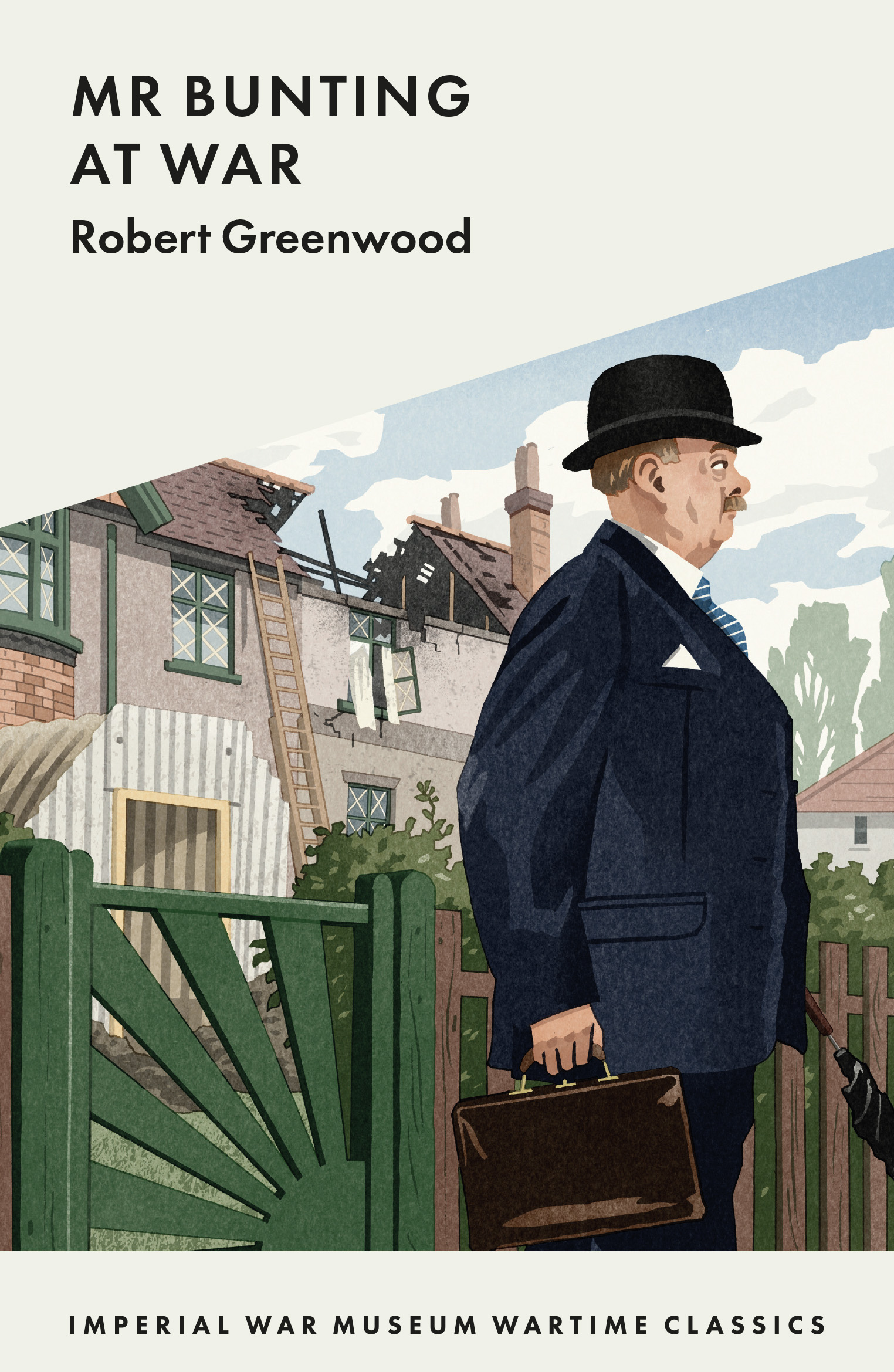
๐Ÿ“– Blog Tour ~ Mr Bunting at War by Robert Greenwood


IWM
April 2022

My thanks to the publishers for my copy of the book

and to Random Things Tours for the invitation to the blog tour


George Bunting, businessman, husband and father, lives a quiet life at home in Laburnam Villa in Essex, reading about the progress of the war in his trusty Siren newspaper and heading to work every day at same the warehouse where he has been employed for his entire adult life. Viewed with an air of slight amusement by his three children, Mr Bunting’s war efforts comprise mainly of digging for victory and reluctantly erecting a dugout in the garden. But as the Second World War continues into the summer of 1940, the Battle of Britain rages in the skies and the bombs begin to reign down on London, this bumbling ‘everyman’ is forced to confront the true realities of the conflict. He does so with a remarkable stoicism, imbuing him with a quiet dignity. 

This reprint of a 1941 classic includes an introduction from IWM putting the work in historical context and shedding a light on the wartime experiences of the quiet ‘everyman’ and his family on the British Home Front: He was not brilliant, nor heroic, but there was one thing he could do – endure. He could stick it out right to the end. It was the one thing he was good at, and it happened to be almost his sole duty.


๐Ÿ“– My Review..

Mr Bunting at War looks at the life of the eponymous George Bunting who lives an ordered life in Laburnum Villas in Essex. He travels to London each day to work at Brockley's, an established ironmongery business, which hasn't, up until now, appreciated George's finer qualities, that is, until the expediency of war causes him to be promoted. We meet the Bunting's family in the early years of the Second World War when George is troubled by his family's seeming indifference to the fact that there is a war going on.

There's a gentleness to the narrative which belies its strength as it takes us directly into the ordered life of the suburban household on the cusp of some of the worst war time devastation. Of course, we can look back with hindsight, to the destruction caused by the bombs which rained down on London, but to those going about their daily lives, they had little sense of what was to come, with many going so far as to think it was simply just an 'empty threat'. 

What Mr Bunting at War brings into sharp focus is the way in which the ordinariness of life was forever changed. People were not just making do and mending, they were enduring hardship which would characterise them for rest of the war. However, with true British fortitude and stoicism, bombs could fall around them but, like Mr Bunting, they would still head off to work, tend to their vegetable patches and sit down for tea at five o'clock. 

Mr Bunting at War is very much of its time and that is what makes this such an absorbing and very readable story. I find that there is something really special in reading a novel which was actually written during the time of the Second World War, bringing us a fascinating glimpse into a world which is now just a distant memory. 


๐ŸดBest read with... Mrs Bunting's sausage rolls , hot from the oven.


About the Author


Robert Greenwood (1897-1981) was a novelist and writer. His first novel depicted the family and working life of the eponymous Mr Bunting (1940) and his next, Mr Bunting at War (1941), continued the story in the first two years of the Second World War. Mr Bunting at War was made into a film the following year entitled Salute John Citizen (1942), which proved popular at the box office. Greenwood wrote eleven novels in total and a number of short stories, including Mr Bunting in the Promised Land (1949) which tells the story of the Bunting family in the aftermath of the war. Robert Greenwood died in 1981.


Twitter @I_W_M #WarTimeClassics

@RandomTTours


Wednesday, 6 October 2021

๐Ÿ“– Blog Tour ~ To All the Living by Monica Felton


Delighted to host a stop on the last day of this blog tour 


Imperial War Museum Classic
23 September 2021

My thanks to the publishers for my copy of this book
and to Random Things Tours for the invitation to the blog tour


First published in 1945, To All the Living takes place in a munitions factory throughout 1941 in Blimpton, a place ‘so far from anywhere as to be, for all practical purposes, nowhere.’ The novel gives a lively account of the experiences of a group of men and women in the factory from both a top down and bottom up perspective, detailing the triumphs and tragedies of a diverse list of characters. It is wide-ranging in the themes it touches on, including class, sexism, socialism, fear of communism, workers’ rights, anti-semitism and xenophobia. Much of it was based on the author’s own experiences in the Ministry of Supply in the first years of the war, and it is one of the best depictions of factory life during wartime, providing the reader with a fascinating insight into this vital aspect of Britain’s home front.

Factory work, as depicted in the novel, could be exhausting and repetitive, with workers often receiving low pay. Initially work was on a voluntary basis which meant there was always a shortage of labour. As the war progressed, conscription for women was introduced in December 1941 to help stem the shortages. 

By 1945, 6.7 million women were contributing to the war effort out of a population of 48 million with a further 2.5 million in the voluntary sector. Only the Soviet Union mobilized a higher percentage of women for the war effort and the novel reflects the experiences of a tiny proportion of these women.

The work undertaken by women at munitions factories will also be explored in IWM’s new Second World War Galleries with personal items belonging to a worker at the Leeds based Blackburn Aircraft Factory on display for the first time when they open in October of this year.

IWM Senior Curator, Alan Jeffreys, has written an introduction that provides context and the wider historical background. He says, ‘researching the Wartime Classics has been one of the most enjoyable projects I’ve worked on in my years at IWM. It’s been very exciting rediscovering these fantastic novels and helping to bring them to the wider readership they so deserve.'

To All the Living by Monica Felton is published by IWM and can be pre-ordered here: www.iwmshop.org.uk/pg/114/IWM-Wartime-Classics at the online IWM shop.


๐Ÿ“– My Thoughts..

It's been my privilege to have read several stories in this IWM series of classic wartime novels and each one brings with it an element of authenticity. However, it’s not just the power of the individual storytelling which holds true but it is also the importance of keeping these classic stories alive for another generation.

To All the Living gives a fictional account of what it was like to work in munitions factory and follows the fortunes of a group of women newly employed in the factory at Blimpton. And as they learn their trade in the factory, so we also get used to the social and political implications of this type of war work.

Without the testimonies of those who have gone before it’s becoming increasingly difficult for us to imagine what life was like at this time and especially in a munitions factory during the Second World War. Largely staffed by young women who, lured by the promise of decent wages and comfortable billets, soon found that life in the factories was both sheer hard work and frighteningly dangerous. Putting their lives at risk every time they arrived for duty, handling explosives, which at the very least caused severe dermatitis, and at its worse could, and often did, prove fatal, especially if the explosives used to fill the shell casings were mishandled.

Set in 1941, but written in 1945, the novel is very much of its time. Within its comprehensive pages there is an undeniable authenticity which comes from the author writing about what she knows best and whose knowledge highlights the stifling bureaucracy amongst petty officials which so often hampered progress. Felton’s own experience of working at the Ministry of Supply gives the story an unequalled breadth of knowledge which certainly helps to put time, place and purpose into the right context.

In reissuing these splendid WW2 novels, the Imperial War Museum is doing a great job in bringing the history of the war era alive for a new audience of readers.


About the Author


Monica Felton (1906 – 1970) was a feminist, socialist, historian, peace activist and a pioneering proponent of town planning. She went to University College, Southampton and then did a Phd at the LSE. In 1937 she was elected a member of the London County Council representing St Pancras South West. During the Second World War she served in the Ministry of Supply, an experience she reflected in To All the Living. In 1942 she became a Clerk of the House of Commons.

After the war she became involved in town planning, serving as Chair for the Peterlee and Stevenage Development Corporations. However, she was fired from this post after taking an unauthorized trip to North Korea on behalf of the Women’s International Democratic Federation in 1951. On her return from this trip she accused American troops of atrocities and British complicity. There was a media and establishment backlash and even accusations of treason. As a result she became increasingly isolated in Britain and moved to India in 1956. She died in Madras (modern day Chennai) in 1970.

About the IWM

IWM (Imperial War Museums) tells the story of people who have lived, fought and died in conflicts involving Britain and the Commonwealth since the First World War.

Our unique collections, made up of the everyday and the exceptional, reveal stories of people, places, ideas and events. Using these, we tell vivid personal stories and create powerful physical experiences across our five museums that reflect the realities of war as both a destructive and creative force. We challenge people to look at conflict from different perspectives, enriching their understanding of the causes, course and consequences of war and its impact on people’s lives.

IWM’s five branches which attract over 2.5 million visitors each year are IWM London, which will open extensive new Second World War and The Holocaust Galleries in autumn 2021; IWM North, housed in an iconic award-winning building designed by Daniel Libeskind; IWM Duxford, a world renowned aviation museum and Britain's best preserved wartime airfield; Churchill War Rooms, housed in Churchill’s secret headquarters below Whitehall; and the Second World War cruiser HMS Belfast.


Twitter @I_W_M  #WarTimeClassics

@angelamarymar

@RandomTTours


Wednesday, 2 June 2021

๐Ÿ“– Blog Tour ~ Sword of Bone by Anthony Rhodes


I'm delighted to be the concluding stop on this Blog Tour

๐Ÿ“–


IWM
#WartimeClassics
20 May 2021

My thanks to the publisher for my copy of this book
and to Random Things Tours for the invitation to the blog tour


IMPERIAL WAR MUSEUMS TO PUBLISH ANOTHER FORGOTTEN MASTERPIECE IN THEIR WARTIME CLASSICS SERIES Published to coincide with the 81st Anniversary of the evacuation of Dunkirk.

In May 2021, IWM will publish two more novels in their Wartime Classics Series which was launched in September 2019 to great acclaim, bringing the total number of novels in the series to ten. Each has been brought back into print to enable a new generation of readers to hear stories of those who experienced conflict first hand.


First published in 1942, Sword of Bone is a lightly fictionalised memoir based on Anthony Rhodes’ own experiences during the Second World War – firstly during the so-called ‘Phoney War’ from 1939 – 40, followed by the terror of the evacuation of Dunkirk. Shortly after war was declared, he was sent to France serving with the British Army where his days were filled with billeting, friendships and administration – the minutiae of Army life. Apart from a visit to the Maginot Line, the conflict seems a distant prospect. It is only in the Spring of 1940 that the true situation becomes clear – the Belgian, British armies and some French divisions are ‘now crowded into a small pocket in the North of France’. The men are ordered to retreat to the coast and the beaches of Dunkirk where they face a desperate and frightening wait for evacuation. The ‘miracle’ of Dunkirk was a brilliantly improvised naval operation that extracted more than 338,000 men from the Dunkirk beaches and brought them safely back to England. Some 850 vessels, including channel steamers and fishing boats, took part in this, Operation ‘Dynamo’. The final pages of the novel outline Rhodes’ experiences of the chaos of the evacuation where the scenes are depicted in vivid and terrifying detail.

IWM Senior Curator, Alan Jeffreys, has written an introduction to each book that provides context and the wider historical background. He says, ‘researching the Wartime Classics has been one of the most enjoyable projects I’ve worked on in my years at IWM. It’s been very exciting rediscovering these fantastic novels and helping to bring them to the wider readership they so deserve’.


My thoughts...

Anyone who once served with the British Army during the early years of WW2 will be familiar with the way in which the events of the 'Phoney War' in 1939 blended into what happened during the retreat of our troops, and the evacuation at Dunkirk in the spring of 1940. For those of us who weren't alive at the time, reading fictionalised accounts such as this one help to put the situation into context. The author, and narrator, Anthony Rhodes, served with the British Army, and writes with a strong sense of authenticity about what happened in the lead up to the German invasion of France in the early part of the war. 

Sword of Bone, written in 1942, gives a fascinating insight into how the general housekeeping of the war was organised. The author was tasked with finding billets for soldiers, often commandeering village accommodation wherever he could, which was achieved with a stoicism and, sometimes, a sense of stalwart resignation. The French and Belgium people were remarkably accommodating and it would seem that hospitality, and friendship, were ever present.

The story moves along well, the author writes with a lightness of touch which belies the seriousness of the situation in which the British forces were placed in during the latter part of 1939. I read with interest some of the more mundane things that happened to our narrator but where the book really starts to excel is in the latter stages of the book when, between  the 27th May and 4th June, the British exodus from Dunkirk starts to occur.  Operation Dynamo, or the Miracle of Dunkirk, as it was called, saw the safe evacuation of over 338,000 Allied troops by a hastily organised fleet of over 800 vessels of all shapes and sizes. The vivid descriptions at the conclusion of the book emphasises the sheer scale of the evacuation and as the author so succinctly writes...'The noise, my dear! And the people'.

This IWM Wartime Classics series gives a fascinating insight into the Second World War, I especially enjoyed reading the introduction by Alan Jeffries, senior curator at the Imperial War Museum.


About the Author

Anthony Rhodes (1916 – 2004) served with the British Army in France during the so-called ‘Phoney War’ and was evacuated from Dunkirk in May 1940. In the latter part of the war he was sent to Canada as a camouflage officer and was invalided out of the Army in 1947 having served for 12 years. After the conflict he enjoyed a long academic and literary career and wrote on various subjects, including the 1956 Hungarian Revolution for the Daily Telegraph and well-regarded histories of the Vatican.

Sword of Bone by Anthony Rhodes is published by IWM and can be ordered here at the online IWM shop.


Twitter @I_W_M #WartimeClassics

@angelamarymor

@RandomTTours


๐ŸŒ 


Thursday, 20 May 2021

๐Ÿ“– Blog Tour ~ Pathfinders by Cecil Lewis


๐Ÿ“– Thrilled to host a stop on today's blog tour ๐Ÿ“–


Imperial War Museum
20 May 2021
#WartimeClassics

My thanks to the publisher for my copy of this book
 and to Random Things Tours for my invitation to be part of the blog tour


In May 2021, IWM publish two more novels in their Wartime Classics series which was launched in September 2019 to great acclaim, bringing the total novels in the series to ten. Each has been brought back into print to enable a new generation of readers to hear stories of those who experienced conflict firsthand.

First published in 1944 and set over the course of one night in 1942, the story follows the fate of six crew members of a Wellington bomber ‘P for Pathfinder’ thrown together by chance from different corners of the world. They each reflect on the paths of their own lives, as they embark on a fateful mission deep into the heart of Nazi Germany. Cecil Lewis’ novel examines the life of every man in turn, rendering a moving account of each as not merely a nameless crew member, but as an individual with a life lived, ‘a life precious to some, or one… these men with dreams and hopes and plans of things to come.” 

Cecil Lewis was a flying instructor for the RAF during the Second World War where he taught hundreds of pilots to fly, including his own son. It was while doing this training that he wrote Pathfinders. Pupils were graded by the time it took them to fly solo – the best became fighters and then bombers. The RAF’s Bomber Command was the only branch of the armed forces that could take direct action against Germany and in 1942 the strategic air offensive changed from precision to area bombing where whole cities were targeted in order to destroy factories as well as the morale of those who worked in them. 

The ‘pathfinders’ of the story were needed because often the bombers could not find the towns and cities they were destined to attack at night, let alone the industrial centres within. The crew used coloured marker flares to guide the bombers to their targets and the crews selected (often from the USA, Canada and NZ as well as Britain) were the best night flying crews who were able to find the target unaided. As a pilot who took part in both World Wars, Cecil Lewis brings his unique experience to bear, shining a light on this vital and sometimes contested aspect of Britain’s Second World War focusing on the sacrifice made by the Allied airmen it depicts. 

IWM Senior Curator, Alan Jeffreys, has written an introduction to each book that provides context and the wider historical background. He says, ‘researching the Wartime Classics has been one of the most enjoyable projects I’ve worked on in my years at IWM. It’s been very exciting rediscovering these fantastic novels and helping to bring them to the wider readership they so deserve.’


๐Ÿ“– My thoughts...

Stepping back in time with this 1944 edition of Pathfinders reiterates the danger and complexity of airborne manoeuveres and of the sheer bravery of the flying crews who manned the bomber aeroplanes during some of the most dangerous times of WW2.

Pathfinders is the story of the crew members of a Wellington bomber, coded 'P' for Pathfinder, as it embarks on a mission into the heart of Germany on a fateful night in 1942. The very human aspect of this novel serves to remind us that the crew members were, quite simply, ordinary men caught up in exceptional circumstances.

The six crew members on whom the book focuses are all very different personalities, and have different nationalities, but once in the sky they become as one, and embody the bravery and stoicism of team work under enemy bombardment. By allocating a chapter to each of the crew members, namely, the pilot, co-pilot, navigator, wireless operator and front and rear gunners we are given an emotional glimpse into each of their personal lives. Each of the six have a story to tell and their own special reasons for being aboard Pathfinder on that fateful night in 1942.

I think what makes this novel so special is that it is of its time, and talented though modern writers of WW2 fiction are, they did not live through the events of the Second World War, and as we know, that exceptional fighting generation is now lost to us. However, having a character driven novel penned by a man who was himself a fighter ace of WW1, and who then went on to become a RAF flying instructor during WW2, is what gives Pathfinders such a poignant insight into the human aspect of being part of a bomber crew, of the complexities of flying under extremely difficult circumstances, and of the forgotten lives of those who took to the skies to fight for our freedom.


About the Author


Cecil Lewis (1898 - 1997) was a British fighter ace in the First World War and his memoir Sagittarius Rising became a classic of the literature from that war, considered by many to be the definitive account of aerial combat. He was a flying instructor for the RAF during the Second World War where he taught hundreds of pilots to fly, including his own son. After the war he was one of the founding executives of the BBC and enjoyed friendships with many of the creative figures of the day, including George Bernard Shaw, winning an Academy Award for co-writing the 1938 film adaptation of Shaw’s Pygmalion. He had a long and varied career but retained a passion for flying all his life. In 1969 he sailed a boat to Corfu where he spent the remainder of his life, dying two months short of his 99th birthday. He was the last surviving British fighter ace of the First World War.

IWM (Imperial War Museums) tells the story of people who have lived, fought and died in conflicts involving Britain and the Commonwealth since the First World War. Our unique collections, made up of the everyday and the exceptional, reveal stories of people, places, ideas and events. Using these, we tell vivid personal stories and create powerful physical experiences across our five museums that reflect the realities of war as both a destructive and creative force. We challenge people to look at conflict from different perspectives, enriching their understanding of the causes, course and consequences of war and its impact on people’s lives. IWM’s five branches which attract over 2.5 million visitors each year are IWM London, which will open extensive new Second World War and The Holocaust Galleries in autumn 2021; IWM North, housed in an iconic award-winning building designed by Daniel Libeskind; IWM Duxford, a world renowned aviation museum and Britain's best preserved wartime airfield; Churchill War Rooms, housed in Churchill’s secret headquarters below Whitehall; and the Second World War cruiser HMS Belfast.


Pathfinders by Cecil Lewis is published by IWM 

and can be ordered here: at the online IWM shop


Twitter @I-W-M #WartimeClassics

@AngelamaryMar @RandomTTours


Sunday, 29 September 2019

Blog Tour ~ Eight Hours from England by Anthony Quayle


Thrilled to be hosting one of the final stops on this Blog Tour


Imperial War Museum Classics
26 September 2019

My thanks to the publishers and Random Things Tours for the opportunity to be part of this blog tour

A candid account of SOE operations in occupied Europe described by Andrew Roberts as ‘As well as being one of our greatest actors, Anthony Quayle was an intrepid war hero and his autobiographical novel is one of the greatest adventure stories of the Second World War. Beautifully written and full of pathos and authenticity, it brings alive the terrible moral decisions that have to be taken by soldiers under unimaginable pressures in wartime.’ 


I'm honoured to be able to share an exclusive extract from Eight Hours from England


It was about four o’clock in the afternoon when I heard running feet outside my hut, then Chela’s voice, an octave higher than usual, crying: 

‘Major! Quick, quick! The Germans are coming!’ 

The alarm and urgency in his voice brought me squirming out through the doorway. He must have given a general alarm already, for the Italians had caught fright and were running helter-skelter out of the camp towards the track that led down to the beach. Chela was jigging about with nerves. 

‘Major,’ he pleaded. ‘Please… Please… We cannot stay… run quick.’ He wrung his hands. 

‘Shut up, Chela,’ I said. ‘Calm down and tell me what has happened?’ 

The whole of Chela’s face was contorted with fear. He started to gabble. 

‘They are coming. They are coming. From the south.’ 

‘How do you know this?’ 

‘A shepherd has come running. They have just shot his dog.’ 

The last sentence had a ring of truth: it decided me. 

‘Major.’ There were tears in his eyes. ‘I am responsible for you… Quickly.’ 

By now there was a knot of Americans and British round us, most of them ready carrying their packs and weapons. 

‘All right. Leave camp. Quick as you can. Operators – don’t forget – hang on tight to your crystals and signal plans.’ 

I dived back into the hut. I had few signals to burn; all was ready. I grabbed my pack and gun, and in a moment we were all running down the only track that led out of camp northwards – down the hill to the beach. 

‘How much of a start have we?’ I called to Chela. 

‘Perhaps ten minutes, perhaps half an hour,’ he called back. ‘I don’t know.’ 

The steep track was sodden with rain, and the running feet of seventy men had turned it into a slippery morass. Drake’s feet shot from under him and he landed on his back in the mud. 

‘F— this for a lark,’ he declared as he was pulled to his feet. 

As I ran I found that I was half frightened and half enjoying myself, as though I were taking part in a very exciting game of hare and hounds. 

Now we had reached the beach, and now the only way of escape was up three hundred feet of absolutely bare hill-side. Already my back was aching under the heavy pack, and my heart sank as I surveyed the precipitous slope. 

‘This is where we’ll get it,’ said Nigel. He was fetching his breath in gulps, but at the same time laughing. ‘They’ll pick us off like rabbits as we go up this.’ 

‘The only alternative is to be trapped here on the beach,’ I said. ‘Come on. Up we go.’ 

We began the climb, digging our fingers into the ground, the loose shale slipping away beneath our boots. All about men were swarming up the scree. Grunting and panting we toiled upwards till we were on a level with the abandoned camp. The American sergeant, coming behind me, stopped for a moment to look back. Suddenly he gave a great cry. 

‘There they are! I seen ‘em! I seen ‘em!’ 

‘Where are they, Butch?’ I called over my shoulder. 

‘Coming into camp,’ he panted. ‘I seen ‘em duck behind some rocks.’ 

As I climbed on I thought: ‘This is the end then. I have often wondered how it would come. Now I know. Any moment a bullet will smack into me, and a khaki bundle that was Overton will go tumbling down the hill on to the beach.’


About the Author


Anthony Quayle was a renowned Shakespearean actor, director and film star and during the Second World War was a Special Operations Executive behind enemy lines in Albania. 

Twitter @I_W_M #wartimeclassics

@angelamarymar

#RandomThingsTours


Saturday, 21 September 2019

Hist fic Saturday ~ Blog Tour ~ Plenty Under the Counter by Kathleen Hewitt


On Hist Fic Saturday 

I'm thrilled to be hosting today's stop on this Blog Tour


In September 2019, to mark the 80th anniversary of the outbreak of the Second World War, IWM will launch a wonderful new series with four novels from their archives all set during the Second World War – Imperial War Museums Wartime Classics. 

Originally published to considerable acclaim, these titles were written either during or just after the Second World War and are currently out of print. Each novel is written directly from the author’s own experience and takes the reader right into the heart of the conflict. They all capture the awful absurdity of war and the trauma and chaos of battle as well as some of the fierce loyalties and black humour that can emerge in extraordinary circumstances. 

Living through a time of great upheaval, as we are today, each wartime story brings the reality of war alive in a vivid and profoundly moving way and is a timely reminder of what the previous generations experienced. 

The remarkable IWM Library has an outstanding literary collection and was an integral part of Imperial War Museums from its very beginnings. Alan Jeffreys, (Senior Curator, Second World War, Imperial War Museums) searched the library collection to come up with these four launch titles, all of which deserve a new and wider audience. He has written an introduction to each novel that sets them in context and gives the wider historical background and says, ‘Researching the Wartime Classics has been one of the most enjoyable projects I’ve worked on in my years at IWM. It’s been very exciting rediscovering these fantastic novels and helping to bring them to the wider readership they so deserve’


IWM
Wartime Classics
26 September 2019

My thanks to the IWM, Angela Martin, and Random Things Tours for my copy of this book
and the opportunity to be part of this Blog Tour


Plenty Under the Counter by Kathleen Hewitt – a murder mystery about opportunism and the black market set against the backdrop of London during the Blitz. ‘With a dead body on the first page and a debonair RAF pilot as the sleuth, this stylish whodunit takes you straight back to Blitzed London and murder most foul. Several plausible suspects, a femme fatale, witty dialogue, memorable scenes and unexpected twists – it boasts everything a great whodunit should have, and more. Andrew Roberts.


My thoughts about it..

WW2 Flight-Lieutenant David Heron is recuperating after a war time injury and has chosen to spend his convalescence in his favourite boarding house in London. When he is rudely awakened with the strange news that the body of a man has been found in the garden everyone in Mrs Meake’s boarding house is immediately under suspicion. David, however, is determined to track down the perpetrator of this heinous crime even though it takes him into some very dangerous situations.

What then follows is an interesting whodunit which is very much in the style of the golden age of sleuthing. The characters take charge from the very start and whilst Flight-Lieutenant Heron is a suave and sophisticated sleuth, he is also very much an old fashioned gentleman, and his considered approach to crime investigation is a real breath of fresh air. However, his air of affability and general bonhomie is about to be tested to the limit as he delves further and further into the clandestine world of the black market.

Plenty Under the Counter is filled with twists, turns and numerous red herrings and is a fascinating snap shot of what it was like to live in wartime London. Written in 1948, there is a definite air of authenticity about it, particularly as the author is using her own experience of living in London during the war years, bringing a real sense of originality to what is, after all, quite a complex murder/mystery.

Plenty Under the Counter is a fascinating addition to the IWM Wartime Classic Collection and will, I’m sure, appeal to those readers who enjoy a good old fashioned crime novel. 


About the Author


Kathleen Hewitt was a British author and playwright who wrote more than 20 novels in her lifetime. She was part of an artistic set in 1930’s London which included Olga Lehman and the poet Roy Campbell.


Twitter @I_W_M #wartimeclassics


@angelamarymar


#randomthingstours


Wednesday, 4 September 2019

Blog Tour ~ From the City, From the Plough by Alexander Baron


Absolutely thrilled to be taking part in this exciting Blog Tour


In September 2019, to mark the 80th anniversary of the outbreak of the Second World War, IWM will launch a wonderful new series with four novels from their archives all set during the Second World War – Imperial War Museums Wartime Classics.

Originally published to considerable acclaim, these titles were written either during or just after the Second World War and are currently out of print. Each novel is written directly from the author’s own experience and takes the reader right into the heart of the conflict. They all capture the awful absurdity of war and the trauma and chaos of battle as well as some of the fierce loyalties and black humour that can emerge in extraordinary circumstances. 

Living through a time of great upheaval, as we are today, each wartime story brings the reality of war alive in a vivid and profoundly moving way and is a timely reminder of what the previous generations experienced.


IWM
26 September 2019
£8.99 Paperback

My thanks to IWM and to Random Things Tours for my copy of this book
and the invitation to be part of this blog tour

From the City, From the Plough by Alexander Baron – A vivid and moving account of preparations for D-Day and the advance into Normandy. Published in the 75th anniversary year of the D-Day landings, this is based on the author’s first-hand experience of D-Day and has been described by Antony Beevor as ‘undoubtedly one of the very greatest British novels of the Second World War.’


 My thoughts about it..

The events of D-Day, now so long ago, with only a handful of war veterans who were actually there, proves that this novel is all the more timely as it gives a fictional account of the build up to D-Day as seen through the eyes of the men who made up the 5th Battalion of the Wessex Regiment. This group of soldiers, like so many battalions, was drawn from all aspects of life, from those who arrived covered in the dust and grime of cities, to the country boys who were more at home wielding a scythe, or ploughing a field, and yet in exceptional circumstances, this band of brothers grouped together to form a cohesive whole.

From the City, From the Plough, is the author's fictional account of a situation he experienced at first hand as he was one of the soldiers to go across the channel around D-Day. He writes with authority about the inertia of the long hot summer of 1944 when the soldiers of the 5th Battalion were waiting for action. The novel instills such a sense of reality that there were times when I forgot that I was reading a fictional account as it feels more as if you are living through every second of the interminable waiting with them.

When the action finally starts to happen there's a real sense of horror as the men struggled with ferocious German bombardment and of the sheer hard slog of trying to keep one step ahead of an enemy who was as dangerous as it was unpredictable. The novel tells a powerful story and doesn't describe the men of the 5th battalion as anything other than soldiers with faults and failings, some good, some bad, some who were typical opportunists, who were out for themselves, and others who were inherently good blokes with a sense of patriotic duty.

The book was published in 1948 and its first print run of 3000 copies sold out before publication. Since then the book has sold over one million copies, and it is hoped that this new IWM edition will bring this powerful story to a whole new readership.

From the City, From the Plough brings D-Day to life in a story which breaks your heart into a million pieces and it is one which will stay with me for a very long time.


About the Author


Alexander Baron was a widely acclaimed author and screenwriter and his London novels have a wide following. From the City, From the Plough was his first novel was his first novel.

Twitter @I_W_M #wartimeclassics

@angelamarymar

#randomthingstours


Sunday, 11 November 2018

Armistice ~ Sunday WW1 Remembered...


At "the eleventh hour of the eleventh day of the eleventh month" in 1918 the guns grew silent on the Western Front. The Armistice of Compiรจgne was signed between the Allies and Germany and went into effect at 11am, Paris time, on the 11th November, 1918 .


©Digital Images


And There Was a Great Calm

BY THOMAS HARDY

(On the Signing of the Armistice, 11 Nov. 1918)

                                       I
There had been years of Passion—scorching, cold,
And much Despair, and Anger heaving high,
Care whitely watching, Sorrows manifold,
Among the young, among the weak and old,
And the pensive Spirit of Pity whispered, “Why?”


                                       II
Men had not paused to answer. Foes distraught
Pierced the thinned peoples in a brute-like blindness,
Philosophies that sages long had taught,
And Selflessness, were as an unknown thought,
And “Hell!” and “Shell!” were yapped at Lovingkindness.


                                       III
The feeble folk at home had grown full-used
To 'dug-outs', 'snipers', 'Huns', from the war-adept
In the mornings heard, and at evetides perused;
To day-dreamt men in millions, when they mused—
To nightmare-men in millions when they slept.


                                       IV
Waking to wish existence timeless, null,
Sirius they watched above where armies fell;
He seemed to check his flapping when, in the lull
Of night a boom came thencewise, like the dull
Plunge of a stone dropped into some deep well.


                                       V
So, when old hopes that earth was bettering slowly
Were dead and damned, there sounded 'War is done!'
One morrow. Said the bereft, and meek, and lowly,
'Will men some day be given to grace? yea, wholly,
And in good sooth, as our dreams used to run?'


                                       VI
Breathless they paused. Out there men raised their glance
To where had stood those poplars lank and lopped,
As they had raised it through the four years’ dance
Of Death in the now familiar flats of France;
And murmured, 'Strange, this! How? All firing stopped?'


                                       VII
Aye; all was hushed. The about-to-fire fired not,
The aimed-at moved away in trance-lipped song.
One checkless regiment slung a clinching shot
And turned. The Spirit of Irony smirked out, 'What?
Spoil peradventures woven of Rage and Wrong?'


                                       VIII
Thenceforth no flying fires inflamed the gray,
No hurtlings shook the dewdrop from the thorn,
No moan perplexed the mute bird on the spray;
Worn horses mused: 'We are not whipped to-day;'
No weft-winged engines blurred the moon’s thin horn.


                                       IX
Calm fell. From Heaven distilled a clemency;
There was peace on earth, and silence in the sky;
Some could, some could not, shake off misery:
The Sinister Spirit sneered: 'It had to be!'

And again the Spirit of Pity whispered, 'Why?'


Wigan Parish Church 2018
©J Barton

It's been a real privilege to bring this WW1 Remembered feature to Jaffareadstoo. 

Huge thanks to all those who have taken the time to read and especially to those who have contributed to this feature.

Gill Paul, Georgia Hill, Juliet Greenwood, Glen Craney, Ros Rendle, Susan Lannigan, Linda Gillard,Terri Nixon, John R McKay, Michael Wills, Jane Cable, Claire Dyer, Karen Maitland, Elisabeth Gifford, David Ebsworth, Kirsty Ferry, Rachel Sargent and John Barton.

I owe a huge debt of gratitude to all the WW1 war poets whose eloquence brought tears to my eyes and whose words, with both poignant simplicity and graphic imagery, conjure the war in so many different ways.

Huge thanks to the Imperial War Museum for their magnificent WW1 archive and valuable shareable resources.

And remember, in the quiet corners of Commonwealth War Graves, there are those soldiers who lie, often forgotten, in our villages, towns and city cemeteries. We owe these quiet sentinels of our peace a huge debt, so do, please visit them and take a quiet moment to remember their extraordinary sacrifice.


Wigan Parish Church 2018
©Digital Images

๐Ÿ’”

In our family we remember 

Pte. John Hopkins

Loyal North Lancashire Regiment

Died 24th January 1919


©Digital Images

๐Ÿ’”


Pte. Sam Whalley

Royal Fusiliers/17th Lancers


©Digital Images


©Digital Images
Sam and his five brothers all survived the war

๐Ÿ’”


Driver Frederick Arkwright

T/14695668


Royal Army Service Corps


©J Barton

Died 1 February 1945
Buried Schoonselhof Cemetery 
Antwerp, Belgium

Wigan Cenotaph
©Digital Images
Wigan Cenotaph
©Digital Images

๐Ÿ’”


A generation of young men and women, gone too soon in a war that robbed them of their future so that we could have ours


At the going down of the sun and in the morning we will remember them

๐Ÿ’”


©Digital Images

๐Ÿ’”