Showing posts with label WW1 Remembered. Show all posts

Sunday, 11 November 2018

Armistice ~ Sunday WW1 Remembered...


At "the eleventh hour of the eleventh day of the eleventh month" in 1918 the guns grew silent on the Western Front. The Armistice of Compiรจgne was signed between the Allies and Germany and went into effect at 11am, Paris time, on the 11th November, 1918 .


©Digital Images


And There Was a Great Calm

BY THOMAS HARDY

(On the Signing of the Armistice, 11 Nov. 1918)

                                       I
There had been years of Passion—scorching, cold,
And much Despair, and Anger heaving high,
Care whitely watching, Sorrows manifold,
Among the young, among the weak and old,
And the pensive Spirit of Pity whispered, “Why?”


                                       II
Men had not paused to answer. Foes distraught
Pierced the thinned peoples in a brute-like blindness,
Philosophies that sages long had taught,
And Selflessness, were as an unknown thought,
And “Hell!” and “Shell!” were yapped at Lovingkindness.


                                       III
The feeble folk at home had grown full-used
To 'dug-outs', 'snipers', 'Huns', from the war-adept
In the mornings heard, and at evetides perused;
To day-dreamt men in millions, when they mused—
To nightmare-men in millions when they slept.


                                       IV
Waking to wish existence timeless, null,
Sirius they watched above where armies fell;
He seemed to check his flapping when, in the lull
Of night a boom came thencewise, like the dull
Plunge of a stone dropped into some deep well.


                                       V
So, when old hopes that earth was bettering slowly
Were dead and damned, there sounded 'War is done!'
One morrow. Said the bereft, and meek, and lowly,
'Will men some day be given to grace? yea, wholly,
And in good sooth, as our dreams used to run?'


                                       VI
Breathless they paused. Out there men raised their glance
To where had stood those poplars lank and lopped,
As they had raised it through the four years’ dance
Of Death in the now familiar flats of France;
And murmured, 'Strange, this! How? All firing stopped?'


                                       VII
Aye; all was hushed. The about-to-fire fired not,
The aimed-at moved away in trance-lipped song.
One checkless regiment slung a clinching shot
And turned. The Spirit of Irony smirked out, 'What?
Spoil peradventures woven of Rage and Wrong?'


                                       VIII
Thenceforth no flying fires inflamed the gray,
No hurtlings shook the dewdrop from the thorn,
No moan perplexed the mute bird on the spray;
Worn horses mused: 'We are not whipped to-day;'
No weft-winged engines blurred the moon’s thin horn.


                                       IX
Calm fell. From Heaven distilled a clemency;
There was peace on earth, and silence in the sky;
Some could, some could not, shake off misery:
The Sinister Spirit sneered: 'It had to be!'

And again the Spirit of Pity whispered, 'Why?'


Wigan Parish Church 2018
©J Barton

It's been a real privilege to bring this WW1 Remembered feature to Jaffareadstoo. 

Huge thanks to all those who have taken the time to read and especially to those who have contributed to this feature.

Gill Paul, Georgia Hill, Juliet Greenwood, Glen Craney, Ros Rendle, Susan Lannigan, Linda Gillard,Terri Nixon, John R McKay, Michael Wills, Jane Cable, Claire Dyer, Karen Maitland, Elisabeth Gifford, David Ebsworth, Kirsty Ferry, Rachel Sargent and John Barton.

I owe a huge debt of gratitude to all the WW1 war poets whose eloquence brought tears to my eyes and whose words, with both poignant simplicity and graphic imagery, conjure the war in so many different ways.

Huge thanks to the Imperial War Museum for their magnificent WW1 archive and valuable shareable resources.

And remember, in the quiet corners of Commonwealth War Graves, there are those soldiers who lie, often forgotten, in our villages, towns and city cemeteries. We owe these quiet sentinels of our peace a huge debt, so do, please visit them and take a quiet moment to remember their extraordinary sacrifice.


Wigan Parish Church 2018
©Digital Images

๐Ÿ’”

In our family we remember 

Pte. John Hopkins

Loyal North Lancashire Regiment

Died 24th January 1919


©Digital Images

๐Ÿ’”


Pte. Sam Whalley

Royal Fusiliers/17th Lancers


©Digital Images


©Digital Images
Sam and his five brothers all survived the war

๐Ÿ’”


Driver Frederick Arkwright

T/14695668


Royal Army Service Corps


©J Barton

Died 1 February 1945
Buried Schoonselhof Cemetery 
Antwerp, Belgium

Wigan Cenotaph
©Digital Images
Wigan Cenotaph
©Digital Images

๐Ÿ’”


A generation of young men and women, gone too soon in a war that robbed them of their future so that we could have ours


At the going down of the sun and in the morning we will remember them

๐Ÿ’”


©Digital Images

๐Ÿ’”

Sunday, 28 October 2018

Sunday WW1 Remembered..


 Gassed by John Singer Sergeant
© IWM (Art.IWM ART 1460)

I recently visited this poignant WW1 Exhibition at IWM North 

Iconic paintings from WW1 are on display including two of my favourites. I first saw The Menin Road when I visited the Imperial War Museum on a school trip to London in the 1970s. This iconic painting left a memorable impression and is still an evocative reminder of the devastation left behind by the fighting on the Western Front.


The Menin Road by Paul Nash (1919)

Nash was commissioned by the British War Memorials Committee to paint a battlefield scene for the proposed national Hall of Remembrance (which was never built!) The painting is considered one of the most iconic images of the First World War and is held by the Imperial War Museum (wikipedia)

© Digital Images

Gassed by John Singer Sergeant (1918)


© Digital Images


Gassed is a very large oil painting completed in March 1919 by John Singer Sargent. It depicts the aftermath of a mustard gas attack during the First World War, with a line of wounded soldiers walking towards a dressing station. Sargent was commissioned by the British War Memorials Committee to document the war and visited the Western Front in July 1918 spending time with the Guards Division near Arras, and then with the American Expeditionary Forces near Ypres (wikipedia)


If you are in the North West this exhibition is well worth a visit

There are lots of WW1 ephemera,exhibitions and installations which explore the effect of the First World War, including a poignant reminder of the preparations for the Tomb of the Unknown Warrior


Until 24 February 2019


~****~

Sunday, 21 October 2018

Sunday WW1 Remembered ...


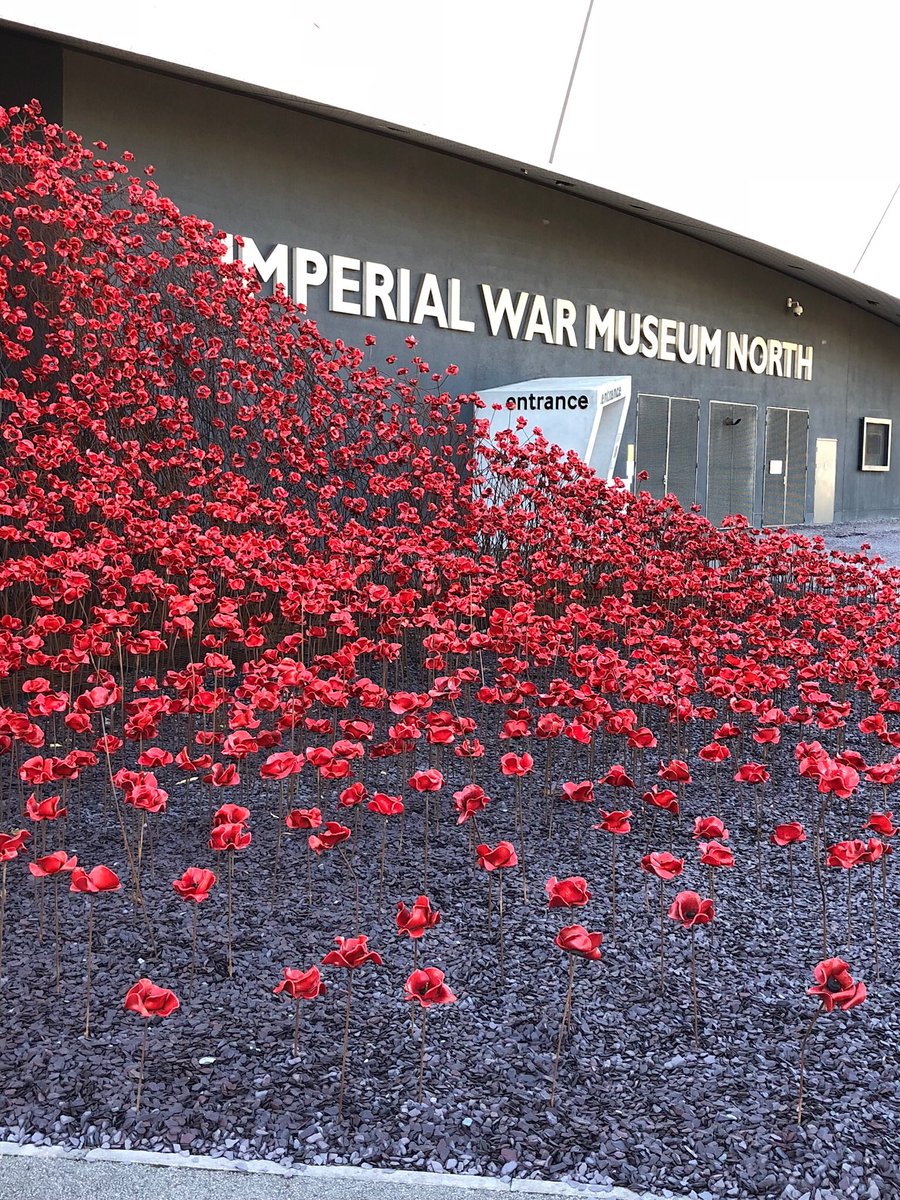
The Poppies Wave and Weeping Window designed by Paul Cummins and Tom Piper have been on tour around the UK since July 2015. The two sculptures were initially part of the Blood Swept Lands and Seas of Red at the Tower of London in the summer and autumn of 2014. 


© J Barton


IWM North is currently hosting Wave whilst IWM London is hosting Weeping Window

At the end of the tour in December 2018 both of the installations will be preserved for the nation and will become part of the IWM collection with Wave remaining at IWM North in Salford and Weeping Window at IWM London.

***

On a glorious autumn day this week I visited the Poppy : Wave installation at the Imperial War Museum North at Salford Quays. 

© Digital Images


People stood quietly, some in contemplation, others walking around the installation to view from different angles, many taking photographs on mobile phones and digital cameras. On every face I saw respect for the thousands of war dead who were represented by each of the scarlet poppies that cascaded in a graceful arch, each symbolising a life which was lost forever.


© Digital Images


Find out more about the poppies on the 14-18Now Website

or visit IWM North where the poppies can be seen until the 25 November


Follow the Poppies on Twitter #PoppiesTour


~****~


Sunday, 14 October 2018

Sunday WW1 Remembered...


As we move ever slowly towards to the cessation of hostilities on the Western Front on the 11th day of the 11th month in 1918, I am reminded of this post I shared in 2015, about Moina Michael who was so inspired by the poem In Flanders Fields by Colonel John McCrae that she made a personal pledge to 'keep the faith'. She felt compelled to make a note of this pledge and hastily scribbled down a response entitled “We Shall Keep the Faith” on the back of a used envelope. From that day she vowed to wear a red poppy of Flanders Fields as a sign of remembrance. 


We Shall Keep the Faith


Oh ! You who sleep in Flanders Fields,
Sleep sweet - to rise anew!
We caught the torch you threw
And holding high, we keep the Faith
With All who died.

We cherish, too, the poppy red
That grows on fields where valor led;
It seems to signal to the skies
That blood of heroes never dies,
But lends a lustre to the red
Of the flower that blooms above the dead
In Flanders Fields.


And now the Torch and Poppy Red
We wear in honor of our dead.
Fear not that ye have died for naught;
We'll teach the lesson that ye wrought
In Flanders Fields


She went on to use the idea of the delicate poppy flower to raise funds for ex-servicemen returning from the First World War.


Moina's fascinating autobiography, "The Miracle Flower, The Story of the Flanders Fields Memorial Poppy” was published in 1941. Moina dedicates the book to the late Colonel John McCrae, whose poem ‘In Flanders Fields’ was the inspiration for her idea of the Flanders Fields Memorial Poppy. 

As a result of Moina Michael's tireless campaigning, her complete dedication to the cause and the inspiration her idea gave to others, the delicate flower of the red field poppy has become an internationally-recognized symbol of Remembrance and welfare for war veterans.

****


For those who like fictional novels set during WW1, I can recommend the historical novel I featured on the blog yesterday. You can find my review of The Poppy Field by Deborah Carr by following this link.

It's currently just 99p Amazon Kindle 

Harper Impulse
12 October 2018


Sunday, 7 October 2018

Sunday WW1 Remembered...


Battle of Canal du Nord 27th September - 1 October 1918


The Canal du Nord is a 95 km canal in northern France which was developed to allow the French coal mining companies to compete with foreign mining production and transportation. At the outbreak of war in 1914 canal construction was stopped and during the war there was widespread damage to the canal.

The Battle of Canal du Nord was part of the the Hundred Days offensive and took place on the outskirts of Cambrai between the 27th September and the 1st October 1918.

The Hundred Days offensive brought victory but with huge loss of life. Allied casualties between August and November 1918 were approximately, 700,000 with German losses slightly higher 760,000.


Twelve Victoria Crosses were awarded during the Battle of Canal du Nord :

Acting Lieutenant-Colonel John Vereker, 6th Viscount Gort of the 1st Battalion, Grenadier Guards.

Captain John MacGregor, 2nd Battalion, Canadian Mounted Rifles.

Captain Cyril Hubert Frisby, 1st Battalion, Coldstream Guards.

Lieutenant Graham Thomson Lyall, 102nd (North British Columbia) Battalion, CEF.

Lieutenant Samuel Lewis Honey, 78th Battalion (Winnipeg Grenadiers), CEF.

Lieutenant George Fraser Kerr, 3rd Battalion (Toronto Regiment), CEF.

Lieutenant Milton Fowler Gregg, Royal Canadian Regiment.

Sergeant William Merrifield, 4th (Central Ontario) Battalion, CEF.

Sergeant Frederick Charles Riggs, 6th Battalion, York and Lancaster Regiment.

Corporal Thomas Neely, 8th Battalion, The King's Own Royal Regiment (Lancaster).

Lance-Corporal Thomas Norman Jackson, 1st Battalion, Coldstream Guards.

Private Henry Tandey, 5th Battalion, Duke of Wellington's Regiment (West Riding).


The Victoria Cross is the highest award in the British Honours System. It is awarded for :

... most conspicuous bravery, or some daring or pre-eminent act of valour or self-sacrifice, or extreme devotion to duty in the presence of the enemy...

It bears the motto : For Valour

Originally the ribbon was dark blue for Royal Navy recipients and crimson (described as 'red' in the Warrants) for the Army. After the formation of the Royal Air Force (1 April 1918) the crimson ribbon (sometimes described as 'claret', 'maroon' or 'dark red') was adopted for all recipients. ( Source: IWM)


© IWM (OMD 2406)


Sunday, 26 August 2018

WW1 Remembered..


Listening to Classic FM on the radio this morning I heard again this beautiful piece of music.The Banks of Green Willow composed by George Butterworth.

I was reminded that this piece was composed in 1913 when Butterworth was on active service on the Western Front.,

George Butterworth joined the British Army as a private in the Duke of Cornwall's Light Infantry but later accepted a commission as a subaltern in the 13th Battalion Durham Light Infantry where he was promoted to temporary Lieutenant. He was awarded the Military Cross in August 1916 but did not live to receive it. He was shot by a sniper at the Battle of the Somme on the 5 August 1916 and his body hastily buried where he fell, at the side of the trench. Tragically, his body was never recovered, but his name is inscribed on Thiepval Memorial.

Butterworth's music dates between 1910-1913 with this, The Banks of Green Willow, perhaps his most poignant work , which was composed in 1913.

You can listen to recordings of The Banks of Green Willow on You Tube.


~****~

Sunday, 19 August 2018

WW1 Remembered...


On this Day in 1918


British Advance in Flanders  ~ Battle of Outtersteene Ridge 18th August 1918


Action of Outtersteene Ridge. 

Wounded from the 27th Brigade, 9th Division, prepare for a light railway journey from Meteren to medical units in the rear area, 18 August 1918.

Brooke, John Warwick ( Lieutenant)
Photographer
© IWM (Q 6959)


Action of Outtersteene Ridge. Artillery observers watching the progress of the creeping barrage laid down to support the attack of 27th Brigade, 9th Division. Meteren, 18 August 1918.


Brooke, John Warwick ( Lieutenant)
Photographer
© IWM (Q 6948)


Action of Outtersteene Ridge. Signallers, Royal Engineers (9th Division), at an artillery observation post sending back messages about the British creeping barrage. Meteren, 18 August 1918.

Brooke, John Warwick ( Lieutenant)
Photographer
© IWM (Q 6947)


The hundred days offensive which began in with the Battle of Amiens in August 1918 saw the rapid series of Allied Victories against which the German army had no real defense.


~****~

Sunday, 12 August 2018

WW1 Remembered...


The Battle of Amiens, also known as the Third Battle of Picardy, was the opening phase of the Allied offensive which began on 8 August 1918, later known as the Hundred Days Offensive, that ultimately led to the end of the First World War. (Wikipedia)

This week saw the commemoration of the centenary of the Battle of Amiens with a service of remembrance held in the cathedral at Amiens and attended by representatives from the allied countries and also relatives of those who had been caught up in this offensive. The story of the battle told through contemporary letters, diaries and poems was a poignant reminder of how deeply significant this battle was in the final push towards the end of the war.


Battle of Amiens. Cavalry passing through Beaucourt en-Santerre to attack Le Quesnel, 9 August 1918. Stereoscopic.

© IWM (Q 8198)

Battle of Amiens. British horse-Wagon convoy passing under the German Ortskommandantur (Town Major's Office) notice swinging across the road at Cayeux-en-Santerre, 9 August 1918, the day after its capture. Stereoscopic.


© IWM (Q 8232)


This poignant photograph was taken exactly 100 years ago today


Battle of Amiens. Prisoners taken by the French near Roye 

12 August 1918. Stereoscopic.


© IWM (Q 8230)

Around 1200 prisoners were captured

All these photographs are from the Ministry of Information First World War Official Collection by kind permission of the Imperial War Museum.


Voices of the First World War

The Beginning of the End


~****~


Sunday, 5 August 2018

WW1 Remembered


On this Day

4th - 5th August, 1914


The assassination of the Archduke Franz Ferdinand in Sarajevo in June 1914 set in motion a series of actions, which would finally culminate at 11pm on Tuesday August 4th 1914, when Britain declared war on Germany.

The first newspaper reports of the outbreak of war began to circulate on Wednesday 5th August 1914 with many of the reports declaring that  "Great Britain declared war on Germany at 11 o'clock last night," and that an ultimatum from the cabinet office to the German government had received an "unsatisfactory" reply and therefore "the King held at once a council which had been called for midnight". 

Unlike today's headlines which appear on the front pages of our newspapers, news didn't appear on the front page until 1952. On the 5th August, 1914 the Manchester Guardian reported the outbreak of war on page 5 and then devoted 7 of its 10 pages to the war.


Posters exhibited on a hoarding the day Britain entered the war, 4 August 1914.


© The rights holder (IWM Q 60484)

The first battle of the war began on the 5th August 1914 when the Germans invaded the Belgian fortified city of Liรจge, which is situated at the confluence of the River Meuse and the River Ourthe, between the Ardennes to the south and Maastricht (in the Netherlands) and Flanders to the north and west. The city also lies on the main railway lines from Germany to Brussels and Paris.


Ruins of Fort Lamin in the Fortress of Liege, shot to pieces by a German 42 cm mortar.


© IWM (Q 87733)


The Great War started amid a flurry of patriotic fervour as men began to enlist in their thousands, for pride and patriotism came top of the agenda, and the excitement of meeting the challenge of war carried the country in a wave of euphoric endeavour.

The first British officer landed in France on the 11th August 1914. It would be four long years until peace was restored in Europe on the 11th November 1918. The total number of military and civilian casualties is estimated to be over 37 million, making it one of the deadliest conflicts in human history.


Chorley Memorial
Photo credit: © Digital Images

Sunday, 29 July 2018

Sunday WW1 Remembered


Over the last four years of adding WW1 information onto my blog I have found lots of books really interesting so I thought it was time to share them.


The Western Front
BBC Books
1999
I've had my copy since 1999.
The book that it was republished in 2008 with a new cover.


7739291
BBC Books
2008


From the book:

For most British people, the First World War was the Western Front, the trench line stretching from the Swiss Frontier to the North Sea. It was there that the majority of nearly nine million British and Dominion soldiers who enlisted during the war served, and where most of the 947,000 who were killed met their deaths.

This detailed but accessible account covers everything from how the front was created and the experiences of the British Army in France, to the battle of Verdun and the last hundred days of the war. Holmes' concise and heartfelt narrative is illustrated with photographs, diagrams, maps and quotations that bring this inhuman four years of history to life.

In one of the best single-volume histories of the First World War available, Holmes skillfully clarifies the complexities of the Western Front, and highlights the political, military and human dilemmas of this, the most bitter and bloody of conflicts.

My thoughts:

The battles and events that shaped the war on the Western Front is complex and bloody. Many lives were lost on the battlefields of northern France and dreams of a better future disappeared amidst the  carnage and guns which echoed relentlessly, maiming, butchering and killing young men in the thousands.

The Western Front reminds us of their sacrifice.


~****~

Sunday, 22 July 2018

Sunday WW1 Remembered


Over the last four years of adding WW1 information onto my blog I have found lots of books really interesting so I thought it was time to share them.


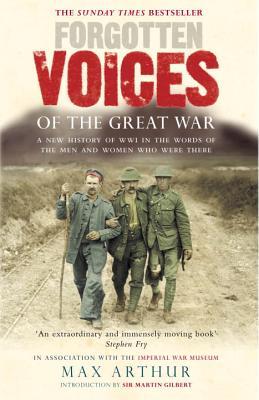
Forgotten Voices of the Great War
Ebury Press
2003
In 1972 The Imperial War Museum began the task of finding the ordinary veterans and survivors of the First World War. This book records the experiences of the ordinary men and women of the Great War who share their stories in this fine collection of reminisces and recollections of what it was like to live during this troubled time in world history. 

From the mundane to the complex each of the stories have a special poignancy, not just because these brave people are now forever lost to us but also because their wealth of knowledge and experience will stand the test of time, and will be part of our collective history forever .

The book is divided into years from 1914-1918 and I've found it very useful in trying to experience just what was being seen, and of the myriad of emotions which, in so many cases, are heartbreaking and occasionally, strangely uplifting.

From an entry dated...July 18th 1918

Captain Reginald Thomas, Royal Artillery

"It was a magnificent sight as the French cavalry came out of the forest at Soissons. Their uniforms were all new, bright blue, every bit and spur-chain was burnished and polished; their lances were gleaming in the sun; and as the bugler blew the charge the horses went into the gallop in a fan attack-two regiments of French cavalry, They went along beautifully, magnificently, through the wheat field in the afternoon sun..."

The stories within Forgotten Voices of the Great War are taken from the sound archives of the Imperial War Museum and after hundreds of hours and unlimited access to the complete WW1 tapes, the author, Max Arthur and his researchers have created this unique insight into WW1 as related by those ordinary men and women who experienced it first hand.


 ~****~

Sunday, 15 July 2018

Sunday WW1 Remembered...


Over the last four years of adding WW1 information onto my blog I have found lots of books really interesting so I thought it was time to share them.


24909772
Corgi Childrens
2016


Who'll Sing the Anthem
Who will tell the story?


One of my absolute favourite go-to books is this classic remembrance book from Michael Morpurgo which was originally published in 2014 to mark the start of the WW1 centenary.

Only Remembered is a  lovely collection of extracts, poems and memories of the Great war . Aimed primarily at the young adult market, this is, most definitely, a book which can be enjoyed by grown ups too. Simply and beautifully illustrated Only Remembered brings the poignancy, the horrors and the heroes of the Great War into stark reality.

Those who have contributed with words, thoughts and deeds are Her Royal Highness the Duchess of Cornwall, Sir Andrew Motion, Miranda Hart, Dame Jacqueline Wilson, Anthony Horowitz, Eoin Colfer, Antony Beevor, Emma Thompson, David Almond, Dr Rowan Williams, Richard Curtis, Joanna Lumley, Raymond Briggs, Shami Chakrabarti and Sir Tony Robinson.


Royalties from the publication of Only Remembered will be spilt between the Royal British Legion and projects for soldiers' children and families at SSAFA.


Sir Michael Andrew Morpurgo, OBE, FRSL is the author of many books for children, five of which have been made into films.


~****~

Sunday, 8 July 2018

Sunday WW1 Remembered..


Over the last four years of adding WW1 information onto my blog I have found lots of books really interesting so I thought it was time to share them.

Michael Joseph 1988
Penguin 1991


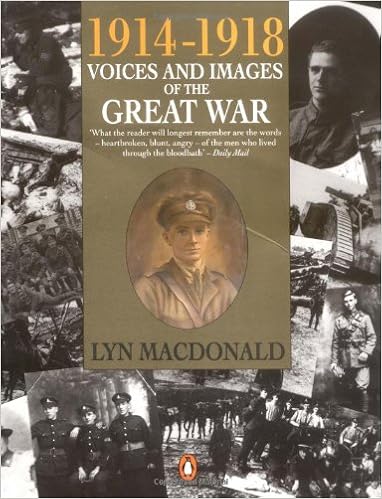
Lyn MacDonald writes with authority on the events of WW1 and this book in one that I use when I want to check up on facts or to look for inspiration for a blog post. It's a very readable account of what happened during 1914-1918 and what I find most useful is the poignant mix of the serious and the ordinary, which all add up to a fascinating account of the lives of those soldiers who fought, and died, on the Western Front.

It contains lots of illustrations, poignant photographs and letters, amateur poetry from 'ordinary' soldiers and the events they describe in letters home are both enlightening and desperately sad. There's even information in a letter which was been sent to The Times newspaper, in 1914, accusing them of reporting false news..so we know that phrase isn't new then !

Of the many books in my WW1 bibliography, 1914-1918 : Voices and Images of the Great war is one of my particular favourites especially as it gives a voice to those ordinary soldiers who found themselves, often unwillingly, living out their, sometimes very short, lives in extraordinary and difficult circumstances.

First written 30 years ago, the book is perhaps a little harder to come by now, however, it's well worth a read if you spot it in a library or second hand book store.


~****~

Sunday, 1 July 2018

Sunday WW1 Remembered...


Over the last four years of adding WW1 information onto my blog I have found lots of books really interesting so I thought it was time to share them.

Some like this one have been featured before, but it's always worth a reminder.


Where Poppies Blow

John Lewis -Stempel


29905681
W&N
2016


WHERE POPPIES BLOW is the story of the British soldiers of the Great War and their relationship with the animals and plants around them. This relationship was of profound importance, because it goes a long way to explaining why they fought, and how they found the will to go on. And in that relationship is found some of the highest, noblest aspirations of humanity in times of war.


My thoughts...

It's not all about blood and bullets and this glorious book looks at the continuance and constancy of allowing, in the midst of carnage, the therapeutic benefits of nature. And, of how, even in the midst of horror, the birds still sang, the blossom bloomed as beautiful as ever, and the tiny creatures of nature still went about their daily business.

The joy of nature brought comfort and in some cases, healing, when I am sure it seemed like the entire world had been plunged into chaos. The author very cleverly divides the content of the book into manageable chapters, each with a  foot firmly placed in what was happening in the war, whilst at the same time allowing a glimpse into a very different world.

The book begins as it should, with a beautiful poem, August, 1914 by John Masefield, who juxtaposes the beauty of the English countryside against what was happening just a few hundred miles away in the trenches of the Western Front. And just as poetry can evoke such strong emotions, so can this recounted story of a group of soldiers, from the Royal Warwickshire, who tenderly buried a dead pigeon they found in a communication trench, or the deep and abiding comradeship between an officer and his horse, or of how medics treated both wounded soldiers and animals, even to making artificial wooden legs for dogs who were thus injured in battle.

One of my favourite chapters, entitled The Bloom of Life explains how soldiers cultivated small trench gardens and regularly sent home for seeds and how grassy mounds would be transformed with nasturtiums, daffodils and hyacinths, and how billets would bloom with tiger lilies, auriculas and roses. And of course, who can forget the image of the poppy fields of Flanders.


~****~

Sunday, 24 June 2018

Sunday WW1 Remembered..


Over the last four years of adding WW1 information onto my blog I have found lots of books really interesting so I thought it was time to share them.

Some, like this one have been featured before, but its always worth a reminder.


22292393
AA Publishing
August 2014

My thanks to the publishers for my copy of this book

In Men of Letters, the author has with considerable skill, given the men of the Post Office Rifles their own very special voice and in a series of personal stories, poignant letters and diary entries, their life at the front becomes a heart rending chronicle of war. Their social observations forcibly remind us of just what life was like at the front, the interminable boredom of long periods of time closeted in the murk and mud of the French countryside, balanced against the shock of the sniper’s bullet and the agonising terror of waiting for the call to go over the top. It is especially heart breaking to realise that over 1500 of them didn’t make it to the end of the war.

In this evocative retelling of the history of the men of the Post Office Rifles, I was forcibly reminded of just how the Great War impacted on the lives of men and women, and of how the ordinary man in the street rose to the challenge of the call to arms. With over 10,000 registered letters per month reaching the Western front, I had never visualised the effort that it took to get the morale boosting mail packets to the men, and yet, whilst the Post Office rifles were made of up from the ranks of postal workers, they were very much part of the fighting force and acted honourably and with great courage under enemy bombardment.

The book is easy to read and well divided into understandable chapters, which cover the involvement of the Post Office Rifles,from the Battle of Festubert during the spring offensive in May 1915, through to their involvement in the Battle of Passchendaele in 1917. The sensitive use of personal documentation highlights the very human face of war and as names begin to crop up in the narrative, I found that I formed an emotional attachment to many of them, and seeing their photographs and reading their memories emphasised to me in a very poignant way, that these are real stories and not just dusty records from the annals of history.

We owe a huge debt of gratitude to, not just the men of the Post Office Rifles, but also to the many thousands of young men and women, who gave their lives unquestionably and who with pride and patriotism served their country in a war they really didn’t fully understand.


~****~