Showing posts with label Bibliography. Show all posts

Sunday, 15 July 2018

Sunday WW1 Remembered...


Over the last four years of adding WW1 information onto my blog I have found lots of books really interesting so I thought it was time to share them.


24909772
Corgi Childrens
2016


Who'll Sing the Anthem
Who will tell the story?


One of my absolute favourite go-to books is this classic remembrance book from Michael Morpurgo which was originally published in 2014 to mark the start of the WW1 centenary.

Only Remembered is a  lovely collection of extracts, poems and memories of the Great war . Aimed primarily at the young adult market, this is, most definitely, a book which can be enjoyed by grown ups too. Simply and beautifully illustrated Only Remembered brings the poignancy, the horrors and the heroes of the Great War into stark reality.

Those who have contributed with words, thoughts and deeds are Her Royal Highness the Duchess of Cornwall, Sir Andrew Motion, Miranda Hart, Dame Jacqueline Wilson, Anthony Horowitz, Eoin Colfer, Antony Beevor, Emma Thompson, David Almond, Dr Rowan Williams, Richard Curtis, Joanna Lumley, Raymond Briggs, Shami Chakrabarti and Sir Tony Robinson.


Royalties from the publication of Only Remembered will be spilt between the Royal British Legion and projects for soldiers' children and families at SSAFA.


Sir Michael Andrew Morpurgo, OBE, FRSL is the author of many books for children, five of which have been made into films.


~****~

Sunday, 8 July 2018

Sunday WW1 Remembered..


Over the last four years of adding WW1 information onto my blog I have found lots of books really interesting so I thought it was time to share them.

Michael Joseph 1988
Penguin 1991


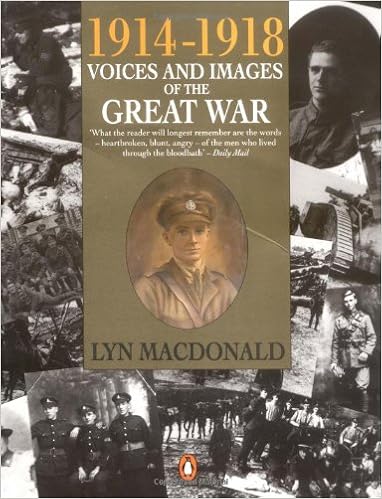
Lyn MacDonald writes with authority on the events of WW1 and this book in one that I use when I want to check up on facts or to look for inspiration for a blog post. It's a very readable account of what happened during 1914-1918 and what I find most useful is the poignant mix of the serious and the ordinary, which all add up to a fascinating account of the lives of those soldiers who fought, and died, on the Western Front.

It contains lots of illustrations, poignant photographs and letters, amateur poetry from 'ordinary' soldiers and the events they describe in letters home are both enlightening and desperately sad. There's even information in a letter which was been sent to The Times newspaper, in 1914, accusing them of reporting false news..so we know that phrase isn't new then !

Of the many books in my WW1 bibliography, 1914-1918 : Voices and Images of the Great war is one of my particular favourites especially as it gives a voice to those ordinary soldiers who found themselves, often unwillingly, living out their, sometimes very short, lives in extraordinary and difficult circumstances.

First written 30 years ago, the book is perhaps a little harder to come by now, however, it's well worth a read if you spot it in a library or second hand book store.


~****~

Sunday, 1 July 2018

Sunday WW1 Remembered...


Over the last four years of adding WW1 information onto my blog I have found lots of books really interesting so I thought it was time to share them.

Some like this one have been featured before, but it's always worth a reminder.


Where Poppies Blow

John Lewis -Stempel


29905681
W&N
2016


WHERE POPPIES BLOW is the story of the British soldiers of the Great War and their relationship with the animals and plants around them. This relationship was of profound importance, because it goes a long way to explaining why they fought, and how they found the will to go on. And in that relationship is found some of the highest, noblest aspirations of humanity in times of war.


My thoughts...

It's not all about blood and bullets and this glorious book looks at the continuance and constancy of allowing, in the midst of carnage, the therapeutic benefits of nature. And, of how, even in the midst of horror, the birds still sang, the blossom bloomed as beautiful as ever, and the tiny creatures of nature still went about their daily business.

The joy of nature brought comfort and in some cases, healing, when I am sure it seemed like the entire world had been plunged into chaos. The author very cleverly divides the content of the book into manageable chapters, each with a  foot firmly placed in what was happening in the war, whilst at the same time allowing a glimpse into a very different world.

The book begins as it should, with a beautiful poem, August, 1914 by John Masefield, who juxtaposes the beauty of the English countryside against what was happening just a few hundred miles away in the trenches of the Western Front. And just as poetry can evoke such strong emotions, so can this recounted story of a group of soldiers, from the Royal Warwickshire, who tenderly buried a dead pigeon they found in a communication trench, or the deep and abiding comradeship between an officer and his horse, or of how medics treated both wounded soldiers and animals, even to making artificial wooden legs for dogs who were thus injured in battle.

One of my favourite chapters, entitled The Bloom of Life explains how soldiers cultivated small trench gardens and regularly sent home for seeds and how grassy mounds would be transformed with nasturtiums, daffodils and hyacinths, and how billets would bloom with tiger lilies, auriculas and roses. And of course, who can forget the image of the poppy fields of Flanders.


~****~

Sunday, 24 June 2018

Sunday WW1 Remembered..


Over the last four years of adding WW1 information onto my blog I have found lots of books really interesting so I thought it was time to share them.

Some, like this one have been featured before, but its always worth a reminder.


22292393
AA Publishing
August 2014

My thanks to the publishers for my copy of this book

In Men of Letters, the author has with considerable skill, given the men of the Post Office Rifles their own very special voice and in a series of personal stories, poignant letters and diary entries, their life at the front becomes a heart rending chronicle of war. Their social observations forcibly remind us of just what life was like at the front, the interminable boredom of long periods of time closeted in the murk and mud of the French countryside, balanced against the shock of the sniper’s bullet and the agonising terror of waiting for the call to go over the top. It is especially heart breaking to realise that over 1500 of them didn’t make it to the end of the war.

In this evocative retelling of the history of the men of the Post Office Rifles, I was forcibly reminded of just how the Great War impacted on the lives of men and women, and of how the ordinary man in the street rose to the challenge of the call to arms. With over 10,000 registered letters per month reaching the Western front, I had never visualised the effort that it took to get the morale boosting mail packets to the men, and yet, whilst the Post Office rifles were made of up from the ranks of postal workers, they were very much part of the fighting force and acted honourably and with great courage under enemy bombardment.

The book is easy to read and well divided into understandable chapters, which cover the involvement of the Post Office Rifles,from the Battle of Festubert during the spring offensive in May 1915, through to their involvement in the Battle of Passchendaele in 1917. The sensitive use of personal documentation highlights the very human face of war and as names begin to crop up in the narrative, I found that I formed an emotional attachment to many of them, and seeing their photographs and reading their memories emphasised to me in a very poignant way, that these are real stories and not just dusty records from the annals of history.

We owe a huge debt of gratitude to, not just the men of the Post Office Rifles, but also to the many thousands of young men and women, who gave their lives unquestionably and who with pride and patriotism served their country in a war they really didn’t fully understand.


~****~