Showing posts with label Allison&Busby. Show all posts

Saturday, 31 July 2021

πŸ“– Book Review ~ The Poor Relation by Susanna Bavin


On Hist Fic Saturday


Let's go back to ...1908


Allison & Busby
2019

My thanks to the author for my copy of this book


1908, Manchester. Mary Maitland is an attractive and intelligent young woman determined to strike out on her own and earn a living. Finding work at a women's employment agency, her creative talent is soon noticed and Mary begins writing articles for newspapers and magazines. But being of independent and progressive mind are troublesome traits when those you hold dear must constantly live up to the expectations of the well-to-do family to which they are linked. With increasing pressures from the powers that be, can Mary find the fine line between honouring her family and honouring herself?


πŸ“– My Thoughts..


The Poor Relation is a compelling historical saga about the vagaries of society in the early twentieth century when the working classes knew their place and those who wanted to move across the social divide were thought to be no better than they should be, and, equally, the upper-middle classes could no more welcome a working girl into their midst than they could fly to the moon. 

It is into this rather stultified social atmosphere that we meet Mary Maitland who even though her family are related to the well-to-do Kimber family they never mix socially except for one awkward visit a year when the Maitlands are invited for tea at the big house. Mary is a bright, intelligent and fiercely ambitious young woman and whilst the constraints of society are set against her it doesn't stop her from trying her best to better herself even though her working class family seem almost as snobbish as their well-to-do counterparts.

The Poor Relation describes, to perfection, the callous attitude which prevailed at this time when social position was paramount and even with the progression of women's suffrage there was still little room room for working class women to rise up against the sheer slog of early marriage, poverty and hardship. Mary's story is a fascinating one and the author describes her struggles with compassion and a firm belief that hard work and determination will prevail. The other supporting characters are a rum bunch, some you love from the start, whilst there are others who you love to hate but, collectively, they bring some welcome light and shade, and give a lively commentary about life in twentieth century Manchester. The story is quite tough going in places, as Mary's life seems to be one challenge after another, however, the author drives the story along with her customary fine eye for even the smallest detail and an uncanny ability to make her characters seem so alive that you can't help but hope that things work out well for some, and that others get their comeuppance.

The author writes really well about life, love and all the difficulties which seem to have been so prominent in the early twentieth century, when social prejudice was very much the norm and it is this historical accuracy which makes The Poor Relation such a special read. 


About the Author


Susanna Bavin has variously been an librarian, an infant school teacher, a carer and a cook. She  lives in Llandudno in North Wales but her writing is inspired by her Manchester roots.


Twitter @SusannaBavin 

#SagaSaturday

@AllisonandBusby


Monday, 31 May 2021

πŸ“– Book Review ~ The Sewing Room Girl by Susanna Bavin


Allison & Busby
2018

My thanks to the author for my copy of this book


1892. When her beloved father dies, Juliet and her mother, the difficult but vulnerable Agnes, are left to fend for themselves. When Agnes lands a job as a seamstress for a titled family, things appear to be looking up. But just as the pair begin to find their feet, Juliet finds herself defenceless and alone.

Without her mother to protect her, Juliet becomes the victim of a traumatic incident and is left to face an impossible dilemma. She flees to Manchester seeking support from her estranged family but comes up against her formidable grandmother, who is determined to bend Juliet to her will. It will take all Juliet’s ingenuity to escape the clutches of her ruthless grandmother and make her own way in life.


πŸ“– My thoughts...

Juliet Harper's life changes forever when her beloved father dies and she and her mother are made to leave the cottage which has been their home for years. Finding work as a seamstress in the home of the local gentry offers both Juliet, and her mother, some element of security but fate has a fickle way of interfering and Juliet finds, to her cost, that not everyone wants to see her succeed. Juliet's life is far from easy but with resilience of spirit and a willingness to learn she is determined to make the best of herself despite the many setbacks which seem to come her way.

The author writes with a real sense of purpose and brings the north of England to life in such a readable way that it is easy to become immersed in the life of all her characters some, it must be said, are more likeable than others. The late Victorian era comes alive particularly in describing Juliet's fascinating career as a seamstress, and shows in detail the social and moral restrictions which were placed upon unmarried women. Location is a real focus point of the novel and the intuitive way in which the author writes about the rich heritage of the North of England is what makes this such a fascinating story and a real page turner.

The Sewing Room Girl is a wonderfully evocative historical saga. Rich in detail and alive with tragedy, heartbreak and happiness, it is a story which is every bit as good as I knew it would be from this talented writer of historical fiction.


About the Author

Susanna Bavin has variously been an librarian, an infant school teacher, a carer and a cook. She  lives in Llandudno in North Wales but her writing is inspired by her Manchester roots.


Twitter @SusannaBavin

@AllisonandBusby


Wednesday, 10 March 2021

πŸ“– Book Review ~ A Respectable Woman by Susanna Bavin


Allison & Busby
2018

My thanks to the author for my copy of this book


After losing everything she holds dear in the Great War, Nell believes that marrying Stan Hibbert will help to recapture the loving family feeling she has lost. Five years on, she is just another penny-pinching, back-street housewife. When she discovers Stan is leading a double-life, she runs away to make a fresh start elsewhere.

Nell forges a new life for herself and her children in Manchester, working in a garment factory as a talented machinist. Her neighbours and colleagues believe she is a respectable widow – even her children think their father is dead – but when the past comes back to haunt her, Nell is faced with a court trial and will have to answer for her actions.

πŸ“– My thoughts..

I discovered this author's historical fiction last year when I read The Deserter's Daughter and was immediately impressed with her writing style and the authenticity of the historical setting. I am delighted to say that A Respectable Woman follows in the same absorbing style.

The story opens in 1922, when the country is adjusting to life after the Great War. Nell Hibbert is forced to take a long look at her circumstances when she discovers that her husband, Stan is leading a double life, and so, together with her young son, Nell flees to Manchester where she presents herself as a young widow. Life is a struggle, making ends meet is something of a challenge and with no man to help her Nell must become the sole breadwinner. 

What comes across so strongly is the resilience of the northern spirit in close knit communities amongst people who have next to nothing materially, and yet they do everything they can to support those who can't always help themselves. The small, terraced streets where Nell makes her home could be any northern town, and the characters, who are portrayed so vividly, remind me so much of my own northern heritage. Strong, no nonsense women, who think nothing of caring for other women's children, well, what's one or two more when you already have a houseful of your own. However, for all the poverty and hardship, this is the story of a respectable woman who only wants to survive and care for her family. And yet as we discover throughout the course of the story, life is not going to be easy for Nell Hibbert and there are many obstacles to overcome before she can find the happiness she so richly deserves.

A Respectable Woman is a beautifully written historical saga which has all the little nuances of historical detail which make this author's work such a joy to read. The author brings to life a story which is packed full of action, from the sewing room of a Manchester clothing factory, to sharing  a pot of strong tea, and a chat, in the back kitchen of a Chorlton terrace, there is never a moment when the story doesn't draw you into a forgotten way of life. Throughout A Respectable Woman there's pathos, danger and despair, but there's also humour and a strong sense of community, and in Nell Hibbert we have a feisty heroine whose fascinating story stays with you long after the last page is turned.


About the Author

Susanna Bavin has variously been an librarian, an infant school teacher, a carer and a cook. She  lives in Llandudno in North Wales but her writing is inspired by her Manchester roots.


Twitter @SusannaBavin


Tuesday, 29 December 2020

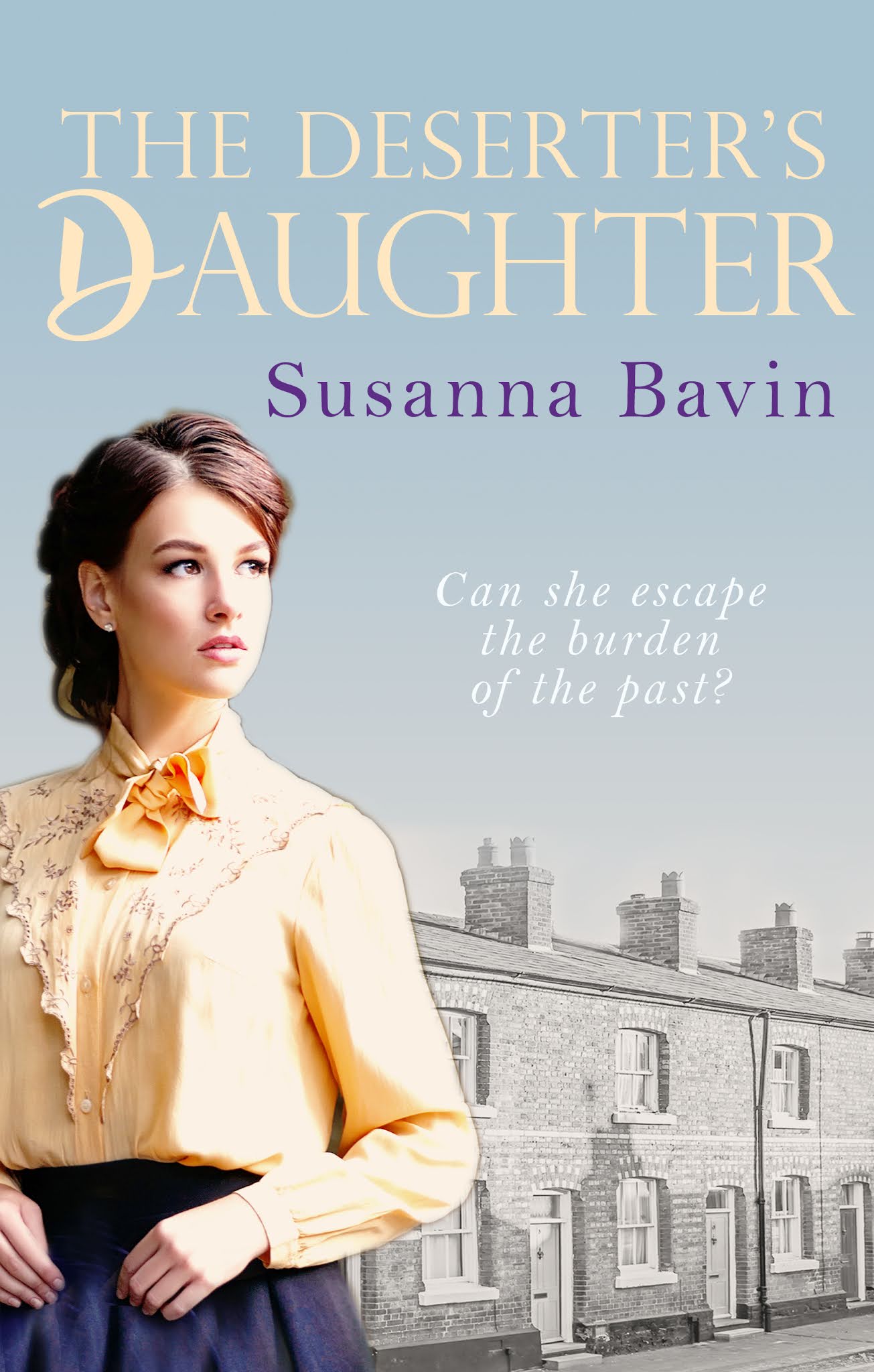
πŸ“– Book Review ~ The Deserter's Daughter by Susanna Bavin

Allison and Busby
2017

My thanks to the author for my copy of this book


1920, Chorlton, Manchester.

As her wedding day approaches, Carrie Jenkins is trying on her dress and eagerly anticipating becoming Mrs Billy Shipton. But all too soon she is reeling from the news that her beloved pa was shot for desertion during the Great War. When Carrie is jilted and the close-knit community turns its back on her, her half-sister Evadne and their mother, the plans Carrie nurtured are destroyed.

Desperate to overcome her private troubles as well as the public humiliation, Carrie accepts the unsettling advances of the well-to-do antiques dealer, Ralph Armstrong. Through Ralph, Evadne meets the aristocratic Alex Larter, who seems to be the answer to her matrimonial ambitions.

But the sisters have chosen men who are not to be trusted and they must face physical danger and personal heartache before they can find the happiness they deserve.

πŸ“– My thoughts..

It should be the happiest time of Carrie Jenkins life as she is about to marry her sweetheart but when devastating news about Carrie's father is revealed it alters the whole trajectory of not just Carrie's life but also that of her mother and older sister. With her marriage plans in disarray Carrie makes a hasty decision to become involved with Ralph Armstrong who offers a solution to her problems but which turns out not to be the safe haven she so desperately desires.

What then follows is an interesting family drama which looks at the stigma which was attached to the families of all those men who were found guilty of desertion during WW1. There is a real sense of shame in this family tragedy not just from the sadness of having once friendly neighbours turn against you but also the bewilderment of having to make life altering decisions when everything around you seems hopeless. 

The author writes well and brings a real sense of historical accuracy to this character driven story. I enjoyed the northern setting around Manchester which highlights the stern good humour, the strict moral code and the implacable northern grit of the inhabitants of this tough industrial city. The characters are well fleshed out, some are instantly likable, others take a while to get to know and some are, quite frankly, vile from the beginning but this all adds to the rich tapestry of this strong and powerful family saga which kept my attention from start to finish.

This is the first book I have read by this author and I am sure it won't be the last.


About the Author

Susanna Bavin has variously been an librarian, an infant school teacher, a carer and a cook. |she lives in Llandudno in North Wales but her writing is inspired by her Manchester roots.
The Deserter's Daughter was her first novel.


Monday, 30 November 2020

Blog Tour ~ The Imperfect Alchemist by Naomi Miller


I am delighted to be joining in with this blog tour stop


Allison & Busby
19 November 2020

My thanks to the publishers for my copy of this book
and the invitation to be part of the blog tour today


Two women. One bond that will unite them across years and social divides. England, 1575. Mary Sidney, who will go on to claim a spot at the heart of Elizabethan court life and culture, is a fourteen-year-old navigating grief and her first awareness of love and desire. Her sharp mind is less interested in the dynastic alliances and marriages that concern her father, but will she be able to forge a place for herself and her writing in the years to come?

Rose Commin, a young country girl with a surprising talent for drawing, is desperate to shrug off the slurs of witchcraft which have tarnished life at home.The opportunity to work at Wilton House, the Earl of Pembroke’s Wiltshire residence, is her chance.

Defying the conventions of their time, these two women, mistress and maid,will find themselves facing the triumphs, revelations and struggles that lie ahead together.


🌠 I am delighted that Naomi is joining us on the blog today🌠


πŸ“– Hi Naomi, tell us a little about yourself and how you got started as an author. 

In a diary entry when I was eight years old, I wrote a message to my “older” self, asserting that writing stories is the most important act of creation possible. I wrote my first novel at the age of twelve – an 80-page handwritten historical fiction mystery set in the England of Jane Austen and the Bronte sisters. So as an adult, it was a natural step to turn from writing scholarship about early modern women authors to writing fiction, in order to share their stories with readers outside academe. 


πŸ“– Where did you get the first flash of inspiration for Imperfect Alchemist? 

Many popular novels about Renaissance women picture them in relation to powerful men – such as the steady stream of novels about the wives of Henry VIII. This perpetuates a phenomenon that I have named the “Noah’s ark approach,” which positions women in dependent relation to famous men. I envisioned a historical fiction series that would bring the attention of a wider public to the extraordinary array of women’s voices that were heard in their own period – both acclaimed and reviled – but then silenced over time and excluded from the canon of accepted classics. Imperfect Alchemist is the first in my projected series, Shakespeare’s Sisters – six interrelated historical novels that imagine the stories of early modern women authors from their own perspectives. 


πŸ“– Mary Sidney is such an interesting character. Tell us about her and why you decided to write a story around her. 

Mary Sidney Herbert, Countess of Pembroke – friend of Queen Elizabeth, visionary scientist, advocate for women writers and scandalous lover of a much younger man – was one of the earliest women authors in Renaissance England to publish under her own name. A member of one of England’s leading families, she carved out space for herself as a daring and often controversial figure in a royal court riven by jealousies and intrigues. 

Her pioneering literary and scientific experiments challenged many of Renaissance England’s established conventions – one of the things that most strongly drew me to her. As an influential literary patron as well as author, she convened a literary salon of writers whose membership included Edmund Spenser, John Donne, Ben Jonson and other authors interested in testing the limits of literary forms. Her own play about Antony and Cleopatra is believed to have influenced Shakespeare. Responding to the Countess’s role as mentor to a cohort of women writers, I have imagined these women into her circle, their interaction with the male authors inspiring visions of new possibilities. 


πŸ“– When combining historical fact with fiction it must be quite a challenge to get the balance right. How do you manage to do this without compromising on authenticity

I employed the scholarly techniques that have served me throughout my career for a new purpose – not to contextualize a literary study, but to create a world in which my fictionalized protagonists could live and breathe, labour and love. To create the form and texture of the time, I read historical studies documenting early modern clothes and food, source texts containing early modern recipes and medical remedies, letters and diary entries. Most important, I returned to the words and works of Mary Sidney Herbert herself. 

One of my guiding principles has been to avoid contradicting historical facts, but I have sometimes adjusted the timing of actual events by a couple of months or years, in order to serve the story and the narrative flow. My aim has been to tell a story that places my characters in a world that encompasses both known facts and imagined possibilities, illuminating the historical record without being limited by it. 

My other primary character is an invented one – Rose Commin, her lady’s maid, a country girl who brings an entirely different outlook to their intersecting lives. Trained to serve and observe, Rose proves to be both a keen judge of character and a skilled artist whose drawings give new dimension to Mary’s own life and writings. My construction of Rose is based on accounts of servants and country folk of the period. Fear of witchcraft was common, and that strand in the story incorporates historical examples of the treatment of women accused of sorcery. 

The supporting cast of characters, both real and invented, add three-dimensionality to the fictional storyline. Most of the characters in the book are fictional renditions of real historical figures whose roles combine elements of their actual lives with my own inventions. 


πŸ“– Imperfect Alchemist is set in Tudor England. In researching the background to the story did anything leave a lasting impression on you? 

My fictional Mary Sidney Herbert has been mediated through my knowledge of her real-life circumstances and her writings. She was also a scientist, practicing alchemy in her private laboratory to prepare chemical and herbal remedies. Although the Countess was a well-regarded alchemist, no manuscript records of her own alchemical recipes or experiments survive. I have drawn on historical accounts documenting the detailed practices of other female alchemists of the period present an authentic, if conjectural, account of her scientific work. 

Two things impressed me about the women alchemists of the time – one, their meticulously detailed records of their experiments, and the other, their overriding interest in finding cures for ailments rather than in the more chimerical search for turning dross into gold that was so characteristic of the better-known male alchemists. 


πŸ“– Is it difficult to find a balance between research and writing? Can you ever have too much historical detail in historical fiction? 

As I embarked on the first draft of the novel, I had to guard against my tendency, as a scholar, to plunge down historical or literary “rabbit-holes,” enticed by fascinating details that would interrupt the writing process and might obscure rather than illuminate the story. Not to mention that some of what thrills me as a scholar/teacher – such as Mary Sidney Herbert’s ingenuity in employing 126 distinct stanzaic forms in her creative paraphrases of 107 Psalms, which influenced the poetry of John Donne and George Herbert – might not grip the general reader or serve the story. 


πŸ“– Whilst you are writing you must live with your characters. Do they ever dictate how the story progresses or do you stick with a writing plan from the beginning and never deviate? 

My characters’ voices and choices have determined the progression of the story, sometimes in unexpected ways. For instance, although I knew biographical details about Mary Sidney Herbert, her inner reactions to life events and historical circumstances came from the character herself. And in the case of an invented character such as Rose Commin – I had no idea she was an artist until her sketches spilled out of her bag of possessions when she met her new mistress, and I saw them for the first time. Rose’s artistry turns out to be an essential driver of the story, from start to finish, and it was a pleasure to discover “what happens next.” I hope that my discoveries as a writer function as discoveries for the reader as well. 

And finally for fun... πŸ˜ƒ

πŸ“– If you could invite three people from history to your dinner table, who would you choose and why? 

That’s easy! I’d invite Mary Sidney Herbert, Mary Wroth, and Aemilia Lanyer, the protagonists of the first three novels in my projected series, and the historical figures that I’d most like to meet and hear from in person – far more than Shakespeare, for instance. I envision dinner table conversation about how to balance being a mother and a writer, how to write “as a woman” in a literary tradition defined by men, how to raise sons as well as daughters who appreciate women’s voices and contributions to the world.


What did I think about it The Imperfect Alchemist


I must admit to knowing very little about Mary Sidney Herbert, Countess of Pembroke,  although I have come across her in other novels where her interest in the study of alchemy has been explored in just a little detail. It's been really interesting, therefore, to have an entire novel which combines Mary's fascinating life based on factual evidence running alongside that of a totally fictional character, namely that of her maidservant, Rose Commin. I enjoyed the juxtaposition of the life of these two very different women, one born to privilege and a life of ease whilst the other was born into poverty and hardship and yet both rose beyond the patriarchal society which stifled their natural talents.

Imperfect Alchemist explores in detail the tangled world of Elizabethan England, from the capriciousness of a powerful female ruler, to the often malign influence and interference of male alchemists who searched for answers to the difficult conundrums of the day. However, intelligent female alchemists were rare indeed, and Mary Sidney Herbert is not only credited for her work in this field but she was also a notable author, excelling at both prose and poetry.

The author brings this rather formidable female to life in an intelligent and thought-provoking way. I enjoyed the alternate chapters which detail what was happening with both Mary, and then Rose, and I watched, with interest, as their relationship gradually built to one of trust and mutual respect. Not only does the story flesh out these characters in some detail but it also gives a commentary about life in Tudor England and the restrictions that women faced not just from male prejudice but also from the perils of daily life when grief and loss often walked hand in hand. 

Beautifully written and extensively researched, Imperfect Alchemist is a commendable debut novel, which brings the life of Mary Sidney Herbert into sharp focus giving her, at last, a voice to be heard.


About the Author


Photo credit : Jon Crispin


Naomi Miller is professor of English at Smith College, Massachusetts. She is the author or editor of nine books in early modern studies and Imperfect Alchemist is her first novel.


Twitter@naomimillerbooks #ImperfectAlchemist

@allisonandbusby


Wednesday, 28 October 2020

Blog Tour ~ The Exiles by Christine Baker Kline


Delighted to host today's blog tour stop


Allison& Busby
22 October 2020

My thanks to the publishers for my copy of this book
and to Random Things Tours for the invitation to be part of the blog tour


London, 1840. Evangeline, pregnant and falsely accused of stealing, has languished in Newgate prison for months. Ahead lies the journey to Australia on a prison ship. On board, Evangeline befriends Hazel, sentenced to seven years’ transport for theft. Soon Hazel’s path will cross with an orphaned indigenous girl. Mathinna is ‘adopted’ by the new governor of Tasmania where the family treat her more like a curiosity than a child. Amid hardships and cruelties, new life will take root in stolen soil, friendships will define lives, and some will find their place in a new society in the land beyond the seas.


What did I think about it..

Evangeline Stokes is falsely accused of theft, and after a sojourn in the hideous depths of Newgate Prison, she is found guilty and sentenced to transportation to Australia. Whilst on board the convict ship, Medea, Evangeline is befriended by Hazel Ferguson, a young woman who is also on her way to start a new life in Australia. These two lives interweave in the most tragic of circumstances in an event which left me reeling.

We also follow the story of Mathinna, a young Aboriginal girl, who is taken to live with the governor, Sir John Franklin, and his wife, on the island of Van Diemen's Land where she is treated as something of a curiosity, more pet, than human. Mathinna is a fascinating young woman and I enjoyed how the elements of her story came together but was saddened by her treatment and the  despicable way her rich heritage was disregarded as unimportant by those who purported to be better than her.

The absolute strength of the story comes from the tragedy of the circumstances in which these characters find themselves in, all of them exiles from the place of their birth, but even as they are used, abused and disregarded, their story is a valuable insight into how, given the right circumstances, some people were able to rise above the circumstances of tragedy.

Beautifully written and extensively researched, The Exiles took me back to a cruel time in history when for the meagre crime of stealing a silver spoon, or being wrongly accused of stealing a ruby ring, the whole pivotal importance of life was changed forever. 

The Exiles is heartrendingly sad in places but nevertheless is a wonderful, insightful read about a largely forgotten and cruel period in history.


About the Author


CHRISTINA BAKER KLINE is the author of seven novels, including the #1 New York Times bestseller Orphan Train. Her essays, articles, and reviews have appeared in the New York Times, the San Francisco Chronicle, Money, More, and Psychology Today, among other publications. She lives in New York City and on the coast of Maine.


Twitter @bakerkline #TheExiles


@AllisonandBusby

@RandomTTours


Thursday, 20 August 2020

Blog Tour and Author Interview ~ Killing In Your Name by Gary Donnelly ☼


☼ Delighted to host today's blog tour stop on Publication Day

with an interview with Gary Donnelly ☼


50670522
Allison & Busby
20 August 2020

My thanks to the publishers for the invitation to be part of this blog tour


A boy’s body is found in bogland: a case as cold as the earth that has hidden it for so long and an echo of Northern Ireland’s darkest hours. DI Owen Sheen has sworn to get justice for the unnamed boy and digs up links to a covert British Army unit that was operating in the 1970s. But as fresh bodies start to litter the streets of Belfast, Sheen and DC Aoife McCusker, who is fighting to restore her professional reputation, must make the connection and stop a killer hellbent on revenge.


Hi Gary, welcome to Jaffareadstoo, thank you for inviting us to your blog tour and 
for joining us today on Publication Day!


Where did you get the first flash of inspiration for Killing in Your Name?

There were a few sparks, but the big one came about five years ago when I was beginning Blood Will Be Born and a mate of mine was completing a postgraduate qualification in art. He created an interactive exhibition based on a piece of sociological research called Black Magic and Bogeymen by the academic Richard Jenkins. The book details black magic rumours along the Irish border in the 1970s, some of which were believed to have been instigated by a covert British Army team. As soon as I heard this I was hooked, and knew I had to build a novel around this dark pearl. The beauty and fun of novel writing is that imagination is in the driving seat, so after the initial spark, I was able to ask, well, ‘What if…?’ What if this group did more than stir up fear? What if the supposed evils of black magic were nothing compared to the real evils that haunted Northern Irish society during those dark days? 


Your writing is very atmospheric – how do you ‘set the scene’ in your novels and how much research did you need to do in order to bring this second book in the D I Owen Sheen series to life? 

I read history way back then, and lots of that attention to detail and instinct to research thoroughly has stayed with me. So, yes, I prefer to get it right where I possibly can and I really feel this is a respect which the reader is owed. The arc of a story and the characters are mine to imagine, but when it comes to things like physical surroundings, technical details, scientific facts, smells, procedures and protocols, I want to be accurate. There’s many ways. Sometimes I ask a professional for guidance (nurses, former police officers), I read and research historical details which can be used, I have attended courses and listened to pathologists and crime scene investigators. Honestly the Internet is invaluable. If I want to see the Belfast sky in December (I live and work in London), if I want to see how a crime scene is taped off, if I want to see a detail from a famous painting. First and foremost I want this for the reader. She has taken my hand and walked into a shadowy world with me, she trusts me to make the frights and the suspense and the excitement real and worth her time. If something snags, if a portion of the set falls apart, the spell can break, and I have reneged on the deal. But it’s also necessary for me as a writer. Not always at that rough first draft point, but definitely thereafter. Unless I know ‘the set’ is as accurate as I can manage, I will get distracted, I won’t submerge in a way that I need to. When details are correct, even if it is a small thing like the vegetation on a hillside, I can use it, and disappear into the story. 


The second book in a series is sometimes considered more difficult to write – were there any challenges with this book, and if so can you tell us how you overcame them? 

The biggest challenge is the one you have just stated! The expectation involved in doing it all again, and hopefully doing it better, or at least on par with the first. The fear that there may be nothing more left to say. For me, opening lines and first words are incredibly potent. They are like an incantation, a whispered prayer that almost generates a form of self-hypnosis, and allows the magic to happen. I knew that the kernel of Killing In Your Name was valid (I still get a little shiver when I think about stumbling over it), but when I went searching for Sheen in the first chapter, the opening line came to me complete and I knew he was there, brooding in shadows and waiting to get to work. “The dead are silent in their graves, but at night they speak to Owen Sheen.” 


How does Killing in Your Name fit in with the previous book in the series? 

Killing In Your Name follows on from Blood Will Be Born, but it also stands alone for the first time reader of the Sheen series. This was something I was really passionate about and which my publisher also bought into and helped with. In terms of challenges, this was certainly one! It’s work that takes place after initial drafts and with fresh-eyed editing, and it was incredibly satisfying to get a sense of having achieved this in some way. It was made even harder because, without a doubt, both novels have a great deal of fine stitching when it comes to plot and character relationships. On the other hand, I was aware that as the book’s first reader, Killing In Your Name owed all readers of Blood Will Be Born a few answers and necessary follow-ups which had to be addressed. Let’s just say a few loose ends needed to be dealt with in a way that real life rarely satisfactorily allows! Books in a series are like siblings. Put them together, the resemblance is usually undeniable, but each brings something unique to the world. As an author, just as a parent, you never really know what you’re going to get until it arrives! 


Whilst you are writing you must live with your characters. How do you feel about them when the book is finished? Are they what you expected them to be

Yes, I know I'm in the groove when, while out walking or jogging, I hear their voices snapping out dialogue for next scenes, or repeating things I have written. But the experience of writing is like being a pilot, so much of it is in point of view during creation that I see it very differently to the first time reader. I’m in the cockpit, matching their breathing, experiencing the beat of seconds passing in action, getting hit, hurting others. In this way, as in real life, my focus is less on the coherent whole (in much the same way as most of us do not ‘see’ ourselves walking down the road as others will, we are in it). In some ways, therefore, I get less! My mate spent a slow pint telling me exactly how Aoife McCusker looks and which actor could play her, and I was amazed at how much he saw. When the book is finished, and I have gained some distance, I find myself as intrigued as anyone else a lot of the time. It’s a bit like having had a dream and then returning to it, on paper. I remember snippets of what I was doing while writing some scenes and building the characters, but when that book arrives, they are no longer me, or mine. In this sense I am always reminded about what Seamus Heaney said about his poems. While he wrote and reworked them, they were all his, but as soon as they were published, they were his no longer, they belonged to the readers. Thankfully, I’ve always been fond of my characters when I finish writing, especially when they appear very real, remain believable and when they manage to make me laugh. 


What characteristics make a good fictional detective and equally, what makes a good fictional villain? 

As the Rolling Stones once sang, every cop is a criminal and all the sinners are saints. That pretty much hits the nail on the nail on the head for me. When Milgram did his 1963 experiment into destructive obedience he was searching for what made some people ‘evil’ enough to follow orders to murder complete strangers. What he discovered was that the main ingredient was being human, that was it. So, it is the humanity in both fictional detectives and villains that make them powerful and successful, for me. Sheen knows the difference between right and wrong but he struggles, the battle is within, no matter what he faces in the world I drop him into. Likewise, if the villain has nothing the reader can even partly empathise with then it’s game over. As a child I remember almost crying watching the old black and white King Kong, even though he did wreak havoc. In Killing In Your Name, I created two villains, and without giving too much away, I was able to have my fun this time! There was space for a spectrum which, at its lightest, was still very murky, and at its darkest, is bad to the bone. 


Tell us about your writing day- are you disciplined, strictly 9 til 5, or are you more of a have a cup of tea and think about it sort of writer

The best advice I was given is what I will repeat. Write every day. That said, I don’t always follow that mantra! It can be a somewhat feast or famine for me when it comes to writing. So, in that sense, discipline is my best friend throughout the process. I am at my best when I establish a routine and stick to it. Simple rules, tricks really, they help me. If I have an opportunity to write and material to work on then it comes first that day. There will always be distractions and excuses, but laying down new words must come first, and for me it’s best if that is earlier rather than later. I think I can access the raw unconscious much better first thing in the morning, less mental energy has been exerted on other things. It’s not always easy, so rather than demanding a hefty word count, my other trick is that I usually ask for ten minutes of concerted effort, head down. Frequently, that’s enough to prime the pump and when I look up, lots of time has passed. I actually have a day job, I teach more or less full time, but have one day off per week which I devote to writing. Outside holiday time and my writing day, I write when I can, sometimes before, and sometimes after work. There are fallow periods, and often these are spent chewing over ideas and beginning to map out potential stories, but consistency is key. By all means, drink that cup of tea, think a little, but if in doubt, write. Every day. 


Can you tell us if you have another DI Sheen novel planned? 

I can tell you that Sheen and Aoife will be back on the streets of Belfast after Killing in Your Name. Book three is in the pipeline, and will be titled Never Ask The Dead, due for publication in 2021. Beyond that, I can’t reveal too much just yet. But something tells me that Sheen’s track record for steering clear of bad luck and trouble is pretty questionable! I have a feeling that if I go looking for him, I might find him waiting for me. He will ask me where I’ve been, and tell me there’s a case that needs him, even though he knows he should leave it, because it spells bad news. But he won’t. He doesn’t listen to a word I say.


Gary Donnelly is a writer and teacher who was born and raised in west Belfast. After attending a state comprehensive school, he read History at Corpus Christi College, Cambridge and has lived and worked in London since the late 1990s.


Twitter @DonnellyWriter #KillingInYourName


@allisonandbusby


Huge thanks to Gary for being such a fabulous guest today.


Check out the other Blog Tour stops for reviews and content and don't miss the Facebook Live launch of Killing In Your Name tonight at 6:30pm (BST)


Monday, 23 March 2020

Blog Tour ~ The Evil Within by S M Hardy


Delighted to host a stop on this blog tour


Allison and Busby
19 March 2020

My thanks to the publishers for my ecopy of this book
and the invitation to be part of this blog tour


On the brink of a breakdown, two years after the death of his fiancΓ©, Jim Hawkes quits his high-powered job in the City to rent a cottage in the Devonshire countryside seeking some well-needed rest. But Slyford St James is far from the peaceful haven Jim was hoping for. Almost immediately he is plagued by strange occurrences: a combination lock that won't open, loud noises in the attic, the figure of a little girl always just out of sight. His new village friends, Jed and Emma, are convinced Jim has found his way to the village for a reason, to solve the mystery surrounding the suspicious death of a child. But as Jim is haunted by the ghosts of his past and endangered by a real-world threat in the present, it soon becomes apparent that true evil never dies.


I am thrilled to be able to share with you the exciting first chapter 
of The Evil Within

Enjoy !!


CHAPTER ONE
I squinted at the alarm clock trying to focus on the fluorescent numerals. One-thirty; I’d been in bed forty-five minutes and asleep for about thirty. Two hours less than last night and three less than the night before. At this rate I was going to die of exhaustion. 

I wasn’t sure whether it was the same goddamn awful dream; I could never remember much about it other than I wake up in a cold sweat, my sheets wrapped around me like a shroud. It was getting that I didn’t want to go to bed. 

Dragging myself into a sitting position I slumped back against the headboard and waited for my pounding heart to calm before swinging my legs over the side of the bed and staggering to my feet. I needed to sleep, but I didn’t want to dream, though how I was going to manage that I wasn’t sure. The strongest thing in my medicine cabinet was paracetamol, or possibly Night Nurse. When I looked, I had neither. 

I padded into the lounge and over to what I laughingly called the bar. The bottle of Smirnoff had a dribble at the bottom, the gin had about two measures, but if I drank it, I would be sick to my stomach; gin and I didn’t get along. The bottle of Grouse was fumes only. I should have known I’d be dry. My least-best friend had come to squat two weeks ago and had only left the day before yesterday. Waking him with my yelling two nights in a row had seen him off. I couldn’t say I wasn’t relieved. His constant ‘Jim, it’s been two years, mate, you’re a young, good-looking fella, you need to get back out there, you need to get back on the pony’ had me wanting to shout in his face: ‘Shut the fuck up – what would you know? Have you ever fucked up your life so badly that you’d lost everything that meant anything to you?’ 

Of course he hadn’t. He was a shallow, know-it-all, know-nothing prick and I was glad to be rid of him. Sad to say he reminded me too much of me. Me before I met Kat; me before I knew what it was like to care deeply about someone other than myself. Shame I didn’t realise how much I cared until she was gone. 

The empties went in the bin, which left me with a bottle of Baileys, two years out of date − I didn’t need to look at the label − and a quarter-bottle of Amontillado sherry, probably just as old. 

I sat down on the settee cradling the Baileys in my hands. If she’d been here she would explain the bad dreams away. She’d have made me feel better. I sighed and dropped the bottle down on the floor beside me. She wasn’t here and never would be, so no point getting ‘all my yesterdays’. She was gone, I was here, and I was maybe beginning to face the consequences of my actions – ambitions – life. Hot fuck and buggeration. I didn’t deserve this. 

Feeling sorry for myself was definitely the pits and way down lower than I needed to go. Kat would have been ashamed of me; I was ashamed of me. I wiped my hand across my face, stood up and dragged my sorry self back to the bedroom. 

If I dreamt the dream I would try and take control. Isn’t that what the mind doctors told you? That’s what she used to say. Take control. Yeah right, just like she did, then my eyes filled up and I whispered, ‘Sorry, babe. I didn’t mean it. You know I didn’t mean it – right?’ I prayed she knew, and I guessed she did. Didn’t the inhabitants of the hereafter know everything? I hoped so. I hoped she knew. 

And then, for the first time in nearly two years I began to cry, and I felt weak and I felt worthless and I wanted to go to sleep and never wake. I wanted to be with Kat. 

I flung myself down on the bed, our bed, and thankfully I did sleep and there were no more dreams, at least none that I remembered. 

I woke to the alarm. Just as well, I had a meeting. I’d had my best work suit dry-cleaned but forgotten about ironing a shirt. After a frantic throwing out of clothing from within my wardrobe I found a shirt that was clean, relatively unrumpled, but white. I hated white; it reminded me of funerals and I’d had enough of those. 

I searched some more, but white it would have to be. The suit at least wasn’t black but a charcoal grey. Not a lot different, but to me a relief. I didn’t want to be seen as a grieving widower. Not that I was. We hadn’t made it to that one final step. Two weeks and one day it would have been different. 

I looked in the mirror, took a deep breath, blinked back tears and tried to block all the bad thoughts out of my head. I at least looked the part: smooth, slick, a clean-cut, up-and-coming young exec. Today I had to act like one and be sharp and focused. This was what I was paid exorbitant amounts of money for. Two years ago, I’d have said I was worth every penny. 

The meeting went on longer than it should have, but not as long as the clients would have hoped. How you could call businessmen whose legs you were about to cut out from beneath them clients I wasn’t sure. After the meeting I guess they were ex-clients. 

In this case the clients were a small family business. On the surface financially sound, but someone, somewhere within the organisation had decided not sound enough. After months of wrangling and solicitors’ letters this was D-Day. The clients and their representatives walked into the room hoping there was a modicum of a chance of their survival. The suits sitting on the other side of the table, of which I was one, had already written them off. The meeting was perfunctory and for the first time it left me with a sour taste in my mouth. I couldn’t do this any more. 

‘That went well,’ Clement said as we left the room. 

I glanced back over my shoulder at the clients’ shell-shocked faces. ‘You think?’ 

He frowned at me. ‘Well, we all knew it was a waste of time.’ 

‘They didn’t.’ 

His frown deepened. ‘Don’t let Sir Peter hear you say that.’ 

I raised an eyebrow at him. ‘Maybe I should.’ 

‘What the fuck?’ 

‘Did you not read their file? Didn’t you go through the figures?’ 

‘The account was terminal,’ he said, clearly exasperated that we were still talking about it when as far as he was concerned there was no more to be said. 

‘Only because of our punitive interest rates, yet they’d never missed a payment and in fifteen months the loan would have been paid off. With the loan repaid, on their current turnover, the overdraft would probably have been gone as well within five years.’ 

‘Five years is a long time – too long.’ 

‘When they came to us for help the loan was meant to be a lifeline, now they owe us a great deal less than they did at the outset and even so we’ve gone and pulled the plug on them.’ I shook my head in disgust. ‘I’ve had it, Clem. What we did in there was brutal. Immoral. Even criminal.’ 

‘What we did was our job.’ 

‘Makes it right, does it?’ 

‘The salary makes it right,’ he said and by God he meant it. From his expression he couldn’t see anything even mildly wrong with what we’d just done. 

I looked back down the corridor; the clients were being shown out, shoulders slumped, faces slack, spirits broken. The father, the man who’d started the business over thirty years ago, looked frail, almost as though he’d aged ten years since the beginning of our meeting. When they entered the lift they shuffled around to face me. I had to turn away; I couldn’t bear to see the look of betrayal in their eyes. 

Sir Peter was pleased. The fact he gestured for us both to sit down was the tell. He dropped the phone-book-thick file on his desk and buzzed his secretary. 

‘Coffee?’ he asked us, although didn’t wait for a reply. ‘Pot of coffee and three cups,’ he said as he sunk down behind his desk. 

A seat and coffee? I was surprised and when I glanced at Clem a self-satisfied smile was creeping onto his face. Was he expecting promotion? A pay rise? Sir Pete was hardly going to call us both in together for either of those things. Christ, if you were found to have even discussed your pay scale with anyone else within the company you were out on your ear. 

The coffee appeared, brought in by a tall, slim, tight-arsed secretary, with a plastic smile. She served us and was dismissed with a nod from the great man and something clicked inside my head and it was as though a veil had been lifted from in front of my eyes. This wasn’t what I wanted to do. This wasn’t where I wanted to be. 

Sir Pete started to speak, at least his lips were moving, though I didn’t hear a word he said. All I wanted was to get out of that room, and out of this life. I reached for my coffee, slopping some into the saucer. If I tried to drink it now I was going to drip it everywhere and the suit was fresh on today. Fresh on . . . I put the cup and saucer back on the desk and got to my feet. 

‘James?’ Sir Pete said with a frown as I interrupted his speech. 

‘I’m leaving,’ I heard myself say as I walked out of his office. 

As I reached the lift Clem came up behind me and grabbed hold of my sleeve. ‘Jim, are you OK? Jim?’ 

‘I’m leaving,’ I repeated as I stepped into the lift. 

He stood there glancing about him as though he wasn’t sure what he should do, then, with a sigh, joined me. 

‘You just walked out on the boss while he was in mid flow.’ 

‘So did you.’ 

‘He sent me after you, you jerk. What are you playing at?’ 

‘I’m leaving.’ 

‘So you fucking said.’ 

‘No, Clem, I’m leaving. Resigning, handing in my notice.’ 

‘No fucking way.’ 

‘Yes fucking way,’ I said and I started to grin. ‘Yes fucking way.’ 

Sir Pete couldn’t believe I was throwing away a successful career and was convinced I’d had some sort of breakdown. Maybe I had. The bank’s shrinks certainly thought so. Worried about lawsuits citing work-related stress, I was signed off on long-term sick leave and, if worse came to worst, would be let go after an appropriate period of time with a handshake good enough to deter any claim of unfair or constructive dismissal. Sir Pete’s biggest mistake; he should have accepted my resignation. 

For the first week there were no more dreams and I’d more or less convinced myself they were down to stress. On night eight of my sabbatical they started again. And boy they were full-blown gorefests. 

These I remembered. Nightmares so bloody and vicious and full of rage that after the fourth day I was wondering whether I hadn’t just had a breakdown but was going full-on insane and heading for a long-term stay in the funny farm. 

After a particularly harrowing night when I’d woken screaming Kat’s name and for a moment could almost feel her cold, dead body lying within my arms, I went to see my doctor. Fortunately for me she was a no-nonsense, matronly figure who didn’t believe in most of today’s PC psychobabble. 

‘Mr Hawkes, all you need is a good, long rest,’ she had said, her voice laced with sympathy. ‘You’ve had three major events in your life within as many years. You lost your mother and father, then your long-term partner within a very short period. Having a highly pressurised job hasn’t helped. Now that’s behind you, I suggest you get away somewhere new. Somewhere you can relax.’ 

And that was it. No pills, no potions, just a prescription of rest, rest and more rest. So that afternoon I started scanning the classifieds for a country retreat somewhere. And this is when I found Slyford St James.


About the Author


S. M. Hardy grew up in south London and worked in banking for many years before turning her attention to arboricultural management. She has now given up the day job to allegedly spend more time with her husband; he, however, has noticed that an awful lot more writing appears to be going on. She currently lives in Devon. The Evil Within is her first paranormal mystery novel.


Twitter @SueTingey #TheEvilWithin

@AllisonandBusby


Friday, 21 February 2020

Blog Tour - Blood will be Born by Gary Donnelly


Delighted to be hosting today’s blog tour stop


Allison and Busby
20 February 2020

My thanks to the publishers for my copy of  this book
And the invitation to be part of this blog tour 

DI Owen Sheen vowed never to return to Belfast, but he needs answers about his brother’s death. He’s on loan from the Met to the Police Service of Northern Ireland, though before he can dig into the past Sheen must babysit DC Aoife McCusker on her first murder investigation. As the case slides into chaos, can Sheen put his personal agenda aside? And will McCusker keep her job long enough to prove herself as a detective?


What did I think about it...

This first book in a proposed new crime series sees DI Owen Sheen return to his native Belfast after years of living away in England and working for the Met. His secondment to the Police Service of Northern Ireland in Belfast sees him paired with DC Aoife McCusker in her first murder investigation.

The murder investigation is complex and complicated and is filled with the shadow of the sectarian animosities that so blighted Belfast in the early 1970s. It would seem that even fifty years later the legacies of the past still threatens the hard earned peace of the present. Blood will be Born is a gritty and thought provoking crime novel which doesn't shy away from taking the reader right into the very heart of a complex and convoluted plot.

Personal agendas are very much part of the story, not just for those perpetrators who seek to do harm, but also for each of the lead investigators whose personal stories, running along side that of the investigation, help to bring a very human aspect to the story and helps them to develop as fascinating narrators. The perpetrators who seem hellbent on revenge do so with chilling accuracy, and I found that, despite the rather gritty aspects of their individual crimes, the story is strangely addictive and utterly compelling.

Blood will be Born is an exciting start to this crime new series and whilst there is a certain amount of getting to know the lead detectives, the clever combination of Sheen's experience over McCusker's enthusiasm is very cleverly done, and I enjoyed watching how their professional relationship developed over the course of the story. I am sure that, in future crime novels, this series will definitely go from strength to strength.


Recommended : Absolutely✅ Intricately plotted, fast paced and gritty, Blood will be Born is a fabulous start to a new series.


About the Author


GARY DONNELLY is a writer and teacher who was born and raised in Belfast. After attending a state comprehensive school, he read History at Corpus Christi College, Cambridge and has lived and worked in London since the late 1990s.


Twitter @DonnellyWriter #BloodwillbeBorn

@allisonandbusby


Tuesday, 14 January 2020

Book Review ~ The Missing American by Kwei Quartey


Gordon Tilson is a lonely widower who befriends a young woman online. When her sister is injured in a car accident, he sends her thousands of dollars to cover the hospital bill and runs off to Ghana to surprise his new love. But he soon disappears without a trace…

Frustrated by the inadequacies of the local police in Accra, his son Derek turns to a PI agency for assistance where there is a new detective on the scene determined to prove her worth…


What did I think about it..

The Missing American is an interesting crime novel which is set in Ghana, a place the author obviously knows well, and he puts this knowledge to good use in the way that the place and the people are made to feel authentic.  

It took me a little time to settle into the story as there is a lot going on and quite a few characters to get to grips with, however, once the story started to take off and I became more invested in the characters I started to settle into the story with more interest. The private detective connected with this complicated case is Emma Djan, she's an interesting character and her search for the eponymous missing American takes her into the dark and dangerous world of internet crime and her quest to root out corruption makes for interesting reading.

The author writes well and brings a complexity to the story, handling the crime at the heart of the novel in a competent way. There's a sense of mystery throughout the story and the author does a tidy job of bringing all the pieces of the puzzle together, I enjoyed trying to second guess where the story was heading.

The Missing American is the start of a new series of crime novels featuring Emma Djan.


About the Author


Kwei Quartey was born in Ghana, but moved to the USA to complete his medical training at a time of political unrest between students and the then military government, He practiced as physician for more than twenty five years while simultaneously writing, before deciding to become a full time novelist in 2018. His previous work has been published to great critical acclaim and had appeared on the Los Angeles best seller list.

@Kwei_Quarty

@AllisonandBusby