Showing posts with label Women in WW1. Show all posts

Saturday, 17 February 2018

Hist Fic Saturday ~ In Love and War by Liz Trenow


On Hist Fic Saturday


Let's go back in time to ... Flanders, 1919


Pan Macmillan
January 25th

My thanks to the publishers for the copy of the book

It was understandable that once the First World War was over grieving relatives would want to visit the towns and villages of Flanders to see the places where the lives of their loved ones had ended so violently. Within a few short months of the Armistice in 1918 travel operators, like Thomas Cook, were organising tours to the battlefields, which although a comfort for some, were also seen by others to be in poor taste and disrespectful to the war dead.

In July, 1919 Ruby, Alice and Martha have their own reasons for visiting the small Flemish village of Hoppestadt. Each of them have lost someone important to them and whilst their backgrounds are very different, their shared loss binds them together in ways they could never have imagined. The women find out, to their cost, that searching for loved ones is fraught with worry and whilst they each have a different story to share, it is the rawness of their grief and their need to understand what happened which eventually unites them.

The repercussions of The First World War are still profoundly real in 1919 and this story highlights the struggle of those small communities who were trying so desperately to bring some semblance of order to areas which had been devastated by war. The descriptions of the remnants of the battlefields and trenches and the huge expanse of grave markers particularly at the Tyne Cot cemetery are so vividly described that I felt like I was seeing them at first hand.

Impeccably researched and beautifully written In Love and War is a gentle story with a powerful message. Its quiet realism doesn’t seek to sensationalise what happened during the momentous years of WW1 but rather focuses on the emotional impact of loss and of the eventual hope of reconciliation.


Twitter @LizTrenow #InLoveAndWar


Sunday, 11 February 2018

Sunday WW1 Remembered..


This week, on the 6th February, it was a 100 years since The Representation of the People Act which gave women over thirty and men over 21 the vote.

 And whilst it didn't go very far, it did, however, allow a glimmer of hope to those brave women who had long been campaigning for Votes for Women.

And so I started to think about all those women who kept the country functioning during the long years of WW1, and this 1917 poem by war poet, Jessie Pope speaks eloquently about their public service contribution.


War Girls

There's the girl who clips your ticket for the train,
  And the girl who speeds the lift from floor to floor,
There's the girl who does a milk-round in the rain,
  And the girl who calls for orders at your door.
      Strong, sensible, and fit,
      They're out to show their grit,
    And tackle jobs with energy and knack.
      No longer caged and penned up,
      They're going to keep their end up
    Till the khaki soldier boys come marching back.


There's the motor girl who drives a heavy van,
  There's the butcher girl who brings your joint of meat,
There's the girl who cries 'All fares, please!' like a man,
  And the girl who whistles taxis up the street.
      Beneath each uniform
      Beats a heart that's soft and warm,
    Though of canny mother-wit they show no lack;
      But a solemn statement this is,
      They've no time for love and kisses
    Till the khaki soldier-boys come marching back.


**

The Women's Work in the War Production 1914-1918


A female switchboard cleaner of the tramways department of the Corporation of Glasgow (now Glasgow City Council). Two such women were employed by the department, starting in November 1915. They worked forty-five hours per week and earned 25 shillings per week, including a bonus.

Women taking up the challenge of public service work during 1914-1918 allowed more men to go to war.


© IWM (Q 110155)

A female worker operating a slugging machine at the boot manufacture of J. Rawson and Sons Limited in Leicester.


© IWM (Q 109965)


Source IWM  archive collection.


~****~


Friday, 19 January 2018

Blog Tour ~ In Love and War by Liz Trenow


Jaffareadstoo is delighted to be hosting today's stop on the 


In Love and War Blog Tour


Pan Macmillan
January 25th

My thanks to the publishers for the copy of the book and for the invitation to be part of this blog tour


I am delighted to have the author, Liz Trenow, as my guest on the blog today.


Welcome to Jaffareadstoo, Liz, tell us a little about yourself and how you started writing? 

I spent most of my working life as a journalist (starting on local newspapers then moving to the BBC) and had tinkered with writing fiction but with a demanding job and a husband and two daughters at home never found time to write a novel. In my late fifties I managed to get early retirement and decided that it was now of never! I was incredibly fortunate to find an agent, and then a publisher – something I’d never even dreamed of.

What can you tell us about In Love and War without giving too much away?

The bodies of one in four who died in the First World War were never found – all their families were told was that they were ‘missing, presumed dead’. My husband’s uncle is one of these, and his name is inscribed with the many thousands of others on the Menin Gate at Ypres. 

When I was researching an earlier book, The Poppy Factory, I discovered that almost immediately after the end of the war several thousands of people made the difficult journey to the devastated battlefield areas of Flanders and the Somme, desperate for news of their lost loved ones. 

It must have been horrifying to witness the chaos that war had left behind: the mud, the trenches, the make-shift cemeteries, and I wanted to try to imagine how these early battlefield ‘pilgrims’ might feel, through my three characters: a young English widow, an American woman whose brother was lost, and a German mother whose son died.

In researching the story, did you discover anything which surprised you?

So many things! I’d intended to set the story in Ypres but when we visited there on a battlefield tour we discovered that the place had been completely rebuilt after being almost levelled to the ground by the war: hardly a building had been left standing and in 1919 there were no hotels or facilities for tourists there. 

Then we visited a little village called Poperinghe, which had never been captured, and it was there we went to Talbot House, the ‘home from home’ for soldiers of all ranks created by a charismatic army chaplain called Tubby Clayton. He and the house play an important part in my story. 


Whilst you are writing you must live with your characters. How do you feel about them when the book is finished? Are they what you expected them to be?

When I start I usually have quite a clear idea of what they are like and what will happen to them during the course of the novel. But characters do evolve as you write them, sometimes in interesting ways. I can get quite attached to them, and they do go on living in my head long after I’ve finished the book. 

Your style of writing is very much ‘from the heart’. Does this take its toll on you emotionally, and if so, how do you overcome it?

Yes I do get emotionally involved in my characters although I wouldn’t say it ‘takes its toll’ to any great extent. All I know is that if I feel genuine sadness, or joy, for them, they have come alive in my mind and will hopefully do the same for my readers. 

Where do your ideas for stories come from, and as one book finishes do you already know where the next book will take you? 

Ideas come from lots of sources – many of my books have been inspired by my family’s 300 year history of silk weaving (they’re still weaving today in Sudbury, Suffolk). Others come from something I have read, perhaps doing research for a previous book, as was the case for In Love and War. I usually know what book I am going to write next – the one I’m currently working on was inspired by a rather minor character from a previous novel, The Silk Weaver.


What's it all about...


July, 1919. The First World War is over. The war-torn area of Flanders near Ypres is no longer home to trenches or troops, but groups of tourists. Controversial battlefield tourism now drives bus-loads of people to witness first-hand where loved ones fell and died. 

At the Hotel de la Paix in the small village of Poperinghe, three women have come to the battlefields to find a trace of men they have loved and lost. Ruby is just 21, a shy Englishwoman looking for the grave of her husband. Alice is only a little older but brimming with confidence; she has travelled all the way from America, convinced her brother is in fact still alive and still in France. Then there’s Martha and her son Otto, who are not all they seem to be…

The three women may have very different backgrounds, but they are united in their search for reconciliation: to reconcile themselves to what the war took from them, but also to what life might still promise for the future,


Liz Trenow is a former journalist who spent fifteen years on regional and national newspapers, and on BBC radio and television news, before turning her hand to fiction. In Love and War is her fifth novel. The Forgotten Seamstress reached the top twenty in the New York Times best seller list and The Last Telegram nominated for a national award. Her books have been translated into a number of languages.

She lives in Colchester in Essex with her artist husband, and they have two grown up daughters and two grandchildren.


Twitter @LizTrenow #InLoveAndWar


My thanks to Liz for answering my questions so thoughtfully and for her invitation to be part of the blog tour.


Do visit the other Blog Tour stops 


~****~

Sunday, 19 February 2017

Sunday WW1 Remembered..


Whilst I was researching Women at Work I came across this enlightening poem
by Madeline Ida Bedford. 

It was written in 1917.


Munition Wages


Earning high wages?
Yus, Five quid a week.
A woman, too, mind you,
I calls it dim sweet.

Ye'are asking some questions –
But bless yer, here goes:
I spends the whole racket
On good times and clothes.

Me saving? Elijah!
Yer do think I'm mad.
I'm acting the lady,
But – I ain't living bad.

I'm having life's good times.
See 'ere, it's like this:
The 'oof come o' danger,
A touch-and-go bizz.

We're all here today, mate,
Tomorrow – perhaps dead,
If Fate tumbles on us
And blows up our shed.

Afraid! Are yer kidding?
With money to spend!
Years back I wore tatters,
Now – silk stockings, mi friend!

I've bracelets and jewellery,
Rings envied by friends;
A sergeant to swank with,
And something to lend.

I drive out in taxis,
Do theatres in style.
And this is mi verdict –
It is jolly worth while.

Worth while, for tomorrow
If I'm blown to the sky,
I'll have repaid mi wages
In death – and pass by.


Female workers at work on munitions in a large factory, working over the Easter holiday - finishing and assembling bullets.

© IWM (Q 110357)


~***~


Sunday, 12 February 2017

Sunday WW1 Remembered..


Women War Workers in the North West during WW1


 The North West of England with its rich industrial heritage played a significant role and as more and more men were recruited to the armed services so women were needed to fill those industrial jobs left by men. 


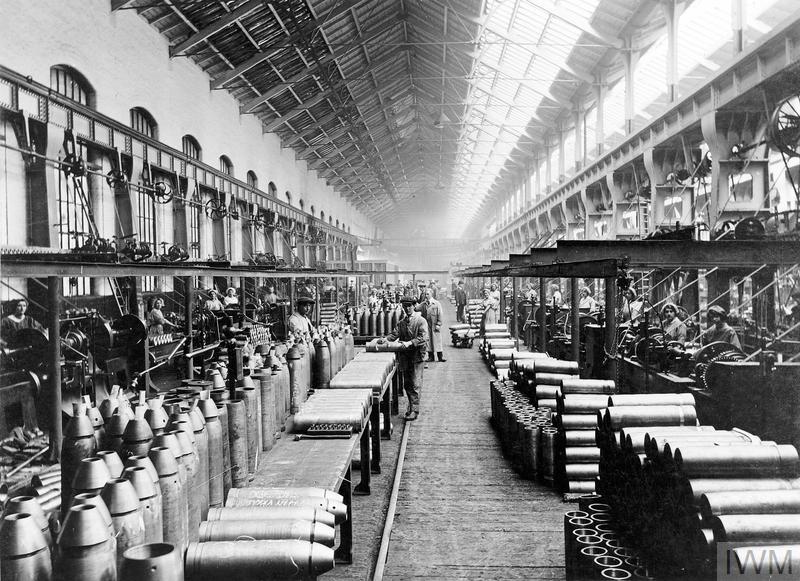
Over 600,000 women were employed in previously male dominated work roles, often working alongside men in reserved occupations. Women made a valuable contribution to the work force working in mills, mines, factories and also in the hazardous ammunition industry.


Women munitions workers at the works of the Yorkshire & Lancashire Railway Company at Horwich, Bolton in 1917.

© IWM (Q 109907 )

Women munitions workers, alongside their male counterparts, produce 6-inch high explosive shells at the works of the Yorkshire & Lancashire Railway Company at Horwich, Bolton in 1917. Many companies switched to making munitions during the war, as well as welcoming more women into their workforce.


It was more important than ever to keep the home fires burning and to do that the country needed fuel. Something that is close to my heart is the Wigan Coal and Iron Company which employed many members of my own family.


My great grandmother was Pit Brow Lass in the latter part of the nineteenth century working at 

Blundells Colliery in Wigan which formed part of  Wigan Coal Field.


Women pit brow workers of the Wigan Coal and Iron Company, 1918.

Women pit brow workers of the Wigan Coal and Iron Company, 1918.
© IWM (Q 28302)

 These women sorted coal and moved heavy tubs on the surface of a coal mine – work that was dirty and physically demanding. Jobs like these had been done by working class women before the war and continued to be important in wartime.


 The Making of Tyres

© IWM (Q 28232)
Women workers at the factory of Charles Macintosh & Sons in Manchester make tyres for motor vehicles. The company produced a wide range of vital rubber products, including mouthpieces for gas masks issued to soldiers. Making these products required technical skill.


~****~

Sunday, 29 January 2017

Sunday WW1 Remembered..


The role that women played during the First World War must not be forgotten.

Women not only kept the home fires burning but also from 1917 they could be found, for the first time, in a military role.


The Women's Army Auxiliary Corps


© IWM (Art.IWM PST 13171)


In January 1917 the first women were recruited into the British Army to serve in a non-nursing role. The Women's Army Auxiliary Corps (WAAC) provided a range of duties for the army including cooking, vehicle maintenance and clerical duties, thus enabling more men to take up a fighting role. In 1918 Queen Mary became the patron of the WAAC and the corps were renamed as the Queen Mary's Army Auxiliary Corps (QMAAC).


BBC Schools World War One


Although recruiting women into the army wasn’t popular, by March 1917, commander-in-chief of the British Army, Sir Douglas Haig, realised that women could play a vital role in the British Army stating “the principle of employing women in this country (France) is accepted and they will be made use of wherever conditions admit.”

The WAAC was organised into four units, cookery, mechanical, clerical and miscellaneous. The War Office confirmed that any job given to a member of WAAC, had to result in a man being released for front-line duties.

Pay in the Women’s Army Auxiliary Corps was reliant on the work done. In the lower ranks, unqualified work was paid at the rate of 24 shillings a week. Shorthand typists could get 45 shillings a week. Money was also deducted per week for food although uniforms and accommodation were free.

There were no officer ranks in the WAAC as it was deemed that only men could achieve commission status, however, over 57,000 women enrolled and often worked very close to danger at the front-line. Three military medals for gallantry were subsequently awarded to women.

The QMAAC was eventually disbanded in September 1921.


The Women’s Royal Naval Service (WRNS) was formed in November 1917, with 3,000 women.  

The Women’s Royal Air Force (WRAF) was born on 1 April 1918 with the Royal Air Force. Members of both the WAAC and WRNS transferred to the new service, which grew to 32,000, serving at home and in Germany and France. They undertook mechanical and technical roles as well as cooking, driving and administration.  The WRAF and WRNS were both dissolved in 1920.


~***~