April 23 2014
is the 450th anniversary
of the birth of
23 April 1564 - 23 April 1616
 William Shakespeare
Wikipedia
William Shakespeare
Wikipedia
It is not in the stars to hold our destiny but in ourselves
Whilst the actual date of Shakespeare's birth is not known, it has been assumed that he was born on or around 23rd April. His baptism date is given as the 26th April 1564. Born and brought up in Stratford-upon -Avon, Shakespeare married Anne Hathaway at 18 and had three children, Susanna, and twins Hamnet and Judith.
By 1585-1592, Shakespeare was in London making a career as a writer, playwright and part owner of a company of players, known as The Lord Chamberlain's men, later known as The King's Men.
Producing most of his work between 1592 -1613, he at first wrote comedies and histories, but by the end of the 16th century he was writing tragedies and tragicomedies and was collaborating with other playwrights.
He died in 1616 and is buried at the Holy Trinity Church Stratford-upon-Avon and is also commemorated at Poet's Corner in Westminster Abbey, London.
***
I recently reviewed two books which feature William Shakespeare as one of the leading characters.
 |
Myriad Editions
March 2014 |
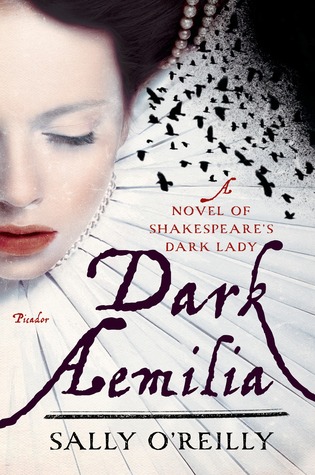
Aemilia Bassano, the daughter of an impoverished court musician, uses her intelligence and her considerable beauty to make her way amongst the upper echelons of Elizabethan high society. As the mistress of Henry Carey, Lord Hunsdon, the patron of Shakespeare’s theatre company, Aemilia, is soon noticed by the charismatic playwright William Shakespeare, and it is this abiding love/hate relationship between Shakespeare and Aemilia which is the real focus of the story. There is much debate about the identity of the mysterious ‘Dark Lady’ who features in the sonnets of William Shakespeare. This novel cleverly explores the alleged fascination which the playwright had for Aemilia Bassano, and it is entirely possible that she could have been muse and his one true love.
Beautifully written, with a real authenticity, the story reads like a time travel journal, and effortlessly takes the reader into the very heart of Elizabethan London, to a land alive with political mayhem and society scandal. The glitterati of the great, and the not so good, of Elizabeth’s court are shown as bright and brittle butterflies, who flit into and out of the story with comparative ease, and yet, it is in the minutiae of daily life where the story really comes alive. With comparable ease, we are taken from the squalor and stench of death-carts and plague-pits, through to the posturing and raucous swagger of the actors who parade centre stage at the Globe theatre. Throughout the novel, there is an authentic ripeness to the narrative with the inspired use of colourful and slightly risqué language, which helps to support the time travel idea, and thankfully, there is a good glossary which places the vocabulary into context.
There is no doubt that Aemilia’s unrivalled charm, wit and intelligence gave her the impetus to become the first professional female poet, and yet, it is her struggle for control, appreciation and survival in a male dominated world, which is her lasting legacy.
 |
Polygon
February 2014 |
This imagined autobiography of
the life of the eminent bard starts as William Shakespeare, on his death bed, attempts
to exit this mortal coil by recounting his life story to his lawyer Francis
Collins. Making sense of this enigmatic playwright’s life and times is no easy
feat and the author has done a commendable job in fleshing out the details of
Shakespeare’s life from his early childhood in Stratford, through to adulthood amongst
the glittering court world of Elizabethan politics and Jacobean skulduggery.
There is no doubt that the author
has done his research extremely well and has unearthed snippets of Shakespeare’s
life which shows that the bard lived a colourful and extremely lively
existence. There are some lovely descriptive accounts of both Elizabethan and
Jacobean England when the glittering prose really does leap off the page and by
leaving nothing to the imagination the sights, sounds and smells of the era really
do come gloriously alive.
There is a compelling lyricism to
the narrative which is rather poetic and it certainly has more than enough
historical content, in fact, there were times when I forgot that the book was a
novel as it is presented more like a non-fiction account and some of the lovely
literary prose is achingly reminiscent of some of Shakespeare’s own writings.
I’m not sure that this book will
appeal to reading groups per se unless they have a real interest in complex
historical content. My view is that this book stands rather as a multifaceted
personal read and more as one to be savoured slowly rather than read at full
speed.
Both these book were originally reviewed for
newbooks - the magazine for readers and reading groups
*~*~*