Showing posts with label Susan Grossey. Show all posts

Thursday, 15 January 2026

๐Ÿ“– Book Review ~ Whipster by Susan Grossey

31 October 2025
Cambridge Hardiman Mysteries #3

Thank you to the author for the copy of this book

 
With the University preparing for Michaelmas term in 1827, Cambridge is alive with promises of fortunes to be made. University constable Gregory Hardiman has neither the appetite nor the funds to invest, but many others are tempted by the gleam of Bolivian silver. On patrol one evening Gregory is called to a violent incident at an inn, and before long his enquiries lead him to several of the town’s best-known figures – including the Master of St Clement’s College.

Struggling to make sense of what he has learned, Gregory himself is targeted as someone threatens to blackmail him. And with a chance of happiness once again within his grasp, can he risk losing it all if his past is revealed?


๐Ÿ“–My Review..


Cambridge 1827 and as the town readies itself for a new term Gregory Hardiman continues to combine his duties as ostler at the Hoop inn together with the role of university Constable. On one of his nightly patrols Hardiman is called to an inn in town where he witnesses the results a violent crime and is dismayed to discover he recognises one of the victims. However, it would seem that whilst seeking out the evil within his midst he upsets someone who has the power to shatter Hardiman’s well guarded secrets. With his usual keen eye for sleuthing Hardiman sets about discovering who was responsible for this heinous crime and in doing so he  uncovers a a sorry tale of blackmail, corruption and deceit.

It’s been a real pleasure to be back in company with Hardiman, he’s such a steadfast man, filled with a genuine need to help others and has a keen eye for seeking out the truth. He cleverly spots charlatans and miscreants and does his utmost to bring them to justice but is always aware of the fickleness of human nature. There is such a strong sense of historical authenticity that whilst reading I feel as if I am whisked away to walk the dark streets with Hardiman as he maintains his role as university Constable finding trouble in the shadows and hidden passageways of Georgian Cambridge.

The eponymous Whipster on whom the story revolves is written with a fine eye for historical detail and an uncanny knack of bringing the smallest detail to life. I must admit to sneaking to the back of the book to the excellent glossary in order to look up the meaning of the word and it fits the story perfectly.

☕️ Best Read with: A strong coffee and a couple of generous slices of damson loaf


About the Author


Susan Grossey is the author of the successful Constable Sam Plank series of historical novels set in the early part of the nineteenth century. Sizar is the second novel in the Cambridge Hardiman Mysteries, set in Cambridge in the 1820s and narrated by a university constable called Gregory Hardiman.


X@SusanGrossey 


Monday, 23 October 2023

๐Ÿ“– Book Review~ Ostler by Susan Grossey


21 August 2023

Cambridge Hardiman Mysteries #1

My thanks to the author for my copy of this book


After the horrors of war against the forces of Napoleon and the hardships of guarding convicts in Australia, ex-soldier Gregory Hardiman is enjoying the quiet life of an ostler at a Cambridge coaching inn, with only the occasional nightmare to disturb his sleep, and memory of lost loves to disturb his waking hours. But when the inn’s cook is found drowned in the river in the spring of 1825 and his distraught widow pleads for help, Gregory finds himself caught up in the unexpectedly murky world of college life in the town. As fine wines and precious artworks disappear from St Clement’s College, he navigates uneasily between the public world of the coaching inn and the hidden life behind the high walls of the college. And when a new law requires the university to create a cadre of constables, will Gregory take on the challenge?

๐Ÿ“– My Review..

I’ve just spent an enjoyable few days in nineteenth century Cambridge in company with Gregory Hardiman as he goes about his work as the ostler at the Sun Hotel. This is a responsible position, tending to the horses and ensuring that coaches bound for London, and beyond, leave for their journeys on time. Ex-soldier, Hardiman is a conscientious man, consistent in his work and generous with his time and always with an obligation towards those less fortunate than himself. When the body of George Ryder, the Sun Hotel’s cook, is found in the river, Hardiman senses foul play and is determined to find out more. This investigation takes Hardiman deep into the heart of the Cambridge Colleges and to a complex mystery involving, theft, deception and murder.

Beautifully written by an author whose knowledge of Cambridge, and impeccable research, brings this nineteenth century world alive in such a way that place and people bound into life. The story wraps around you with ease and at each step of the mystery a little bit more is revealed, not just about Hardiman, who I am sure we will discover more about as the series progresses, but also about the intricacies of nineteenth century life in a bustling collegiate town. Mysteries and complexities abound, and throughout, stalwart and steadfast, Hardiman goes quietly about his business, methodical in his manner and naturally trustworthy. His easy affability draws people to him and yet there are complexities within him and secrets we have yet to discover.

Villians, rogues, pugilists and academics vie for attention as we are drawn deeper into a complicated crime mystery and a story which entertained from first page to last. I’m already looking forward to spending more time with Gregory Hardiman in future historical crime mysteries.


About the Author


Susan Grossey is the author of the successful Constable Sam Plank series of historical novels set in the early part of the nineteenth century. Ostler is the first novel in the Cambridge Hardiman Mysteries, set in Cambridge in the 1820s and narrated by a university constable called Gregory Hardiman.


Thursday, 23 June 2022

Author in the Spotlight ~ Susan Grossey


It is my great pleasure to welcome back to Jaffareadstoo, author


Susan Grossey 


Susan has recently brought her long running, and very successful, crime series about Constable Sam Plank to an end and is about to embark on a new venture.  Here Susan shares her love for Sam and the excitement and anticipation for the new series.


Serial offender: my love of the book series


Many of the best things in my life have been happy accidents: meeting my husband (he gate-crashed a party so shouldn’t have been there), buying our house (the seller’s girlfriend left him the week after they finished renovating and he couldn’t bear to stay) – and writing the Sam Plank Mysteries, a seven-book series. I did not intend to write a series: as far as I was concerned, “Fatal Forgery” was a standalone novel – and having completely rewritten it to change the narrator, frankly I was glad to see the back of it. But that new narrator, a well-meaning, slightly crusty, deeply honourable magistrates’ constable called Sam Plank… I just couldn’t get him out of my mind. And after only a month or two he popped back into my brain with another story to tell, and quickly let me know that he was in it for the long haul. Over nine years I have written seven Sam Plank books, finishing the series with number seven – “Notes of Change” – in April 2022.


I am secretly glad that I didn’t know from the beginning that there would be seven linked books (albeit with standalone plots) – the prospect would have been petrifying. Although I have always been fascinated by the idea of continuing characters, I knew it would be hard work: do the screenwriters for “Coronation Street” and “Eastenders”, for instance, have the most enormous wall of Post-It notes, showing all the family connections and plot intricacies, to make sure that no-one accidentally sleeps with their sister? And it has certainly been a mental puzzle – but one that I have grown to love. I have fulsome notes on each of the major characters – hair colour, favourite meals, childhood memories – to ensure consistency. I have several maps of London (thank you, Transport for London – your free cycling maps have been a boon!) carefully marked with locations (and notes of any changes of street name since the 1820s – more common than you might imagine). And my own author copies of the novels bristle with sticky page markers, highlighting important revelations that should be echoed or addressed or resolved in later books.

But the benefits of writing a series far outweigh the difficulties. First and foremost, I have been able to spend almost a decade with the characters I love. I have had the luxury of watching them develop and grow and learn and change. I have seen friendships blossom and love grow slowly – and I have watched grief take hold. I have enjoyed seeing my own knowledge deepen. In the beginning, it was a slog, this historical setting lark – I couldn’t write “she poured him a cup of tea” without checking (a) could a man and woman be alone in that setting, (b) would people of their class and wealth have cups, and (c) did people in 1824 drink tea at that time of day? It took forever to write a single chapter, as I was determined to get it right – and I do so love my research. But by book seven I am fairly confident that I know enough about late Regency London to write a convincing and accurate description, which is intellectually extremely satisfying as an author. And then of course there are the readers: they are a small band, but loyal. As soon as a book is published, I get emails asking when the next one will be out – Sam’s wife Martha seems to have a particularly vociferous fan-club. I love the idea that we have created this alternative world of made-up characters that we all share.

As I say, the final Sam Plank book is now out. But writing seven books has not cured me of my obsessions with financial crime, or the 1820s, or early policing, or indeed book series. And so I have now embarked on another series. This will be a five-book series (that’s the plan…) set again in the 1820s, but this time in my hometown of Cambridge and narrated by a university constable called Gregory Hardiman. Knowing from the outset that it will be a series – and with hard-won wisdom from the Sam Plank series behind me – has certainly informed how I am working. I already have separate notes files for each character and each plot, and (six chapters in) I am knowingly “saving” information for later – I don’t feel I have to tell the readers everything about Gregory right up front. It is rather like a new friendship: I am enjoying getting to know him – and Cambridge in the 1820s – slowly and carefully, as I look forward to at least five years in his company.


Susan Grossey has made her living from crime: for twenty-five years she ran her own anti-money laundering consultancy, indulging her fascination with financial crime. And now she feeds her obsession by writing historical crime fiction dealing with such nasties as blackmail, counterfeiting, fraud and art crime. She has spent years haunting the streets of late Regency London, in the company of magistrates’ constable Sam Plank, who operates in the fascinating policing period after the Bow Street Runners and before the Metropolitan Police. The fourth Sam Plank novel – “Portraits of Pretence” – was given the “Book of the Year 2017” award by influential book review website Discovering Diamonds. And the fifth – “Faith, Hope and Trickery” – was shortlisted for the Selfies Award 2019. Susan lives in Cambridge with her gate-crashing husband and cat/critic Maggie.

“Fatal Forgery” – the first Sam Plank novel – is currently available as a free e-book on Amazon (and all other e-book retailers).


If you want to get a monthly update on the research Susan is doing (with a free Regency glossary as a sign-up bonus), you can sign up here 


Twitter @ConstablePlank


Huge thanks to Susan for being our author in the spotlight today
and for sharing her Sam Plank stories with me over the last few years.


Wednesday, 1 June 2022

๐Ÿ“– Featured Book of the Month ~ Notes of Change by Susan Grossey


In the autumn of 1829, the body of a wealthy young man is found dumped in a dust-pit behind one of London's most exciting new venues. Constable Sam Plank's enquiries lead him from horse auctions to houses of correction, and from the rarefied atmosphere of the Bank of England to the German-speaking streets of Whitechapel. And when he comes face to face with an old foe, he finds himself considering shocking compromises...

The new and highly organised Metropolitan Police are taking to the streets, calling into question the future of the magistrates' constables. Sam's junior constable, William Wilson, is keen, but what is an old campaigner like Sam to do when faced with the new force and its little black book of instructions?


๐Ÿ“– My Review...

Few reviews have given me as much pleasure to write than those of the Constable Sam Plank series of historical crime novels. I first started my journey in 2013 when a new author approached Jaffareadstoo to read and review, Fatal Forgery, the first book in a proposed seven book series. 

Always happy to give new authors a chance, I very quickly realised that this series was historical gold and have lost count at how many times I have recommended the books, delighting in each adventure and engrossed as soon as I opened the page at Chapter One. Getting to know Sam, his wife, Martha, and his assistant, William has been a joy, and as each subsequent story took me deeper into the mean and moody streets of Regency London, so I became engrossed in Sam's valiant quest for justice for the community which he serves so stoically.

So it was with an element of bitter-sweetness that I approached Sam's last adventure on the streets of London, a place which he has made pretty much his own. Notes of Change starts when Constable Plank and his assistant, William are called to investigate the mysterious death of a young man who has been found close to one of London's newest establishments. That there is something suspicious about this death is obvious and Sam's investigation will take him into the dangerous world of gambling and the heinous crime of counterfeiting. 

As with any last book in a long running series there is a sense of the tying up of loose ends, I was especially pleased to see the brief return of an old character, and with the formation of the newly formed Metropolitan Police Force there is definitely a change in the air for both Sam and William as each ponders their future.

Finishing the book with an air of sadness but also the satisfaction which comes from a story well told, I took the time to acknowledge the skill of this wonderfully talented author who has fed my imagination with bright and bold stories, rich in Georgian history, and ferociously alive with intrigue. Jaffareadstoo is especially honoured to have been quoted both on the inside of the books and also to be featured on a couple of the book covers.

Meticulously researched, and beautifully written as ever, I have no hesitation in making Notes of Change my Featured Book of the Month in June.


๐Ÿ“– Best Read with... tankard of dark ale and a generous slice Mrs Plank's rabbit pie.


Discover more about Susan's writing and the world of Sam Plank


Twitter @ConstablePlank


Sunday, 9 February 2020

Sunday Brunch with Jaffareadstoo ~ Susan Grossey


On this quiet Sunday morning why don't you put the kettle on, make your favourite breakfast, and settle down for Sunday Brunch with Jaffareadstoo


 I'm delighted to welcome author, Susan Grossey


☼ Good Morning, Susan. Happy Sunday!


What favourite food are you bringing to Sunday brunch?

My very favourite brunch dish is a stack of Eggo waffles (available in the frozen aisle of any cheap American supermarket, and a Proustian memory from staying with American friends when I was little) with maple syrup carefully drizzled into each little square.


Would you like a pot of English Breakfast tea, a strong Americano, or a glass of Bucks Fizz?

None of those: please may I have a large glass of iced tea with plenty of ice? I’m teetotal and I can’t bear hot drinks.


Which of your literary heroes are joining us today?

I’d like to bring Jo March from “Little Women”, for her determination to succeed as a writer and her ability to put her foot in it, and Paddington Bear, for his sunny nature, his politeness, and his ability to put his foot in it. I would bring Ross Poldark too, but I’d be too distracted and would drool unbecomingly.


What’s the title of the book nearest to you?

“Girl in a Green Gown” by Carola Hicks – it’s a close look at the portrait of the Arnolfini marriage, currently in the National Gallery in London, and it was recommended so highly by a friend that she gave it to me (and she was right – it’s terrific)


12587805


What’s the oldest book on your book shelf?

A complete set of the Poldark novels, which were owned by my mother when she was a young woman


Which book do you really want to read but haven’t had time for …yet!

“Middlemarch” by George Eliot – everyone tells me it’s wonderful


19089


Do you have a guilty reading pleasure, and if so will you tell us about it?

I download free romances onto my Kindle – usually American, and often involving a damaged man (fireman, farmer, rancher, fisherman – strong but with a soft centre) and a woman who shows him how to love again. They’re uniformly ghastly and predictable, but I just can’t resist.


If the house was on fire which book would you rescue?

“The Little White Horse” by Elizabeth Goudge – I was given my worm-eaten paperback (already about third-hand by then) when I was eight and I re-read it every year


Do you have a reading/writing playlist on Spotify, or a favourite CD to listen to when reading/writing? And if so will you share with us a favourite song or piece of music that makes you feel happy?

I cannot write with any noise at all in the background – I was an only child and am used to quiet surroundings. As for songs to make me happy, anything by Abba or the Bee Gees is bound to do it.


Do you have a favourite place to settle down to read/write?

I sit on the sofa with my legs up on a footstool (a leather elephant that we brought back from holiday in Canada – not the most practical souvenir to transport…), the cat on my ankles and my laptop on my lap. It’s comfortable for about an hour until blood-flow to the feet is halted.


Give us four essential items that a writer absolutely needs?

This writer absolutely needs silence, chocolate biscuits, a laptop (my handwriting is shockingly messy these days) and the encouragement of good friends


What can you tell us about your latest novel, or your current work in progress?

I am about to embark on a new series of books – five historical crime novels set in Cambridge in the 1820s – so I am at the very beginning of my research, which is both daunting and exciting. I’m looking forward to creating/meeting a whole new cast of characters.


Where can we follow you on social media?


• Twitter handle: @ConstablePlank


• Blog/web url: www.susangrossey.wordpress.com


Saturday, 30 November 2019

His Fic Saturday....Heir Apparent by Susan Grossey


On Hist Fic Saturday


Let's go back to ...London,1829


A young man returns to London from the family plantation in the Caribbean after an absence of six years to be at his father’s deathbed – and to inherit his estate. But is the new arrival who he says he is, or an impostor? Anyone who doubts his identity seems to meet an untimely end, but his sister swears that he is her beloved brother.With their investigations leading them into the complicated world of inheritance law and due process after death, Constable Sam Plank and his loyal lieutenant William Wilson come face to face with the death trade and those who profit from it – legally or otherwise. Among them is an old enemy who has used his cunning and ruthlessness to rise through the ranks of London’s criminal world. And, in this sixth novel in the series, it’s now 1829: as plans progress for a new police force for the metropolis, Sam and his wife Martha look to the future. 


What did I think about it..

It’s always such a treat to kick off my shoes, brew a large cup of my favourite Darjeeling tea, and relax with the latest Sam Plank adventure, safe in the knowledge that I am about to enter into the life of this most intriguing of constables in another well imagined historical crime adventure. Heir Apparent is now the sixth book in the series and Sam and his wife, Martha are as familiar as old friends, as indeed, is young constable, William Wilson, who we have witnessed coming into his own in the last few stories.

In this penultimate book in the series, Plank and Wilson face an inordinate amount of mysterious deaths which seem to focus on the problems facing a well to do family and the return of a prodigal son. Dipping into the complicated process of inheritance law, both Plank and Wilson need to keep, their considerable, wits about them as they seek to find reasonable cause for doubt in a complex criminal case which gets more and more complicated which each successive turn of the page.

There’s an authenticity to the characters, particularly Sam, and his wife, Martha, which not only makes these stories such a joy to read, but which also gives such an imagined insight into life in the capital in the early 1800s so that it really does feel as though you are moving in tandem with Plank, Martha, and the intrepid Wilson as they go about their business, forever trying, and usually succeeding, to live their lives in the full glare of the criminal fraternity. Sam Plank is such an out and out good guy that you feel, entirely comfortable in his presence, and undoubtedly it is his strong reliability which brings these stories to glorious life.

Once again in Heir Apparent, the author has given us an adventure which takes us on a riotous journey through London, and beyond, into a dangerous criminal underworld of forged identity, dastardly dealings and general skulduggery. The historical research is impeccable, the nature of the crime is explained in minute detail and the way in which the mystery is solved is expertly concluded in a way which has you nodding your head in wry agreement. As always the author brings time and place vividly alive and it is no exaggeration when I say that the Sam Plank Mysteries are perhaps one of the best historical crime series I have read. 

I had a little bit of a lump in my throat when I finished the story as it is obvious that there are significant changes on the way with the formation of the new Metropolitan Police Force, what this means for Sam, Martha and Wilson we must wait to find out in the last book in this exceptional historical crime series.


Read a fascinating interview with Susan here


Discover more about Susan's writing and the world of Sam Plank


Twitter @ConstablePlank


Friday, 25 October 2019

☆Author Spotlight ~ Susan Grossey☆


It gives me great pleasure to welcome Susan Grossey back to the blog. 
Susan is the author of the wonderful Sam Plank series of historical financial crime novels.


Hi and welcome, Susan. This is now the sixth book in the Sam Plank series of historical crime novels - will you tell us where you got the inspiration for Sam and is he based on anyone you know?

I was doing some research for a client into the history of their bank and I came across the story of a corrupt London banker in 1824. As I was reading his story, I found that he was arrested by something called a “magistrates’ constable”, which piqued my interest (as I am a magistrate myself and had never heard of such a thing). It turns out that magistrates’ constables existed only for a couple of decades, chronologically between the Bow Street Runners and the Metropolitan Police, and their duty was to execute warrants issued by magistrates. They had no investigative powers and detection had yet to be invented, and yet they had a great impact on reducing levels of crime in the capital. I turned to one of the greatest resources for a writer of historical crime fiction – the transcripts of trials at the Old Bailey, which have been digitised – and found that magistrates’ constables were often called to testify. And in my browsing through these transcripts, I came across a fellow (not a constable, just a layperson witness) called Sam Plank – and I thought it was just the perfect name for a solid, dependable, honest Englishman. So Sam is an amalgamation of all the magistrates’ constables and his name is pilfered from someone else!

With each successive book does the series become easier, or harder, to write and at the start of the series did you have a plan on how Sam’s character would evolve?

When I wrote “Fatal Forgery” – the first Sam Plank story – I had no idea it would lead to a series. In fact, “Fatal Forgery” was first written from the point of view of the banker, not the constable, and then I completely re-wrote it when I realised that the constable was the more interesting character. And by the end of that book I had fallen in love with Sam. I couldn’t face life without him and decided that he could have some more adventures – one per year from 1824 to 1829, when his role was swept away by the creation of the Metropolitan Police. As for the evolution of his character, I have let Sam take the lead. In each book I try to reveal something significant about him – why he became a constable, for instance, or how he met his wife Martha, or how they feel about having no children, and (in this latest outing, “Heir Apparent”) how he copes with the imminent disappearance of his job.

When combining historical fact with fiction it must be quite a challenge to get the balance right. How do you manage this without compromising on authenticity?

I have a very clear policy that I follow: if something is known to be true (e.g. John Conant was the Chief Magistrate at Great Marlborough Street and had a home in Portland Place) then I have to stick to that truth, but if something is uncertain (e.g. how many children the banker in “Fatal Forgery” had) then I am allowed to speculate and fill in the gaps, as long as it fits in with what we do know. London is a joy of a location for the historical fiction writer, as – if you look above shopfront level – so much of it is still in evidence. Mind you, I do have to be careful about street names, as these change; I always refer to the 1827 map of London that was created by the great mapmaker John Greenwood (and is searchable online via the library at Harvard in America – the wonders of modern technology!).

Talk us through your experiences as a self-published author. Why did you go down this route?

When I finished “Fatal Forgery” I did try the “traditional” publishing route – I sent the book to nine agents and publishers. And they all replied with the same answer: it’s a good story, well-written, but we won’t be able to sell it because no-one is interested in financial crime. I thought that was rubbish, because I work every day with people who are fascinated by financial crime, and the self-publishing industry was just taking off. So I decided to go it alone, and it has been an absolute blast – I have loved every minute of indie publishing. You can pick and choose which bits of the process you want to do yourself (I’m very happy with formatting the inside of the book, using a template that I have bought) and which bits you want to farm out (I have no artistic eye and so I use the marvellous team at Design for Writers to create my covers), and you have the satisfaction of knowing that you have created something from scratch.

I know that you fit in writing your novels around your ‘day job’ – how easy is it to combine the two and do they ever overlap?

My day job is as an anti-money laundering consultant – I advise businesses on how to avoid criminal money. So the overlap is a complete obsession with financial crime – the awful things that people do for money, and why they do those awful things simply for money. We think that we modern folk have invented financial crime but all that has changed is the technology: there have been corrupt bankers since banks were invented, forgers and thieves since money was invented, and fraudsters and victims since investment was invented. And I enjoy spending my work life looking at the modern versions and my writing life looking at the historical ones. People have always been greedy, amoral, sneaky, naรฏve and desperate – and financial crime is the result.

When I read the stories I have a definite image of Sam in my head. If the Sam Plank series were optioned for a TV drama, and I really think it should be - who would you choose to play Sam?

I’m a bit nervous about this, if you have your own image of Sam, but I have always thought that Brendan Coyle and Claudie Blakley would make the perfect Sam and Martha – they were married in “Lark Rise to Candleford”, so I know they can do it! And as for a Sunday evening drama, wouldn’t that be perfect?


The latest book, #6 in the series 

Heir Apparent was published 13 October 2019


48395241. sy475


A young man returns to London from the family plantation in the Caribbean after an absence of six years to be at his father’s deathbed – and to inherit his estate. But is the new arrival who he says he is, or an impostor? Anyone who doubts his identity seems to meet an untimely end, but his sister swears that he is her beloved brother.With their investigations leading them into the complicated world of inheritance law and due process after death, Constable Sam Plank and his loyal lieutenant William Wilson come face to face with the death trade and those who profit from it – legally or otherwise. Among them is an old enemy who has used his cunning and ruthlessness to rise through the ranks of London’s criminal world. And, in this sixth novel in the series, it’s now 1829: as plans progress for a new police force for the metropolis, Sam and his wife Martha look to the future.


Discover more about Susan's writing and the world of Sam Plank


Twitter @ConstablePlank


☆Huge thanks to Susan ( and Sam) for being the author in the spotlight today 


Saturday, 30 June 2018

Hist Fic Saturday ~ Faith, Hope and Trickery by Susan Grossey


On Hist Fic Saturday


Let's go back to ...1828


39340770
CreateSpace Independent Publishing Platform
March 2018
Investigating Crime in Regency London


It's never too late to join Constable Sam Plank as he patrols the mean, and it must be said, often moody streets of Regency London. In this, his fifth adventure, Sam and his assistant Constable, William Wilson, find themselves drawn into the mysterious world of religious meeting houses. Shadowy places where the vulnerable go to find comfort and hope in messages from loved ones who have departed this life. When Sam's wife, Martha, gets drawn into this eerie world, Sam is determined to discover as much as he can about the enigmatic preacher, John Buxton and of the perplexing women, known as ‘heralds’, who receive messages from the dead.

As always, from the very first page, the world of Regency London springs into action and Sam’s patch around Great Marlborough Street takes shape, whether it be serving warrants on behalf of the magistrate John Conant, or attending the scene of a grisly murder, Sam does so with his usual steadfastness and meticulous attention to even the smallest of detail. There’s an inherent dependability about Constable Plank which shines through in every novel and yet, I think that in Faith, Hope and Trickery we see an altogether more vulnerable Sam which is centred on Martha’s unusual susceptibility and of his unerring need to protect her. We rarely go behind the bedroom door of this marriage; there has never been a need before, so it was really interesting to see how this crack in their relationship altered the perceived intimacy between them, something which, perhaps, we have taken for granted in previous novels.

The mystery at the heart of the novel, is as ever, beautifully explained and so meticulously detailed that nothing is ever left to chance and everything flows like the wheels of a well oiled machine. And such is the great partnership which exists between Sam and Wilson that it's an absolute joy to see them continue to work so well with each other.

Beautifully written and impeccably researched, Faith, Hope and Trickery takes us into the very heart of teeming London. Whether it be taking a Hackney coach to the religious meeting place at Cooper’s Gardens in Bethnal Green or visiting the criminally insane in the confines of the notorious Bethlem Hospital, I always know that, travelling alongside Constable Plank as he goes about his purposeful business, I am always going to be held in a safe pair of hands. 

From the minute I opened Faith, Hope and Trickery, cup of tea in hand, I relaxed, safe in the knowledge that neither Sam, nor his creator, will ever let me down.


Susan Grossey has written five Sam Plank novels, set in subsequent years in the 1820s: “Fatal Forgery”, “The Man in the Canary Waistcoat”, “Worm in the Blossom”, “Portraits of Pretence” and “Faith, Hope and Trickery”.


Fatal Forgery (Sam Plank #1) 23474400 Worm in the Blossom (Sam Plank #3) 32619973 


Susan has her own blog here

You can purchase her novels (in paperback and various e-editions) here

And you can follow Sam himself on Twitter, where he appears as @ConstablePlank


Monday, 16 January 2017

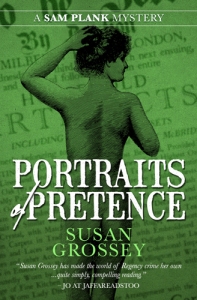
Review ~ Portraits of Pretence by Susan Grossey


32619973
CreateSpace Independent Publishing Platform
2016

A bit of book blurb..

An elderly French artist is found dead in his rooms in London clutching a miniature portrait of a little girl. Intrigued, Constable Sam Plank delves into the world of art dealing and finds himself navigating the fragile post-war relationship between England and France. What is the link between this and the recent attacks on customs officers in London Docks? And will a beautiful mademoiselle put paid to Martha Plank’s matchmaking?
In this fourth novel in the Sam Plank series, set in the chilly spring of 1827, Plank and his junior constable William Wilson meet Frenchmen in London and daring blockademen in Kent to uncover smuggling and even more dangerous ambitions,


My thoughts about the book..

There are a collection of authors in my arsenal of ‘authors who will never let me down’ and I can officially say that Susan Grossey is now firmly placed in this category. The whole of the Sam Plank series of Regency crime novels have been an absolute joy to read and this fourth outing by Constable Sam and his able assistant Wilson is just as exciting as the previous three books.

The chilly spring of 1827 sees Sam and his junior constable, William Wilson, investigating the unexplained death of an elderly French artist who has been found dead in mysterious circumstances. The only clue left at the scene is an exquisite miniature of a young girl which the old man is clutching in his hand. Given the unusual circumstances surrounding this death neither officer will leave any stone unturned until the mystery is solved to their satisfaction. However, dabbling in the complicated world of art reveals far more questions than it does answers, and Plank and Wilson soon find themselves drawn deeper and deeper into a shadowy criminal underworld filled with conspiracy and dangerous secrets.

Confident in his ability, Constable Plank strides the streets of London with all the self-assurance of a man who knows his place in the world. He strives for justice and truth in an entirely commendable way, and his integrity and honesty shines through with every word that this author so lovingly shares with her readers. What I enjoy most about this series is the way that the world of Regency crime comes alive in the imagination, so that it becomes an entirely believable world of thieves, vagabonds, conmen and criminals who scurry and skulk within the shadows of the great city of London.

There is no doubt that the author has created a plausible and comprehensive Regency world and with each successive novel I feel as if I am returning into the bosom of a well-loved family. Sam and Martha’s thoughtful care and supervision of the ever vulnerable Constable Wilson, and of course, Martha’s marvellous ability, in moments of extreme worry, to be her husband’s still small voice of calm is, as always, written with such thoughtful attention to detail.

As one book finishes I am heartened to know that, like buses another one will be along soon, after all, the author did say that there would be seven Sam Plank stories and I am holding her to that promise. I don’t want to contemplate what I will do when this wonderful crime series comes to an end but maybe by book number seven Sam may well have put his foot down and said… “There’s more”..!


Best Read With.. A tankard or two of porter and a well roasted chop..


About the Author


You can find more about Susan and her writing by visiting her website ~ click here

Follow on Twitter @ConstablePlank or @susangrossey


Read an extract from Portraits of Pretence by clicking here 


My thanks to Susan for sharing Sam Plank's world with me and for including a "Jaffareadstoo" quote on the cover on Portraits of Pretence.

As a reader I am delighted to endorse this wonderful series.


~***~

Thursday, 27 October 2016

Guest Author ~ Susan Grossey


It's always a real delight to welcome this talented writer back to the blog as I'm a huge fan of this well written historical crime series.


Today the author, Susan Grossey is sharing an extract from Portraits of Pretence which is the latest Sam Plank adventure published on the 21st October.


Hi and welcome back to Jaffareadstoo, Susan

Tell us a little about Portraits of Pretence...

An elderly French artist is found dead in his rooms in London clutching a miniature portrait of a little girl. Intrigued, Constable Sam Plank delves into the world of art dealing and finds himself navigating the fragile post-war relationship between England and France. What is the link between this and the recent attacks on customs officers in London Docks? And will a beautiful mademoiselle put paid to Martha Plank’s matchmaking? In this fourth novel in the series, set in the chilly spring of 1827, Plank and his junior constable William Wilson meet Frenchmen in London and daring blockademen in Kent to uncover smuggling and even more dangerous ambitions.


And here's a tantalising extract which I'll let Susan introduce..


The book is set in the spring of 1827 and this extract comes from the second chapter of “Portraits of Pretence”, after Sam has found a miniature portrait of a little girl clutched in the hand of a dead artist. Keen to learn what made the picture so precious to the dead man, Sam takes it to a curio dealer in Piccadilly.


"...The curiosity dealer certainly practised what he preached.  In the room where I waited, every surface was covered with ornaments, statuettes, gilt boxes and coins, while the walls displayed drawings and paintings of every size, from grand landscapes to tiny, intimate sketches.  There was even a pair of miniature portraits side by side near the mantelpiece and I was just walking over to examine them when the door opened and the maid said that Mr Causon would receive me in the drawing room.
In his sombre black jacket and snowy cravat, Henri Causon stood in sharp contrast to the profusion of colour and excess in his drawing room, which was even more filled with examples of his trade than the parlour I had just left.  He was a tall man with defined features, in particular a long, straight nose down which he looked at me now.  He came toward me and bowed before putting out his hand.
“After many years in your fine city, Constable Plank, I have learned how the Englishman does love to shake hands.  With this firm grip, you can tell that I am a man to be trusted, no?”
“I can tell that you are a man not armed with a sword,” I replied.
“Which is also useful to know,” he said with a smile.  “Come: you will join me in a little cognac before we turn to business.”  It was a statement rather than a question, and I took a seat on the small sofa that he indicated.  He poured two measures from a decanter and handed one to me.
“To your health, and to my santรฉ,” he said and raised his glass.  I did likewise.  It was an uncommonly fine wine and I looked at him in appreciation.  “All duty paid,” he said with a wink.  “One of the many benefits of the renewed friendship between our two countries.”
“You say that you have lived in London for many years,” I prompted.
“Many,” he replied.  “My late wife and I came here at the end of the last century, as did plenty of our countrymen.”  I nodded: London had provided sanctuary to many who had fallen foul of the new regime in France.  “We were young then, of course – all of us.”  He smiled at me.  “My wife died nearly twenty years ago now, and my son returned to France.  He was a babe in arms when we came to London, but he always said he felt more French.  And he died for her, for France.  Leipzig.”  I said nothing: what is there to say to a man who has lost a son?  He was silent for a moment or two and then seemed to remember me.  “I, on the other hand, well, there is little for me now in France, and so I stay.  My daughter and I, we stay.”
His mention of a daughter brought Elizabeth to mind and I put my hand to my pocket.  Causon saw the movement and put down his glass.
“Ah, you have something to show me,” he said.  He leaned towards me and I handed him the miniature.  He carefully unwrapped the cloth and held the portrait in the flat of one hand while reaching into his pocket with the other, bringing out a small oval mother-of-pearl case.  He passed it to me.
“Would you open that for me, please?” he said.
I pushed the side of the case and a magnifying lens swung out.  “A neat device,” I said, handing it back to him, but his attention was elsewhere.  He bent forward and looked closely at the miniature, moving the magnifier across it as he examined the picture itself, the frame and even the reverse.  I waited.
“Exquisite,” he said finally, still looking through the magnifier.  “The finest quality.  Where did you obtain it?”  I said nothing, and he looked up at me, blinking.  “I see, I see.  Still, no matter.  You have come to me for a professional appraisal and this I can offer.”
I took my notebook out of my pocket.  “Do you mind?” I asked.  “The memory is not always reliable.”
“It fades, does it not, constable?  The memory, the eyesight,” he waved the magnifier at me.  “It all fades.  By all means, take your notes.”  His voice became business-like in tone.  “Miniature three-quarter portrait of female child in formal wear and setting.  Watercolour on ivory.  Unknown sitter and unknown artist – which does not mean that we shall never know, constable, but simply that the work is unsigned.  Estimated date – I shall say 1800, from the look of the frame, and the way the little girl’s hair is curled.  I cannot be sure, but I would guess that it was painted ad vivum – from life, that is – or at the very least by someone who knew the child well.  The – how to put this? – the emotion of the piece would not be present in a mere copy.”
I looked up from my notebook and nodded.  “I felt that too – and my wife.  She has taken to calling her Elizabeth.”  I flushed slightly.
“Hah!”  My host smiled.  “Your wife is a woman of feeling.  Elizabeth: it suits her, I think, and will work as well in French as in English.”  He took another close look at the miniature.  “Yes, she is definitely French, our little Elizabeth.”

©Susan Grossey


You can find more about Susan and her writing by visiting her website ~ click here

Follow on Twitter @ConstablePlank or @susangrossey

Find on Amazon UK


Published by CreateSpace Independent Publishing Platform


dfw-sg-ff-cover-front-large dfw-sg-tmitcw-cover-mid dfw-sg-witb-cover-large dfw-sg-pop-cover-thumb


Huge thanks to Susan for sharing this enticing extract from Portraits of Pretence and for sharing Sam's world so eloquently.


~***~


Tuesday, 5 January 2016

Review ~ Worm in the Blossom by Susan Grossey


27202955
October 2015
CreateSpace Independent Publishing Platform


I have several writers on my selective list of authors who never let me down, and Susan Grossey is firmly placed on this list. Ever since I was introduced to Constable Sam Plank and his intrepid wife Martha, in Fatal Forgery, I have followed his exploits with great interest.  There is something so entirely dependable about Sam, that to walk in his footsteps through nineteenth century London, is rather like being in possession of a superior time travelling machine, which picks you up and drops you smack in the middle of the dark and, it must be said, rather seedy underworld of late Regency crime.

In this, now the third book in the series, Sam is faced with an altogether darker dilemma than in previous stories. During one of his nightly perusals he hears a high pitched whimper and discovers a distressed prostitute, who is obviously in an advanced stage of pregnancy. The girl’s extreme youth poses somewhat of a moral dilemma for Sam, who on realising that he cannot leave her to give birth on the streets decides that the only course of action open to him is to take her into the safekeeping of his long suffering wife, Martha.

Inevitably, this kindly action has dramatic consequences and soon Sam and his intrepid sidekick, Wilson, are entangled in a story which is rich in intrigue and alive with scheming trickery. The dark and dirty underbelly of Regency London comes alive once again, and during Sam’s investigation into moral corruption at the highest level, we enter into the disreputable and shady world of scandalous bawdy houses, and of the domain of malevolent procuresses who look for those vulnerable members of society who are too weak to resist, and of the despicable and corrupt men who exploit and abuse those who are all too susceptible to small kindnesses.

The mystery at the heart of Worm in the Blossom is dark and desperate in equal measure. It shows human nature at its worst and also at its very best. Constable Sam Plank is as ever calm and efficient; slow to anger and quick to action, valiantly fighting for the defenceless, and as always, relentless in his pursuit of fraudulent and dishonest activity, but it must not be forgotten about the strength of his supporting characters, the astute Martha who is perhaps my favourite, closely followed by the equally stoical Wilson, who must be by now, in the running for most promising assistant.

There is no doubt that Susan Grossey has made the world of Regency crime her own; the writing, is as ever, crisp and clear, no superfluous waffle, just good old fashioned storytelling, with a tantalising beginning, an adventurous middle, and a wonderfully dramatic ending, which, when all is combined, add up to, quite simply, compelling reading.

Bring on Book 4…


Best read with a tankard of dark ale and a bread roll stuffed with roast pork….


About the Author


Find Susan on her blog

Follow her on Twitter @susangrossey

You can read an interview with the author talking about her writing  - here 


My thanks to Susan for sharing Sam and his adventures with me.


~***~