Showing posts with label Regency Crime. Show all posts

Saturday, 30 June 2018

Hist Fic Saturday ~ Faith, Hope and Trickery by Susan Grossey


On Hist Fic Saturday


Let's go back to ...1828


39340770
CreateSpace Independent Publishing Platform
March 2018
Investigating Crime in Regency London


It's never too late to join Constable Sam Plank as he patrols the mean, and it must be said, often moody streets of Regency London. In this, his fifth adventure, Sam and his assistant Constable, William Wilson, find themselves drawn into the mysterious world of religious meeting houses. Shadowy places where the vulnerable go to find comfort and hope in messages from loved ones who have departed this life. When Sam's wife, Martha, gets drawn into this eerie world, Sam is determined to discover as much as he can about the enigmatic preacher, John Buxton and of the perplexing women, known as ‘heralds’, who receive messages from the dead.

As always, from the very first page, the world of Regency London springs into action and Sam’s patch around Great Marlborough Street takes shape, whether it be serving warrants on behalf of the magistrate John Conant, or attending the scene of a grisly murder, Sam does so with his usual steadfastness and meticulous attention to even the smallest of detail. There’s an inherent dependability about Constable Plank which shines through in every novel and yet, I think that in Faith, Hope and Trickery we see an altogether more vulnerable Sam which is centred on Martha’s unusual susceptibility and of his unerring need to protect her. We rarely go behind the bedroom door of this marriage; there has never been a need before, so it was really interesting to see how this crack in their relationship altered the perceived intimacy between them, something which, perhaps, we have taken for granted in previous novels.

The mystery at the heart of the novel, is as ever, beautifully explained and so meticulously detailed that nothing is ever left to chance and everything flows like the wheels of a well oiled machine. And such is the great partnership which exists between Sam and Wilson that it's an absolute joy to see them continue to work so well with each other.

Beautifully written and impeccably researched, Faith, Hope and Trickery takes us into the very heart of teeming London. Whether it be taking a Hackney coach to the religious meeting place at Cooper’s Gardens in Bethnal Green or visiting the criminally insane in the confines of the notorious Bethlem Hospital, I always know that, travelling alongside Constable Plank as he goes about his purposeful business, I am always going to be held in a safe pair of hands. 

From the minute I opened Faith, Hope and Trickery, cup of tea in hand, I relaxed, safe in the knowledge that neither Sam, nor his creator, will ever let me down.


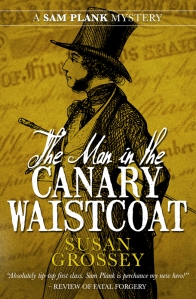
Susan Grossey has written five Sam Plank novels, set in subsequent years in the 1820s: “Fatal Forgery”, “The Man in the Canary Waistcoat”, “Worm in the Blossom”, “Portraits of Pretence” and “Faith, Hope and Trickery”.


Fatal Forgery (Sam Plank #1) 23474400 Worm in the Blossom (Sam Plank #3) 32619973 


Susan has her own blog here

You can purchase her novels (in paperback and various e-editions) here

And you can follow Sam himself on Twitter, where he appears as @ConstablePlank


Saturday, 9 June 2018

Hist Fic Saturday ~ Susan Grossey


On Hist Fic Saturday I am excited to welcome back to the blog  historical fiction writer

Susan Grossey


Susan has just published her latest historical novel, Faith, Hope and Trickery and I am thrilled that she has taken the time to talk to me about why she writes historical fiction.


Why I write historical fiction by Susan Grossey


When you think of the Regency period, what comes to mind? I’m guessing that you’re now imagining Jane Austen, or perhaps the astonishing confection that is the Royal Pavilion in Brighton, or maybe the rather portly George IV, or even any one of dozens of heated romances with titles like “The Wicked Marquis and the Innocent Maid”. And if I say “historical detective”, is it Sherlock Holmes or Hercule Poirot who leaps into view? A genre that you rarely see is a mash-up of the two – Regency detective – and yet this is precisely the space in which I find myself writing.

I cannot claim to have thought of it myself. Rather, the timing was foist upon me by real history. In my day job I work as an anti-money laundering consultant (basically, I advise institutions on how to avoid criminal money) and I was doing some research for a client into the history of banking fraud. And I came across the story of Henry Fauntleroy, a London banker who took advantage of his clients’ lack of understanding around the latest financial technology – share certificates – to pinch their assets. He was caught in 1824 and put on trial, at a time when fraud carried the death penalty. (Those were the days….) His story formed the basis of my first historical crime novel – “Fatal Forgery” – and when I realised that I had fallen in love with my narrator, Constable Sam Plank, I decided to write six more books about him. And there he was, firmly anchored in the Regency period.

But if it was not my choice, it was certainly my very great fortune – what a gift of a period! The two strands that thread through all five of the novels I have written so far (there are two more to go) are policing and finance, and both were experiencing enormous, exciting change in the Regency period. In policing terms it was post-Bow Street Runners and pre-Metropolitan Police, with London kept in check by magistrates and their constables (of which Sam is one, based at the magistrates’ office in Great Marlborough Street – now the Courthouse Hotel). And in finance, people were coming to terms with all sorts of innovations: share certificates, paper banknotes and amazing investment opportunities (railways! gas lighting!). As you can imagine, there is tremendous scope for writing about all sorts of financial crime.

So why do I love living in the past? First of all, I love research. I live in a university city with access to the most amazing library, and I like nothing more than a day spent in the newspaper archive or the rare books room, looking at actual publications that someone handled and read in the 1820s. It’s like putting together the most complicated and satisfying jigsaw, with every detail that I learn helping to make the picture that little bit clearer. I can take nothing for granted. Even writing a simple sentence like “Sam sat down with his wife after dinner and she poured him a welcome cup of tea” involves all sorts of checking. When did men of his class eat their main meal in the 1820s? Did they have cups? Did they have tea? Did they have it every day, or was it a special treat? And you know what readers of historical fiction are like – they expect to get both a story and reliable information for their money, so I’d better get it right!

And secondly, I have always preferred the past to the future. I have probably read no more than a handful of novels set in the future, whereas my shelves (stairs, tables, footstools...) are groaning with historical fiction. I like to learn as I read, and I like to escape. Nothing allows me to do this quite as effectively as good historical fiction. Like all readers I have favoured eras: I’m a sucker for anything eighteenth century, and went through quite a long phase of “first world war but on the home front”. But when it comes to my own writing, I’m drawn back time and again to the Regency – so why not tie that wonderful white cravat, gentlemen, or adjust that feather-trimmed bonnet, ladies, and join me.

Susan has written five Sam Plank novels, set in subsequent years in the 1820s: “Fatal Forgery”, “The Man in the Canary Waistcoat”, “Worm in the Blossom”, “Portraits of Pretence” and “Faith, Hope and Trickery”.


Fatal Forgery (Sam Plank #1) 23474400 Worm in the Blossom (Sam Plank #3) 32619973


CreateSpace Independent Publishing Platform
March 2018


Rose Welford, the wife of a bootmaker, is smothered in her bed in the summer of 1828. Her husband quickly confesses to the crime, claiming that a message from beyond the grave told him to do it. At ever more popular gatherings in fields, factories and fine houses, a charismatic preacher with a history of religious offences seems to be at the heart of it all – but who, and what, can be believed when fortunes are at stake? 

In this fifth novel in the series, Constable Sam Plank is drawn into matters beyond his understanding when his wife Martha hears a message of her own and his junior constable Wilson makes a momentous choice.

Susan has her own blog here

You can purchase her novels (in paperback and various e-editions) here

And you can follow Sam himself on Twitter, where he appears as @ConstablePlank


Huge thanks to Susan for being my guest today and for continuing to entertain us with the wonderful Sam Plank Regency Crime series.


Thursday, 23 February 2017

Review ~ The Fatal Tree by Jake Arnott


32194583
Sceptre
February 23 2017

What's it all about...

This is the tale of Edgware Bess, related in her own words, and a darker narrative for those that would look a little closer.

A hidden history that must be told in secret of lives too scandalous even for the Newgate Calendar.

And of love lost, which is the saddest story of them all.


My thoughts about the book...


Arriving in London, Elizabeth Lyon is assaulted on all sides by those who would, given half a chance, exploit her to the fullest measure. Hoping to entice naive country girls, procuresses, lurk in the confines of the city's deepest corners and hunt in dark shadows just waiting to pounce on their next innocent victim. And thus, begins the metamorphosis of country girl, Elizabeth Lyon, into the notorious prostitute and petty criminal, 'Edgware Bess'. With her sharp introduction into Mother Breedlove's Vaulting School, Bess’s initiation into the brothels and flash world of Romeville is swift and uncompromising.

What then follows is the narrated tale of Bess' introduction into a lively criminal underclass, of her downward spiral into a world of thievery, and of her association with the thief-takers, bung-nippers, culls and coves who loiter around the brothels and molly-houses of the parish known as the Hundreds of Drury. The colourful characters who make up this world are, without doubt, a debauched and dangerous bunch who operate within their own unique moral code, and, always, with an eye on the main chance.

It is obvious that the author has done a great deal of research and cleverly interweaves fictional alongside factual characters. The adept use of Romeville’s unique flash language takes some getting used, but, thank goodness, there is a detailed glossary at the back of the book, and all is expressed with a ready wit and a great understanding of time and place.

The Fatal Tree is a compelling and realistic account of living life in the underbelly of Regency London society.  There is darkness to the narrative which is reflected in the imagery and sensations evoked, and the characters, whilst not always particularly likeable, express such a worldly weariness that you can’t help but be moved emotionally by their plight.


Best Read With... a visit to Moll's coffee house, and a dish of coffee liberally laced with brandy...


About the Author


Jake Arnott - Author
Jake Arnott burst onto the literary scene with his debut novel, The Long Firm, a cult hit that has sold over a quarter of a million copies and was subsequently made into a BAFTA nominated BBC TV series.

The Fatal Tree is the authors first foray into historical fiction and is published  today, 23rd February 2017.


More about the Author can be found on his website by clicking here


My thanks to Sceptre and Bookbridgr for my copy of The Fatal Tree


~***~

Monday, 16 January 2017

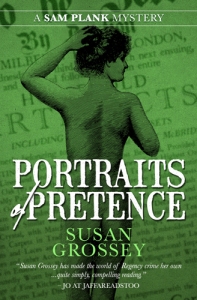
Review ~ Portraits of Pretence by Susan Grossey


32619973
CreateSpace Independent Publishing Platform
2016

A bit of book blurb..

An elderly French artist is found dead in his rooms in London clutching a miniature portrait of a little girl. Intrigued, Constable Sam Plank delves into the world of art dealing and finds himself navigating the fragile post-war relationship between England and France. What is the link between this and the recent attacks on customs officers in London Docks? And will a beautiful mademoiselle put paid to Martha Plank’s matchmaking?
In this fourth novel in the Sam Plank series, set in the chilly spring of 1827, Plank and his junior constable William Wilson meet Frenchmen in London and daring blockademen in Kent to uncover smuggling and even more dangerous ambitions,


My thoughts about the book..

There are a collection of authors in my arsenal of ‘authors who will never let me down’ and I can officially say that Susan Grossey is now firmly placed in this category. The whole of the Sam Plank series of Regency crime novels have been an absolute joy to read and this fourth outing by Constable Sam and his able assistant Wilson is just as exciting as the previous three books.

The chilly spring of 1827 sees Sam and his junior constable, William Wilson, investigating the unexplained death of an elderly French artist who has been found dead in mysterious circumstances. The only clue left at the scene is an exquisite miniature of a young girl which the old man is clutching in his hand. Given the unusual circumstances surrounding this death neither officer will leave any stone unturned until the mystery is solved to their satisfaction. However, dabbling in the complicated world of art reveals far more questions than it does answers, and Plank and Wilson soon find themselves drawn deeper and deeper into a shadowy criminal underworld filled with conspiracy and dangerous secrets.

Confident in his ability, Constable Plank strides the streets of London with all the self-assurance of a man who knows his place in the world. He strives for justice and truth in an entirely commendable way, and his integrity and honesty shines through with every word that this author so lovingly shares with her readers. What I enjoy most about this series is the way that the world of Regency crime comes alive in the imagination, so that it becomes an entirely believable world of thieves, vagabonds, conmen and criminals who scurry and skulk within the shadows of the great city of London.

There is no doubt that the author has created a plausible and comprehensive Regency world and with each successive novel I feel as if I am returning into the bosom of a well-loved family. Sam and Martha’s thoughtful care and supervision of the ever vulnerable Constable Wilson, and of course, Martha’s marvellous ability, in moments of extreme worry, to be her husband’s still small voice of calm is, as always, written with such thoughtful attention to detail.

As one book finishes I am heartened to know that, like buses another one will be along soon, after all, the author did say that there would be seven Sam Plank stories and I am holding her to that promise. I don’t want to contemplate what I will do when this wonderful crime series comes to an end but maybe by book number seven Sam may well have put his foot down and said… “There’s more”..!


Best Read With.. A tankard or two of porter and a well roasted chop..


About the Author


You can find more about Susan and her writing by visiting her website ~ click here

Follow on Twitter @ConstablePlank or @susangrossey


Read an extract from Portraits of Pretence by clicking here 


My thanks to Susan for sharing Sam Plank's world with me and for including a "Jaffareadstoo" quote on the cover on Portraits of Pretence.

As a reader I am delighted to endorse this wonderful series.


~***~

Thursday, 27 October 2016

Guest Author ~ Susan Grossey


It's always a real delight to welcome this talented writer back to the blog as I'm a huge fan of this well written historical crime series.


Today the author, Susan Grossey is sharing an extract from Portraits of Pretence which is the latest Sam Plank adventure published on the 21st October.


Hi and welcome back to Jaffareadstoo, Susan

Tell us a little about Portraits of Pretence...

An elderly French artist is found dead in his rooms in London clutching a miniature portrait of a little girl. Intrigued, Constable Sam Plank delves into the world of art dealing and finds himself navigating the fragile post-war relationship between England and France. What is the link between this and the recent attacks on customs officers in London Docks? And will a beautiful mademoiselle put paid to Martha Plank’s matchmaking? In this fourth novel in the series, set in the chilly spring of 1827, Plank and his junior constable William Wilson meet Frenchmen in London and daring blockademen in Kent to uncover smuggling and even more dangerous ambitions.


And here's a tantalising extract which I'll let Susan introduce..


The book is set in the spring of 1827 and this extract comes from the second chapter of “Portraits of Pretence”, after Sam has found a miniature portrait of a little girl clutched in the hand of a dead artist. Keen to learn what made the picture so precious to the dead man, Sam takes it to a curio dealer in Piccadilly.


"...The curiosity dealer certainly practised what he preached.  In the room where I waited, every surface was covered with ornaments, statuettes, gilt boxes and coins, while the walls displayed drawings and paintings of every size, from grand landscapes to tiny, intimate sketches.  There was even a pair of miniature portraits side by side near the mantelpiece and I was just walking over to examine them when the door opened and the maid said that Mr Causon would receive me in the drawing room.
In his sombre black jacket and snowy cravat, Henri Causon stood in sharp contrast to the profusion of colour and excess in his drawing room, which was even more filled with examples of his trade than the parlour I had just left.  He was a tall man with defined features, in particular a long, straight nose down which he looked at me now.  He came toward me and bowed before putting out his hand.
“After many years in your fine city, Constable Plank, I have learned how the Englishman does love to shake hands.  With this firm grip, you can tell that I am a man to be trusted, no?”
“I can tell that you are a man not armed with a sword,” I replied.
“Which is also useful to know,” he said with a smile.  “Come: you will join me in a little cognac before we turn to business.”  It was a statement rather than a question, and I took a seat on the small sofa that he indicated.  He poured two measures from a decanter and handed one to me.
“To your health, and to my santé,” he said and raised his glass.  I did likewise.  It was an uncommonly fine wine and I looked at him in appreciation.  “All duty paid,” he said with a wink.  “One of the many benefits of the renewed friendship between our two countries.”
“You say that you have lived in London for many years,” I prompted.
“Many,” he replied.  “My late wife and I came here at the end of the last century, as did plenty of our countrymen.”  I nodded: London had provided sanctuary to many who had fallen foul of the new regime in France.  “We were young then, of course – all of us.”  He smiled at me.  “My wife died nearly twenty years ago now, and my son returned to France.  He was a babe in arms when we came to London, but he always said he felt more French.  And he died for her, for France.  Leipzig.”  I said nothing: what is there to say to a man who has lost a son?  He was silent for a moment or two and then seemed to remember me.  “I, on the other hand, well, there is little for me now in France, and so I stay.  My daughter and I, we stay.”
His mention of a daughter brought Elizabeth to mind and I put my hand to my pocket.  Causon saw the movement and put down his glass.
“Ah, you have something to show me,” he said.  He leaned towards me and I handed him the miniature.  He carefully unwrapped the cloth and held the portrait in the flat of one hand while reaching into his pocket with the other, bringing out a small oval mother-of-pearl case.  He passed it to me.
“Would you open that for me, please?” he said.
I pushed the side of the case and a magnifying lens swung out.  “A neat device,” I said, handing it back to him, but his attention was elsewhere.  He bent forward and looked closely at the miniature, moving the magnifier across it as he examined the picture itself, the frame and even the reverse.  I waited.
“Exquisite,” he said finally, still looking through the magnifier.  “The finest quality.  Where did you obtain it?”  I said nothing, and he looked up at me, blinking.  “I see, I see.  Still, no matter.  You have come to me for a professional appraisal and this I can offer.”
I took my notebook out of my pocket.  “Do you mind?” I asked.  “The memory is not always reliable.”
“It fades, does it not, constable?  The memory, the eyesight,” he waved the magnifier at me.  “It all fades.  By all means, take your notes.”  His voice became business-like in tone.  “Miniature three-quarter portrait of female child in formal wear and setting.  Watercolour on ivory.  Unknown sitter and unknown artist – which does not mean that we shall never know, constable, but simply that the work is unsigned.  Estimated date – I shall say 1800, from the look of the frame, and the way the little girl’s hair is curled.  I cannot be sure, but I would guess that it was painted ad vivum – from life, that is – or at the very least by someone who knew the child well.  The – how to put this? – the emotion of the piece would not be present in a mere copy.”
I looked up from my notebook and nodded.  “I felt that too – and my wife.  She has taken to calling her Elizabeth.”  I flushed slightly.
“Hah!”  My host smiled.  “Your wife is a woman of feeling.  Elizabeth: it suits her, I think, and will work as well in French as in English.”  He took another close look at the miniature.  “Yes, she is definitely French, our little Elizabeth.”

©Susan Grossey


You can find more about Susan and her writing by visiting her website ~ click here

Follow on Twitter @ConstablePlank or @susangrossey

Find on Amazon UK


Published by CreateSpace Independent Publishing Platform


dfw-sg-ff-cover-front-large dfw-sg-tmitcw-cover-mid dfw-sg-witb-cover-large dfw-sg-pop-cover-thumb


Huge thanks to Susan for sharing this enticing extract from Portraits of Pretence and for sharing Sam's world so eloquently.


~***~


Tuesday, 5 January 2016

Review ~ Worm in the Blossom by Susan Grossey


27202955
October 2015
CreateSpace Independent Publishing Platform


I have several writers on my selective list of authors who never let me down, and Susan Grossey is firmly placed on this list. Ever since I was introduced to Constable Sam Plank and his intrepid wife Martha, in Fatal Forgery, I have followed his exploits with great interest.  There is something so entirely dependable about Sam, that to walk in his footsteps through nineteenth century London, is rather like being in possession of a superior time travelling machine, which picks you up and drops you smack in the middle of the dark and, it must be said, rather seedy underworld of late Regency crime.

In this, now the third book in the series, Sam is faced with an altogether darker dilemma than in previous stories. During one of his nightly perusals he hears a high pitched whimper and discovers a distressed prostitute, who is obviously in an advanced stage of pregnancy. The girl’s extreme youth poses somewhat of a moral dilemma for Sam, who on realising that he cannot leave her to give birth on the streets decides that the only course of action open to him is to take her into the safekeeping of his long suffering wife, Martha.

Inevitably, this kindly action has dramatic consequences and soon Sam and his intrepid sidekick, Wilson, are entangled in a story which is rich in intrigue and alive with scheming trickery. The dark and dirty underbelly of Regency London comes alive once again, and during Sam’s investigation into moral corruption at the highest level, we enter into the disreputable and shady world of scandalous bawdy houses, and of the domain of malevolent procuresses who look for those vulnerable members of society who are too weak to resist, and of the despicable and corrupt men who exploit and abuse those who are all too susceptible to small kindnesses.

The mystery at the heart of Worm in the Blossom is dark and desperate in equal measure. It shows human nature at its worst and also at its very best. Constable Sam Plank is as ever calm and efficient; slow to anger and quick to action, valiantly fighting for the defenceless, and as always, relentless in his pursuit of fraudulent and dishonest activity, but it must not be forgotten about the strength of his supporting characters, the astute Martha who is perhaps my favourite, closely followed by the equally stoical Wilson, who must be by now, in the running for most promising assistant.

There is no doubt that Susan Grossey has made the world of Regency crime her own; the writing, is as ever, crisp and clear, no superfluous waffle, just good old fashioned storytelling, with a tantalising beginning, an adventurous middle, and a wonderfully dramatic ending, which, when all is combined, add up to, quite simply, compelling reading.

Bring on Book 4…


Best read with a tankard of dark ale and a bread roll stuffed with roast pork….


About the Author


Find Susan on her blog

Follow her on Twitter @susangrossey

You can read an interview with the author talking about her writing  - here 


My thanks to Susan for sharing Sam and his adventures with me.


~***~