Showing posts with label Music of WW1. Show all posts

Sunday, 20 May 2018

Sunday WW1 Remembered..


Morale Boosting Songs of WW1


Florrie Forde


Florrie Forde was a popular music hall entertainer who came to England, aged 21, from Australia. She made her first appearance on the London stage in 1897 and her powerful performances and charismatic stage presence meant that she was soon in demand. Her popularity, as a vaudeville act, made her one of the most sought after entertainers of the early twentieth century,

Her morale boosting songs during World War One were some of the most popular songs of the time.

These included songs which are still remembered today.

Down at the Old Bull and Bush
Pack Up Your Troubles in your old kit bag
It's a long way to Tipperary
Take Me Back to Dear Old Blighty


Take Me Back to Dear Old Blighty

Jack Dunn, son of a gun, somewhere in France today
Keeps fit doing his bit, up to his eyes in clay
Each night after a fight to pass the time along
He's got a little gramophone that plays this song

Take me back to dear old Blighty!
Put me on the train for London town
Take me over there
Drop me anywhere
Birmingham, Leeds, or Manchester, well, I don't care!
I should love to see my best girl
Cuddling up again we soon should be
(Whoa!)
Tiddley-iddley-ighty
Hurry me back to Blighty
Blighty is the place for me!

One day, Mickey O'Shea, out in a trench somewhere
So brave, having a shave, trying to part his hair
Mick yells, dodging the shells and lumps of dynamite:
"Talk of the Crystal Palace on a firework night!"


Take me back to dear old Blighty!
Put me on the train for London town
Take me over there
Drop me anywhere
Birmingham, Leeds, or Manchester, well, I don't care!
I should love to see my best girl
Cuddling up again we soon should be
(Whoa!)
Tiddley-iddley-ighty
Hurry me back to Blighty


Take Me Back to Dear Old Blighty was written by Arthur J. Mills, Fred Godfrey and Bennett Scott in 1916. It was popular during the First World War and tells a story of fictional soldiers on the Western Front suffering from homesickness and their longing to return to "Blighty"..

During a recent visit to the IWM (North) I bought a set of WW1 memorabilia which contained a few replica WW1 morale boosting postcards and came across this image of a soldier in the trenches listening to this song and imagining himself back home with his folks and his sweetheart.


You can listen to Florrie Forde sing Take Me Back to Dear Old Blighty 
by clicking on the You Tube link below.


Sunday, 18 September 2016

Sunday WW1 Remembered..


Musicians of The Great War


Joseph Maurice Ravel (1837 - 1937) was a French composer, pianist and conductor,  born in the Basque town of Ciboure in France. During the war Ravel tried to enlist in the French Air Force as a pilot but both his age and health thwarted his ambition, so instead he joined the Thirteenth  Artillery Regiment as a lorry driver. He was distressed by what he saw during his war years and composed little, however his most substantial wartime composition Le Tombeau de Couperin was composed between 1914 - 1917 and each movement is dedicated to one of Ravel's friends who was lost during these years.


Le Tombeau de Couperin


~***~

Sunday, 20 March 2016

Sunday WW1 Remembered..


Composers of the Great War


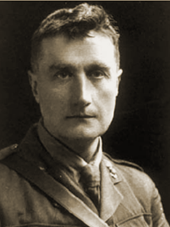
Ralph Vaughan Williams
1872-1953


Portrait of Ralph Vaughan Williams, C.1916, courtest RVW Society
War composers.co.uk


Whilst the poetry  of WW1 is reminiscent of time and place it must also be remembered that music evoked strong feelings and none more so than the compositions of Ralph Vaughan Williams.

George Meredith's poem The Lark Ascending (1881) was Vaughan William's inspiration for his musical composition of the same name. It is thought that the musical piece, The Lark Ascending (1918) is a reflective study on Vaughan William's war experiences. He enlisted as a private into the Royal Army Medical Corp (Territorial Force) where he became a medical orderly and there is no doubt that Vaughan William's experiences as a stretcher bearer left a lasting impression on him. In 1917, he was commissioned as a 2nd Lieutenant in the Royal Garrison Artillery and was responsible for firing shells towards enemy lines. His deafness in later life is usually attributed to the ear-shattering noise that these big guns emitted.


It is thought that his Pastoral Symphony (1921) and his cantata Dona Nobis Pacem (1936) are his musical response to the war.


Symphony No 3

Pastoral Symphony

Ralph Vaughan Williams


Just to say that this piece is  approx.35 minutes long but well worth listening to.


 If you've time to spare, grab a nice pot of English Breakfast tea and enjoy listening to this stunning piece of music.


It's one of my favourites.


~***~


Sunday, 7 February 2016

Sunday WW1 Remembered...


Music of The Great War


Listening to Classic FM early this morning I was inspired by a piece of music
which was composed just before the outbreak of WW1 in August 1914. 


Sospiri Opus 70 by Edward Elgar


Sir Edward William Elgar, 1st Baronet OM GCVO (2 June 1857 – 23 February 1934) was an English composer, born in the village of Lower Broadheath, a village just outside Worcester. Among his best-known compositions are the Enigma Variations, the Pomp and Circumstance Marches, several concertos for violin and cello, and two symphonies. He also composed classic choral works, including The Dream of Gerontius.


Listen to Sospiri 


Sospiri, Op. 70, is an adagio for string orchestra, harp (or piano), and organ (or harmonium) composed by Edward Elgar just before the beginning of World War I.

Originally intended for violin and piano and Elgar used it as a companion piece to Salut d'Amour and had in mind the title Soupir d'Amour (French for "Sigh of Love"). While composing it, however, he realised that he was writing something more intense, and so chose an Italian word, sospiri, meaning "sighs"


Sospiri with a performance time of approximately five minutes, was first performed on 15 August 1914 in Queen's Hall in London, conducted by Sir Henry Wood.

Sospiri was dedicated to Elgar's long-time friend, the violinist W. H. "Billy" Reed.


War was declared on the August 4th 1914. 

The gentleness of Sospiri bears no resemblance to what would shortly be taking place on the Western Front.


\relative c' \new Staff \with { \remove "Time_signature_engraver" } {
 \key d \minor \time 4/4 \tempo "Quasi recit."
  r8\fermata e'4\upbow \p \< (g8) a2~\> << a8 { s16 s16\! } >> a4( c8) d,2~ d8 c\<( d e\!) f--[ e--] d4~ d8 c-- d-- e~( e\>[ c]) c4\!
 }
Source: Wikipedia


~***~