Showing posts with label Harriet Steel. Show all posts

Monday, 11 September 2023

πŸ“– Book Review ~ Long Odds in Nuala by Harriet Steel


30 June 2023

Inspector de Silva Mysteries #13

My thanks to the author for my copy of this book


When Nuala’s premier race meeting ends in controversy and a tragic death, Inspector Shanti de Silva and his wife Jane must turn their minds to unravelling a new mystery. With evidence elusive and a hostile British establishment to deal with, it looks like it won’t be easy to uncover the truth, but when did long odds ever deter Shanti and Jane?

Set in the 1930s and 40s on the exotic island of Ceylon, now Sri Lanka, in the twilight years of the British Empire, the Inspector de Silva mysteries offer an entertaining and intriguing read spiced with humour and a colourful cast of characters.

πŸ“– My Review..

A controversial race meeting which takes place in Nuala is the focus of this thirteenth cosy crime novel in which Inspector Shanti de Silva is once again embroiled in a complicated mystery which focuses on those in the racing fraternity. When an unexpected death occurs no-one is beyond suspicion and de Silva is determined to find the perpetrator before more tragedy occurs.

Long Odds in Nuala feels just as fresh, and expertly written, as the ones which have gone before and Inspector Shanti de Silva and his wife, Jane, are now as comfortable as old friends so it has been especially delightful to have both of them feature so prominently in this story. All the old favourites make an appearance along with a couple of other dastardly characters who I was particularly glad to see get their comeuppance. The mystery at the heart of the story is well written and I enjoyed the references to the horse world, and racing in particular, which added a different feel to the story. As always, 1940s Ceylon comes alive with all the sights and sounds of Nuala coming into sharp focus and to watch the intrepid inspector with his meticulous gift for crime investigation is always a real pleasure.

This thirteenth novel as been every bit as fascinating as the ones which have gone before and, as this book finishes, I am already looking forward to more adventures in Nuala with Inspector de Silva and his lovely wife, Jane.


Harriet Steel wrote four historical novels before turning to crime with the Inspector de Silva mysteries, inspired by time spent in Sri Lanka (the former Ceylon)). Her work has also appeared in national newspapers and magazines. Visit her blog to sign up to her monthly newsletter for news of new releases and great offers, Blog 

Harriet is married with two daughters and lives in Surrey. When Harriet is not writing, she likes reading, long walks and visiting art galleries and museums.


Twitter @harrietsteel1


Tuesday, 17 January 2023

πŸ“– Book Review ~ Stardust in Nuala by Harriet Steel


November 2022

The Inspector de Silva Mysteries #12

My thanks to the author for my copy of this book


A celebrated Indian film company comes to Nuala, sprinkling its stardust over the quiet little town and keeping Inspector de Silva busy. With the end of the visit at last in sight, he looks forward to returning to a more peaceful existence, but a sudden death dashes his hopes. With Jane’s help and that of a new ally, he’s drawn into the turbulent affairs of a warring family. Meanwhile, a mysterious intruder is causing trouble at the Residence.


πŸ“– My Review

There is great excitement in Nuala when an Indian film crew descends upon the town and of course, it falls upon Inspector de Silva to keep everything under control. However, even as the film crew are packing up to leave Nuala, the inspector is informed that there has been an unexpected death in the hotel where the main members of the cast have been staying. This mysterious death of one of the main actors opens up a whole set of mysterious circumstances and places several other members of the cast under suspicion. As always, this careful detective leaves no stone unturned, or wall unclimbed, in his quest to get to the bottom of this complex crime.

It's always a huge pleasure to return to Nuala and spend time in the company of de Silva and his lovely wife Jane as they quietly go about their lives in this beautiful part of what was once Ceylon. Set in 1941, the colonial atmosphere still persists although with the war raging in Europe there is definitely a hint of change in the air. The place and its people come alive especially with all the colourful sights, sounds and tastes which this author describes so thoughtfully. The mystery at the heart of this gentle crime story is beautifully explored and everything comes together in a satisfactory conclusion which I felt was entirely appropriate.

Whilst this is the twelfth novel in this cosy crime series it is perfectly possible to read as a standalone mystery although for greater enjoyment and to get to know the Inspector it is better to read the series from the beginning that way you get to spend time in this pretty little hill town with de Silva, his wife Jane, and their two cats Billy and Bella.


Harriet Steel wrote four historical novels before turning to crime with the Inspector de Silva mysteries, inspired by time spent in Sri Lanka (the former Ceylon)). Her work has also appeared in national newspapers and magazines. Visit her blog to sign up to her monthly newsletter for news of new releases and great offers, Blog 

Harriet is married with two daughters and lives in Surrey. When Harriet is not writing, she likes reading, long walks and visiting art galleries and museums.


Twitter @harrietsteel1


Wednesday, 11 May 2022

πŸ“– Book Review ~ Break from Nuala by Harriet Steel


10 March 2022

My thanks to the author for my copy of this book


It is autumn 1940, and Inspector de Silva and his wife Jane are looking forward to a well-earned holiday. But their hopes of a relaxing break in the picturesque city of Galle beside the Indian Ocean are dashed when death, mysterious illnesses, and a missing guest cast a gloomy shadow.

As they’re drawn into the investigation, the mystery deepens. Is there a villain amongst their fellow guests or further afield? The search for answers will lead them into great danger that has repercussions far beyond the island of Ceylon.

The paperback edition of Break from Nuala contains a copy of Christmas in Nuala, previously only published as a Kindle Short Read.

πŸ“– My Review...

Inspector Shanti de Silva, and his lovely wife Jane, are enjoying a short holiday away from Nuala when they are inadvertently drawn into the mysterious disappearance of a guest from the hotel in which they are staying. With the inspector's fine eye for getting into the very heart of a mystery it's not long before he is piecing together the minuscule clues which the local police inspector seems determined to ignore.

As most of the previous books in the series have taken place in Nuala, the hill town which the inspector and his wife call home, it was good to explore another place in 1940s Ceylon, this time we discover something of Galle, a pretty coastal town, with an interesting history. With the intrepid inspector determined to enjoy his holiday at the beautifully named Cinnamon Lodge there is a more relaxed feel to the story however, as the mystery starts to deepen we are treated once again to all the elements we have come to enjoy from this well established series. There is the usual well developed sense of intrigue, more than a hint of danger and a cast of quirky characters who, it would seem, all have something to hide. Spending time in the company of the intrepid Inspector de Silva is always such a joy as this wonderful cosy crime series just goes from strength to strength.

Break from Nuala is the eleventh book in the series and whilst it is perfectly possible to read it as a standalone story, it does make sense to start at the beginning of the series in order to enjoy getting to know more about the time, place and people which this talented author brings so creatively to life.


🍜Best read with... a restorative bowl of mulligatawny soup


Harriet Steel wrote four historical novels before turning to crime with the Inspector de Silva mysteries, inspired by time spent in Sri Lanka (the former Ceylon)). Her work has also appeared in national newspapers and magazines. Visit her blog to sign up to her monthly newsletter for news of new releases and great offers, Blog 

She’s married with two daughters and lives in Surrey. When she’s not writing, she likes reading, long walks and visiting art galleries and museums.


Twitter @harrietsteel1


Wednesday, 14 July 2021

πŸ“– Book Review ~ Cold Case in Nuala by Harriet Steel


Independently Published
May 2021
Inspector de Silva #10

My thanks to the author for my copy of this book


It’s January 1940 and the day of Nuala’s famous motor rally. Excitement is at full throttle, but matters take a dark turn when that same evening, human remains are found buried in a lonely corner of a local tea plantation.

Inspector de Silva has a cold case to solve. Add a playboy racing driver, a missing Bugatti and a family scandal hushed up years ago into the mix and he has plenty to think about. You can be sure that whatever happened in the past, now de Silva’s in the driving seat, you’re in for a gripping ride.


πŸ“– My Thoughts..

It's always such a treat to curl up in my favourite chair and escape to the languid days of 1940s Ceylon in company with Inspector de Silva as he goes about cracking another complex crime case in the beautiful hill town of Nuala. When a set of human bones are found well hidden on a remote tea plantation the intrepid Inspector has a difficult job in trying to discover just who was buried in this remote spot. The Inspector is determined to leave no clue unanswered but in this perplexing cold case mystery he finds that there are an abundance of twists and turns, and quite possibly, more questions than there are answers.

In Cold Case in Nuala there are some interesting, and rather complex characters, who the Inspector investigates with his own brand of steely determination and even though the Inspector always seems to find his culprit, the investigation which takes de Silva to the conclusion of the case is always filled with a strong sense of righteous satisfaction of a case well solved. In setting the books during the last, heady years of colonialism there is so much to enjoy in this series of cosy crime mysteries and each one brings something different to the table whilst keeping the continuity and vibrancy of what has gone before in past stories. I thoroughly enjoy being whisked away to Nuala as not only is there a fascinating sense of stepping back in time but the author does a great job of bringing to life both the unique character of the area, along with the idiosyncrasies of its inhabitants.

Cold Case in Nuala is now the tenth book in the series and whilst it is perfectly possible to read as a standalone mystery, for the sheer pleasure of getting to know Inspector de Silva, his lovely wife, Jane, and all the other long standing characters, I suggest that you start at the very beginning and escape to the colourful world of Nuala which is so vividly recreated in these lovely stories.


Harriet Steel wrote four historical novels before turning to crime with the Inspector de Silva mysteries, inspired by time spent in Sri Lanka (the former Ceylon)). Her work has also appeared in national newspapers and magazines. Visit her blog to sign up to her monthly newsletter for news of new releases and great offers, Blog 

She’s married with two daughters and lives in Surrey. When she’s not writing, she likes reading, long walks and visiting art galleries and museums.


Twitter @harrietsteel1


Friday, 4 December 2020

πŸŽ„ High Wire in Nuala by Harriet Steel

Independently Published
October 2020

Inspector de Silva Mysteries #9

My thanks to the author for my copy of this book


Much to the delight of the locals, a colourful Russian circus rolls into Nuala, but the fun ends abruptly when, on the opening night, a tragic accident takes place. Shanti de Silva and his wife, Jane are among the crowd to witness the accident. Or was it an accident? Inspector de Silva senses murder, and soon, he’s juggling with the evidence. Will the trail lead to the circus’s dashing stunt rider and master of horse, Alexei Goncharov, or to Alexei’s brother Boris, its boisterous ringmaster? Throw a string of jewel thefts and some deadly snakes into the mix and the list of suspects grows.
De Silva will need to keep his wits about him to unravel yet another absorbing puzzle in this charming and addictive mystery series set in the 1930s in exotic Ceylon.

My thoughts..

When an exotic Russian circus arrives in Nuala it is cause for much excitement that is, until a tragic accident occurs which leads Inspector Shanti de Silva to suspect foul play. The circus people are naturally reticent about the accident and don't give up their secrets easily but, as always, the intrepid inspector is determined to uncover all the clues even if it means upsetting a few people along the way.

The author brings the colourful world of 1930s Nuala alive and treats us to another well considered murder mystery that has all the trademarks of delicate writing which we have come to expect from this talented writer. The story rolls out gently, and the mystery is allowed to unfold at entirely its own pace, nothing ever feel rushed or hurried in Nuala, there's always time to stop for tea or a lovely dinner, however, with Inspector de Silva at the helm every investigation comes to a satisfactory conclusion.

I've loved this series of cosy crime novels from the beginning and have enjoyed getting to know Inspector de Silva and his wife, Jane, so that every return to Nuala feels like a meeting up with old and treasured friends. Whilst the colonial rule seems set to continue there's a definite hint in this novel that times are changing with the threat of a possible war in Europe looming on the horizon.

High Wire in Nuala is now the ninth book in the series and it is every bit as good as the previous books, and whilst it can be read quite comfortably as a stand alone story it really is better to appreciate this crime series from the start.


Harriet Steel wrote four historical novels before turning to crime with the Inspector de Silva mysteries, inspired by time spent in Sri Lanka (the former Ceylon)). Her work has also appeared in national newspapers and magazines. Visit her blog to sign up to her monthly newsletter for news of new releases and great offers, Blog 

She’s married with two daughters and lives in Surrey. When she’s not writing, she likes reading, long walks and visiting art galleries and museums.


Twitter @harrietsteel1


Monday, 6 July 2020

Book Review ~ Taken in Nuala by Harriet Steel

53211259
18 April 2020

Inspector de Silva Mystery #8

My thanks to the author for my copy of this book

When an American millionaire and his glamorous daughter visit Nuala, the splendour they bring to the town's high society is soon tragically tarnished by a vicious crime.With many avenues of inquiry to follow, including the involvement of a mysterious fortune teller, Inspector de Silva will need all his resources to unravel the evidence and avert further disaster.A gripping mystery with lots of twists and turns set in the colourful and fascinating world of 1930s Ceylon.

What did I think about it..

Whenever I step back in time to 1930s Ceylon in the company of Inspector de Silva and his lovely wife, Jane, I know that I am in for a real treat, as not only is the history of the time beautifully recreated, but also I know that there will be a sharp mystery for the intrepid Inspector to solve.

Taken In Nuala focuses on a mystery surrounding the daughter a wealthy American businessman and from the very start it is obvious that there is more to this investigation than at first appears. The Inspector and his associates have to get to grips with a particularly intricate crime and as always it's fascinating to see the Inspector working alongside all the regular characters we have come to love and appreciate from reading the other novels in the series.

For those who haven't read the series, and Taken in Nuala is now the eight book, each story can be read as a standalone mystery as the author includes, at the start of the book, a useful description of each of the major characters. That Inspector Shanti de Silva is the star of the series is without question, his attention to even the smallest detail of the crime ensures that there is no stone unturned in his quest for justice. His lovely wife, Jane, is the still small voice of calm in Shanti's world as she helps him make sense of the complicated crimes he invariably gets drawn into, but it is the homely interludes between them which work so well, along with the sumptuous descriptions of Shanti's favourite meals and his beautiful garden.

This series really has caught my imagination and I look forward to the next story in this cosy crime series. For a sleepy Ceylonese town there is much going on and I am sure that before too long, this talented author, will involve the intrepid Inspector in another complicated crime mystery.


Harriet Steel wrote four historical novels before turning to crime with the Inspector de Silva mysteries, inspired by time spent in Sri Lanka (the former Ceylon)). Her work has also appeared in national newspapers and magazines. Visit her blog to sign up to her monthly newsletter for news of new releases and great offers, Blog 

She’s married with two daughters and lives in Surrey. When she’s not writing, she likes reading, long walks and visiting art galleries and museums.


Twitter @harrietsteel1


Saturday, 14 December 2019

Hist Fic Saturday ~ Rough Time in Nuala by Harriet Steel


On Hist Fic Saturday

Let's go back to....1930s Ceylon

50853523. sx318 sy475
October 2019

My thanks to the author for my copy of this book


Inspector de Silva’s peaceful evening is disrupted when he is called up to the Royal Nuala Golf Club where a wealthy member has been found brutally murdered.

Is this a bungled robbery, a private feud, or does the killer have another motive that will cause them to strike again?

With the help of his resourceful wife, Jane, and a new and unexpected ally, de Silva must navigate his way into the heart of the privileged British establishment to find the answer, and there’s no time to lose.

Rough Time in Nuala is another colourful and exciting mystery in this series set in the exotic location of 1930s Ceylon.


What did I think about it..

When Inspector Shanti de Silva is called upon to investigate a vicious murder which has taken place at the Royal Nuala Golf Club it opens up, once again, a complex case, the type of which this intrepid Inspector excels at investigating. There are many false clues and numerous twists and turns but, as always, the inspector leaves no stone unturned in his quest to get to the bottom of this heinous crime.

It's such a treat to return to Nuala and meet again with Shanti, and his delightful wife, Jane and I thoroughly enjoy the descriptions of their life together in Nuala which this author does so well. She really brings time and place alive in the imagination, and just as much as I enjoy trying to work out the pieces of the investigative puzzle, so I also find much delight in reading of Shanti's life in his well tended bungalow, his beautiful gardens and his delight in the well made, and delicious curries, which his cook serves at dinner time.

Rough Time in Nuala is now the seventh book in this series and the characters who make this such an enjoyable experience are now as familiar as old friends. There is no doubt that this author has found her niche in creating the 1930s world of Inspector de Silva. This cosy crime series has the capacity to run for as long as there are stories to tell and I am sure that, thanks to this talented author's imagination, we can look forward to many more Inspector de Silva murder mysteries.   


You can find out more about Harriet Steel on her blog

Follow on Twitter @harrietsteel1


Saturday, 1 June 2019

His Fic Saturday ~ Passage from Nuala by Harriet Steel


On Hist fic Saturday

 I am delighted to return to ...the Inspector de Silva series


© Harriet Steel
2019
My thanks to the author for my copy of this book

Inspector de Silva and Jane embark on a cruise to Egypt to visit the pyramids, excited at the prospect of two weeks of sun, sea and relaxation. With Nuala, and de Silva’s duties as a police officer, far behind them, what can possibly spoil their plans? Then a writer is found dead in his cabin, suffocated by newspaper thrust down his throat. Once again, de Silva must swing into action.


My thoughts...

In this sixth book in the Inspector de Silva mysteries it's a real pleasure to see Shanti de Silva and his lovely wife, Jane, taken away from their beloved Nuala, and placed into a completely different environment. A leisure cruise, from Ceylon to Cairo, aboard the Blue Star Line's magnificent, Jewel of the East, should be all about the pleasures of being at sea, and of the delicious lunches and dinners that the chefs in Tourist Class can offer, however, with the discovery of a body aboard ship, the intrepid inspector is, once again, inadvertently drawn into a complex murder mystery.

There's so much to enjoy in this series that I am always delighted to spend time in the Inspector's company and, in Passage from Nuala, we are treated to observing how he works alongside a new character. William Petrie, is a high ranking government official who is returning to England with his wife, Lady Caroline, and he and the inspector need to work closely together in order to uncover a whole web of secrets and lies.

The mystery at the heart of the novel is complicated and the author does a great job of weaving together all the different strands, and in doing so brings together a disparate group of individuals who all have rather complex reasons for being suspected of murder. I have so enjoyed trying to keep one step ahead of the investigation and genuinely admire the inspector's rather particular approach to sleuthing.

As always, the history of the time comes alive and the care and attention shown to the detail of life on board ship along with other snippets of historical interest make Passage from Nuala a lively and thought-provoking read. I am sure that there are many more adventures to come for the intrepid Inspector and his lovely wife.


You can find out more about Harriet Steel on her blog

Follow on Twitter @harrietsteel1


Sunday, 21 April 2019

Author Interview ~ Harriet Steel


I'm delighted to welcome back to the blog the author of the Inspector de Silva novels

Harriet Steel


Hi Harriet, welcome back to Jaffareadstoo, it's lovely to have you back to talk about your latest novel, Passage from Nuala. 

Passage from Nuala is now the sixth book in your crime series set in 1930’s Ceylon. When you wrote the first book, Trouble in Nuala, in 2016, did you expect to go on to write a long running series?


The number 7 has a bit of a history as a magic number in literature, for example the seven Chronicles of Narnia or the seven Harry Potter books, and I used to joke that I was aiming for seven books in my series. In truth, I must admit that I was far from convinced that I’d come anywhere near that, but I’ve grown very fond of my characters and many readers say they feel the same, so that has spurred me on. The other day, a reviewer on Amazon challenged me to match Alexander McCall Smith whose No 1 Ladies Detective Agency Series is about to reach its twentieth instalment. I’m still mulling that one over! 

What can you tell us about this latest book that won’t give too much of the plot away?

Shanti wants to treat Jane to a holiday, and they set off on a cruise to Egypt to visit Cairo and the pyramids. They plan to enjoy a relaxing change from home, but trouble isn’t long coming. When a journalist is found dead, killed by newspaper thrust down his throat, it’s back to work for Shanti and Jane. In the enclosed world of the cruise ship, there are plenty of potential suspects ranging from an arrogant wealthy woman; a mismatched couple, who are recently engaged; a flamboyant singer, and a romantic novelist. All of them have secrets to hide. Can Shanti and Jane uncover the truth and salvage their holiday into the bargain? Like the other books in the series, Passage from Nuala is designed to provide an absorbing but relaxing read in a colourful setting. It can be read as a standalone novel or as part of the series. 


Evenings in Cabin Class
A surviving interior from the cruise ship Normandie


Inspector Shanti de Silva is the main protagonist of your novels, what can you tell us about him, and have you noticed any changes in his character since the start of the series?

He’s pragmatic but principled with a dry sense of humour. Happily married, he likes books and gardens as I do. There are so many murder mysteries around that feature detectives with messy private lives. I wanted Shanti to be quite a conventional man who must deal with abnormal situations as part of his job. However, his private life isn’t entirely conventional – his wife Jane is an Englishwoman, and they’ve had to negotiate the problems that a mixed marriage would have raised in a colonial society.

I think the main changes that have occurred over the series come from Shanti’s developing relationships within the British community, particularly his boss, Archie Clutterbuck, and in my latest book, Archie’s own boss, William Petrie. Shanti has had to tread carefully when handling his colonial masters, but he’s managed to establish an increasing rapport with them. This may have been made easier by the fact that Nuala’s society is small compared with what he had to contend with in Colombo.

The series has, so far, focused on quite a wide variety of crimes, what do you think makes a good fictional villain and detective?

That’s a very interesting question. As a writer of cosy crime that veers towards the traditional, or Golden Age style, end of the spectrum, I need to be attuned to what my readers find acceptable, so serial killers and psychopaths are out. A good villain can, and perhaps should, have likeable qualities, so that hopefully, when the twist comes, and he or she is revealed, the reader won’t have guessed who they are ages ago. They need to be clever and resourceful enough to inspire respect, both from the reader and the detective, and they need to have strong motivation for their crime. It’s not enough for them to do evil simply because they are evil.

As far as a good detective goes, again, a dysfunctional character wouldn’t fit with the ethos of my kind of murder mystery, unless they were dysfunctional in a kooky, humorous way. I think the qualities needed are not dissimilar to those required for a good villain, without the murderous intent of course. 

Where do you get your inspiration for the stories, and, as one book ends, do you already have the idea in place for a new story?

My travels in Sri Lanka, formerly Ceylon, provided the initial inspiration for the series. It’s a fascinating and beautiful country. Even though the tone of the series is essentially light, its colonial past and the tensions that must have created adds, I hope, an extra layer of interest.


Tea Plantation Workers
Sri Lanka

I usually have a future book in mind by the time I finish the current one. Sometimes, as with Passage from Nuala, an event or a book gives me an idea. With Offstage in Nuala, for example, it was Shakespeare Wallah, Felicity Kendall’s memoire of touring India with her theatrical family. The recent exhibition at the V & A Museum about the great days of cruise liners provided a lot of colour and ideas for Passage from Nuala. 


And finally, what do you hope readers will take away from your Inspector de Silva mysteries?

A smile! 😊


You can find out more about the author on her blog

Follow on Twitter @harrietsteel1


Huge thanks to Harriet for being my guest on the blog today and for bringing Inspector de Silva's world to life so perfectly.


Friday, 28 December 2018

Review ~ Christmas in Nuala and Fatal Finds in Nuala by Harriet Steel


43070795
Kindle Edition
2018
The little town of Nuala is full of Christmas good cheer, until a brutal murder overshadows the festivities. The mystery he needs to solve baffles Inspector de Silva. It’s just as well he has his wife Jane to support him in his race both to unmask the villain and save an endangered romance. This colourful series set in Ceylon in the 1930s is perfect for fans of Golden Age mysteries, and Christmas in Nuala makes a great short read for the holiday season.

My thoughts..

Spending time with Inspector de Silva and his lovely wife Jane at Christmas time has been such a treat and this festive novella certainly acts as a real tonic, bringing all that is good about these crime stories which are set in 1930s Ceylon. This gentle crime series manages to both entertain and keep you guessing as there is always something new to discover in Inspector de Silva's world. It was rather nice to have the inspector's wife, Jane doing what she does best, supporting her husband and with gentle wisdom steering in him the right direction.

Giving away any of the plot would really spoil this story as its best read without any indication of where the mystery is heading. My advice is to cosy up with Christmas in Nuala and a restorative glass of sherry and a warm mince pie and enjoy working out the mystery alongside Shanti de Silva and Jane.


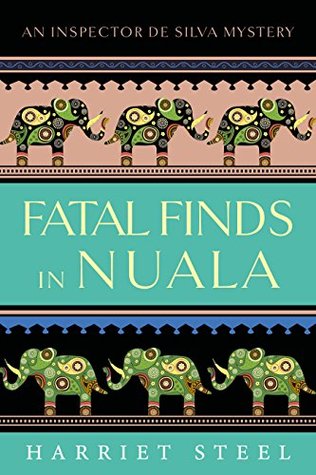
Fatal Finds in Nuala (The Inspector de Silva Mysteries, #4)
Stane Street Press
2018
In this fourth instalment of the Inspector de Silva mysteries, it is monsoon season in the Hill Country. One stormy night, a ghostly encounter on a lonely road leads de Silva into a case of murder, and a mystery that stretches back to Ceylon’s distant past. To uncover the truth, he will have to face death and his inner demons.

My thoughts..

I've grown so accustomed to the intrepid adventures of Inspector de Silva that returning to his life in the hill town of Nuala is always like being reunited with a much loved friend. Fatal Finds gets off to a dark start with de Silva investigating a rather complicated murder involving a local man, and as the investigation deepens, so de Silva gets drawn further and further into the mystery.

As in previous de Silva mysteries, the author writes really well and brings such life to the characters that they are always fascinating, whether it be in observing de Silva's loving relationship with his English wife, Jane or his, often, complicated interaction with Archie Clutterbuck, the government agent in Nuala, there is never a moment when the story doesn't draw you into 1930s Ceylon.

As always, the mystery at the heart of the story is well explained and whilst the overall pace of the novel is one of elegant gentility, the investigation into the mystery surrounding the murder is done with fine attention to period detail. There is no doubt that this author has created a rather special series and I hope to share more adventures with the intrepid Inspector in future stories.


You can find out more about the author on her blog


Follow on Twitter @harrietsteel1


Saturday, 7 April 2018

Hist Fic Saturday ~ Offstage in Nuala by Harriet Steel


On Hist Fic Saturday


Let's go back to ... Ceylon, 1936


36486865
Stane Street Press
2017

My thanks to the author for my copy of this book


Offstage in Nuala is the third book in the Inspector de Silva mysteries which takes us back to the 1930s, and to the days of Colonial Ceylon. 

A travelling theatre company has arrived in Nuala and there is great excitement when their production of Hamlet opens to a packed audience. The great and the good of the community are gathered there, including Inspector de Silva and his lovely wife, Jane. 

Just a few nights later, the Inspector receives a telephone call, informing him of an incident which has occurred at the theatre where, to his consternation, he discovers that the company's actor manager has been murdered. Fraught with complications from the very start of the investigation, the inspector finds that he has several possible leads to consider however, tracking down the perpetrator of this heinous crime is never going to be easy, especially when de Silva seems to be thwarted at every turn by his superior, Assistant Government Agent, Archie Clutterbuck. 

What I love about this series is the absolute authenticity of the historical detail. From de Silva's leisurely drive to work in his stately Morris, to relaxing on the veranda in the cool of the evening, the Ceylonese way of life comes to life. The colonial splendour of the Residence, Clutterback's palatial home, is often the scene of some delicious humour and de Silva's obvious discomfort at visiting his boss there always leaves me with a smile on my face, 

The mystery at the heart of the story is well contrived and I enjoyed trying to figure out the clues alongside the Inspector, who, as always, has great support from Jane, who continues to be his sounding block and that still small voice of calm when all seems to be going awry. That the investigation has its complexities is what gives the book its characteristic sharpness and it is in the small details where the author really excels. 

The writing is as crisp as ever and just as sharply observed with some very fine attention to detail, particularly about what happens backstage in a provincial theatre. I enjoyed exploring the nooks and crannies of Nuala's Gaiety Theatre with its crumbly corridors and dodgy stage trap.
The Inspector de Silva mysteries are beautifully written historical crime stories with more than a hint of humour and quite enough mystery to keep you guessing from start to finish.


You can find out more about the author on her blog


Follow on Twitter @harrietsteel1


Saturday, 11 November 2017

Hist Fic Saturday ~ Dark Clouds Over Nuala by Harriet Steel


On Hist Fic Saturday 


Let's go back to... 1930s Ceylon


35187542
Stane Street Press
2017
My thanks to the author for  my copy of this book

Returning to 1930 Ceylon in the company of Inspector Shanti de Silva and his delightful wife, Jane, is rather like becoming reacquainted with old friends, in whose convivial company you enjoy a pleasant afternoon in a delightful setting.

It also sees a welcome return of all the lovely characters we met in the first book and it's a real pleasure to see how they are all progressing, especially, Constable Nadar as he struggles with the pitfalls of new parenthood, and Sergeant Prasanna's rather dangerous entanglement with a young lady from a neighbouring village gives us a rather shadowy side to the story.

The mystery at the heart of the novel is perhaps a little more complex in this second book and I enjoyed watching how all the clues pieced together. As always, Inspector de Silva is a shrewd operator, keeping everything perfectly in control and never giving too much away until all the pieces of the puzzle fit comfortably together.

The author writes well, both in terms of keeping a complicated plot ticking along nicely but also in the way the people and place come vividly to life so that it becomes very easy to imagine the genteel brightness of 1930s Ceylon. The whirl of social activities and the well mannered behaviour of the colonials is in direct contrast with the sinister activities in which Silva finds himself immersed in, especially when his investigation into an alleged suicide turns into something far more complicated.

There is no need to have read the first book in the series to enjoy this second Inspector de Silva mystery however, Trouble in Nuala is such a lovely start to the series that, for greater enjoyment, you would do well to follow the series from the beginning.

You can find out more about the author on her blog

Follow on Twitter @harrietsteel1

Amazon UK


~****~

Friday, 14 July 2017

First Remembered Read ~ Poem...


Those of us who read, and who are influenced by books, tend to squirrel away our memories of all the stories we have read over the years. 


And yet, there is always that one special book tucked away in the far corner of your mind which reminds you just why you love reading so much…


During July and August I've invited a few friends to share their First Remembered Read


My First Remembered ~ Poem


I'm thrilled to welcome


Anna Belfrage, author of Under the Approaching Dark


When I was a child, my mother would often read me poetry. Most of the time, it would be Swedish poetry, but now and then she’d open her well-worn books of English verse, leafing swiftly back and forth to find her favourites. Her books were dog-eared and splotched – like my own books of verse are – testament to how often she opened them, fingers caressing the words as she spoke them.

At the time, we were living in South America, and my mother was badly affected by what the Welsh call Hiraeth, a melancholic longing for home. Hence, most of the Swedish poetry she read us was by poets describing Sweden at its most nostalgic best—whether it be in the purple shadows of the very short Midsummer night, or the dappled sunlight of a forest glade—places that screamed “home” to my mother, but not so much for me, as I had little recollection of the land of my birth. 

I preferred the English poems as they never affected my mother quite as much. Well, they usually didn’t, until the day she cleared her throat and started reading Michael Drayton to me:

Since there’s no help, come let us kiss and part.
Nay, I have done, you get no more of me,
And I am glad, yea, glad with all my heart,
That thus so cleanly I myself can free;
Shake hands forever, cancel all my vows,
And when we meet at any time again,
Be it not seen in either of our brows
That we one jot of former love retain.
Now at the last gasp of Love’s latest breath,
When, his pulse failing, Passion speechless lies,
When Faith is kneeling by his bed of death,
And Innocence is closing up his eyes,
Now, if thou wouldst, when all have given him over,
From death to life thou mightst him yet recover.

Clearly, this poem held a lot of significance for her, as her eyes moistened slightly. She cleared her voice and explained this was a poem about how love can suddenly end, leaving the lovers angry and hurting even while they (or at least one of them) hope that somehow things could be mended. “Once broken, it’s difficult to do,” she added. “The break never heals completely.”

Well, that was well over my eleven-year-old head, but I nodded all the same and scooted closer to her, offering what wordless comfort I could.

My mother cleared her throat and went on to read some more. Robert Herrick’s “Gather ye rosebuds while ye may” made her smile as she told me this had been a favourite of a boy she’d met at university. These days, I wonder if maybe that same boy was the one she thought of when declaiming Drayton. Back then, I asked her to read some more.

“Alright,” she said, thumbing through the pages until she reached the John Donne section:

Go and catch a falling star,
Get with child a mandrake root,
Tell me where all past years are,
Or who cleft the Devil’s foot:
Teach me to hear the mermaids singing,
Or to keep off envy’s stinging,
And find
What wind
Serves to advance an honest mind

If thou beest born to strange sights,
Things Invisible to see,
Ride ten thousand days and night,
Till Age snow white hairs on thee;
Thou, when thou return’st, wilt tell me,
All strange wonders that befell thee,
And swear,
No where,
Lives a woman true and fair.

If thou find’st one let me know;
Such a pilgrimage were sweet.
Yet do not: I would not go,
Though at next door we might meet.
Though she were true when you met her,
And last till you write your letter,
Yet she
Will be
False, ere I come, to two or three.

When she finished, she was crying. So was I, struck through the heart by the bitterness of the poet. Once again, I didn’t fully understand, but I was amazed at how such beautiful words could contain so much anger. I went about for days murmuring the first few lines over and over again. When my mother was busy elsewhere, I pulled out her precious book and found the poem, reading it silently to myself while I wondered what a mandrake was, and why he disliked women so much. What I also found was a folded slip of paper, worn so thin it was see-through. Faded blue ink in an unfamiliar handwriting covered the page, beginning with “Go and catch a falling star”.

Many years later, I bought a historical novel called The Moon in the Water by Pamela Belle. It has a sequel called The Chains of Fate, and these two books count among the best historical fiction I have ever read. It was while reading these books that I fully understood Donne’s poem, weeping until my eyes itched as Thomazine and Francis loved, lost, hated, loved, lost…

This is also when I understood that maybe my mother wept because she was never given the chance to explain herself. Maybe that boy (and yes, I’m stuck on that boy who shared her love of English poetry) thought her false and sent her that paper on which he’d copied Donne’s poem. Maybe she wanted to tell him otherwise, maybe she quoted Drayton at him, beseeching him to try again.  Or maybe it is as simple as two poet-lovers comparing notes over tea, one very long-gone spring day in the 1950s. I’ll never know, as I have no intention of asking. 


Matador 2017


Jane Cable, author of Another You


My first poem is Robert Louis Stevenson's 'From a Railway Carriage' which is from 'A Child's Garden of Verses'. My 1971 copy is illustrated by Hilda Boswell and I still think it's beautiful.


To be fair, it isn't the first poem I remember but it's the first I committed to memory and can still recite today. Because my father wrote poetry my early years were full of it, starting with his own childhood copy of A A Milne's 'When We Were Very Young'. I did go through it to see if I could pick a first or favourite but failed miserably. Every weekend morning I'd climb onto his bed and he'd read to me and very often it was poetry of some sort.

What I especially love about 'From a Railway Carriage' is that it can be read aloud in the rhythm of a train rattling along a track - try it and it works perfectly, speeding up and slowing down just like the real carriages would. As a child that fascinated me and I expect it's why the poem has stayed with me for so long. My father was really good at breathing life into poems and as he loved trains too I expect we were both swept up on a wonderful journey through the countryside, far away from the semi in Cardiff where I grew up, our noses pressed to the windows together as the fairies, witches and tramp all flashed past.

It's a really lovely memory!


33400567
Endeavour Press
2016


Harriet Steel, author of Dark Clouds Over Nuala


I’ve chosen The Listeners by Walter de la Mare, the first poem to make a strong impression on me when I learnt it at school. It’s a lovely piece and still one of the most evocative I know. Moonlight shines on the lonely forest clearing as the traveller reaches the mysterious door. Apart from his knocks, the champ of his horse eating grass, and the whirr of wings of a startled bird, there’s an eerie silence. He knocks repeatedly, his impatience growing. No one answers. But the host of phantom listeners who live in the dark house hear him, and, as he senses their presence, the eeriness increases. At last, he makes a final, desperate appeal:

‘Tell them I came and no one answered,

That I kept my word,’ he said.

Still no reply. Dejected, he rides away, and the silence surges softly back.

De la Mare was celebrated for his ghost stories and, on one level, that’s what the poem is. When I was a child, the story fascinated me as well as making me shiver, and it still does. Why has the traveller come? Is it to return something to its rightful owners, or to claim something? The ghostly atmosphere brings back memories of childhood nights spent reading spooky stories by torchlight under the bedcovers.

However although de la Mare said there was no hidden meaning in his poem, some people have seen it as an allegory of man’s soul searching for answers to the eternal questions. Often, literature affects us differently as different times of our lives. As I grow older, the idea of an allegory has an increasing resonance.


35187542
Stane Street Press
2017


Huge thanks to Anna, Jane and Harriet for sharing their memories with me today.


Next week : My First Classic